Three options. You don't have to know the whole system
It's 21:30.
Your child has a fever.
Or your stomach suddenly begins to hurt badly.
Or your partner suddenly says that their arm is numb in a strange way.
At a moment like that the last thing you need is five pages of theory about the Norwegian health service.
You need an answer:
where do I call now?
In practice the choice most often comes down to three places:
GP
116 117
113
And each is for something different.
GP — the problem can wait until a normal appointment
Your fastlege is usually your first contact with the Norwegian health service. Helsenorge recommends contacting the family doctor during their working hours if you need medical help but the situation is not an immediate emergency.
Go to your GP for matters such as:
an infection that has lasted for several days,
back pain,
skin problems,
monitoring a chronic condition,
prescription,
sykmelding,
a problem that requires diagnostics,
a condition that is not getting markedly worse.
If you need same-day help, call the clinic and say the matter is urgent.
Helsenorge states that your fastlege can assess urgency and, if necessary, will usually offer help the same day.
Check your doctor or the clinic contact:
Helsenorge — GP
Example
Your throat has been sore for three days.
You have a fever of 38°C.
You are drinking, breathing normally, the condition is not getting markedly worse.
It's Monday morning.
Start with your GP.
116 117 — not life‑threatening, but you can't wait
This is a number worth saving in your phone.
116 117
The call is free.
It operates 24/7 and directs you to the out-of-hours clinic appropriate for the place where you are currently located.
The out-of-hours clinic is for situations where:
your GP is not available
and at the same time:
help cannot wait.
Helsenorge lists, among others, the following examples:
high fever, especially in children,
moderate breathing problems,
a sudden illness or a marked deterioration in condition,
a serious mental health crisis,
suspected complications in pregnancy,
deeper wounds,
suspected fracture.
Official information:
Helsenorge — out-of-hours medical service 116 117
Call first
You don't have to get in the car right away.
Helsenorge recommends calling the out-of-hours clinic in advance.
The staff will ask, among other things:
who you are,
where you are,
what happened,
what symptoms you have,
what previous illnesses you have had,
what medications you take.
Based on the conversation they may say:
come in,
wait for your GP,
or:
call 113.
Example
It's Saturday evening.
The child has a very high fever and clearly feels unwell.
Your GP is closed.
It does not look like an immediate threat to life, but you don't want to wait until Monday.
Call 116 117.
113 — when the situation is truly serious
This is not about:
"am I overreacting?"
If there is a risk of a serious threat to life or health, call:
113
Helsenorge lists specific symptoms for which you should contact the medical emergency number. These include, among others:
new facial paralysis,
sudden difficulty lifting both arms,
new speech disturbances,
sudden, unexplained loss of balance,
loss of consciousness or significant impairment of consciousness,
chest pain lasting more than five minutes.
In the case of:
a serious accident,
a severe illness,
a sudden threat to life,
also call 113.
Official information about emergency assistance:
Helsenorge — 113 and medical assistance
Example
Someone suddenly stops speaking clearly.
One side of the face drops.
They cannot lift one arm.
You do not wait for your GP.
You do not look for the address of the out-of-hours clinic.
Call 113.
"What if I don't know whether it's already 113?"
That's very common.
Because life does not look like a textbook.
Symptoms are not always clear-cut.
One thinks:
"Maybe it will pass."
"I don't want to make a fuss."
"Maybe others need help more."
Helsenorge says plainly:
better to call one time too many than one time too few.
The dispatcher will assess the situation.
You do not need to make a diagnosis yourself before making the call.
And if someone is unconscious and not breathing normally?
That is 113.
And you begin first aid.
Helsenorge emphasizes that for an unconscious person who is not breathing or is breathing abnormally, resuscitation should be started.
The 113 dispatcher can guide you through the next steps.
Do not put down the phone to first search for instructions on the internet.
First:
113.
"I have a broken arm. 113 or 116 117?"
It depends on the situation.
Suspected fracture without an immediate threat to life is one example of a situation you can contact the out-of-hours clinic about.
But if the fracture is part of a serious accident, there is heavy bleeding, loss of consciousness or other symptoms of a life-threatening condition:
113.
Do not try to treat the numbers like a rigid table of diseases.
The whole condition of the person matters.
"I'm short of breath"
Here the severity also matters.
Helsenorge lists moderate breathing difficulties as one of the examples for contacting the out-of-hours clinic.
However, if the person:
cannot breathe normally,
deteriorates rapidly,
loses consciousness,
turns blue,
or the situation appears to be immediately life-threatening:
113.
If in doubt, don’t try to determine on your own where the line is.
Call.
“My chest hurts”
Here it’s not worth waiting for hours to see how things develop.
Helsenorge lists chest pain lasting more than five minutes among situations requiring contact with 113.
Call 113.
Do not drive yourself to the out-of-hours clinic just because “it’s close.”
Mental health problems can also be urgent
The out-of-hours clinic is not only for fractures and fever.
Helsenorge lists serious mental disorders among situations for which you should contact the out-of-hours clinic if help cannot wait.
If the situation is immediately life-threatening:
113.
Do not try to judge yourself whether psychological suffering is “medical enough.”
It is part of health.
Pregnancy and a sudden problem
In case of suspected pregnancy complications Helsenorge also points to the out-of-hours clinic as the place to contact when urgent help is needed and you cannot wait.
In a life-threatening situation:
113.
If you already have contact with the maternity ward or you were previously given instructions on where to call in your situation, follow them.
Don’t speak Norwegian well?
For number 113 Helsenorge in the Polish version states that the call is conducted in Norwegian or English.
If you do not know Norwegian well, say immediately:
“English, please.”
Don’t try to build perfect sentences.
Say the most important things:
where you are
what happened
who needs help
whether the person is conscious and breathing
In an emergency simple English is better than waiting.
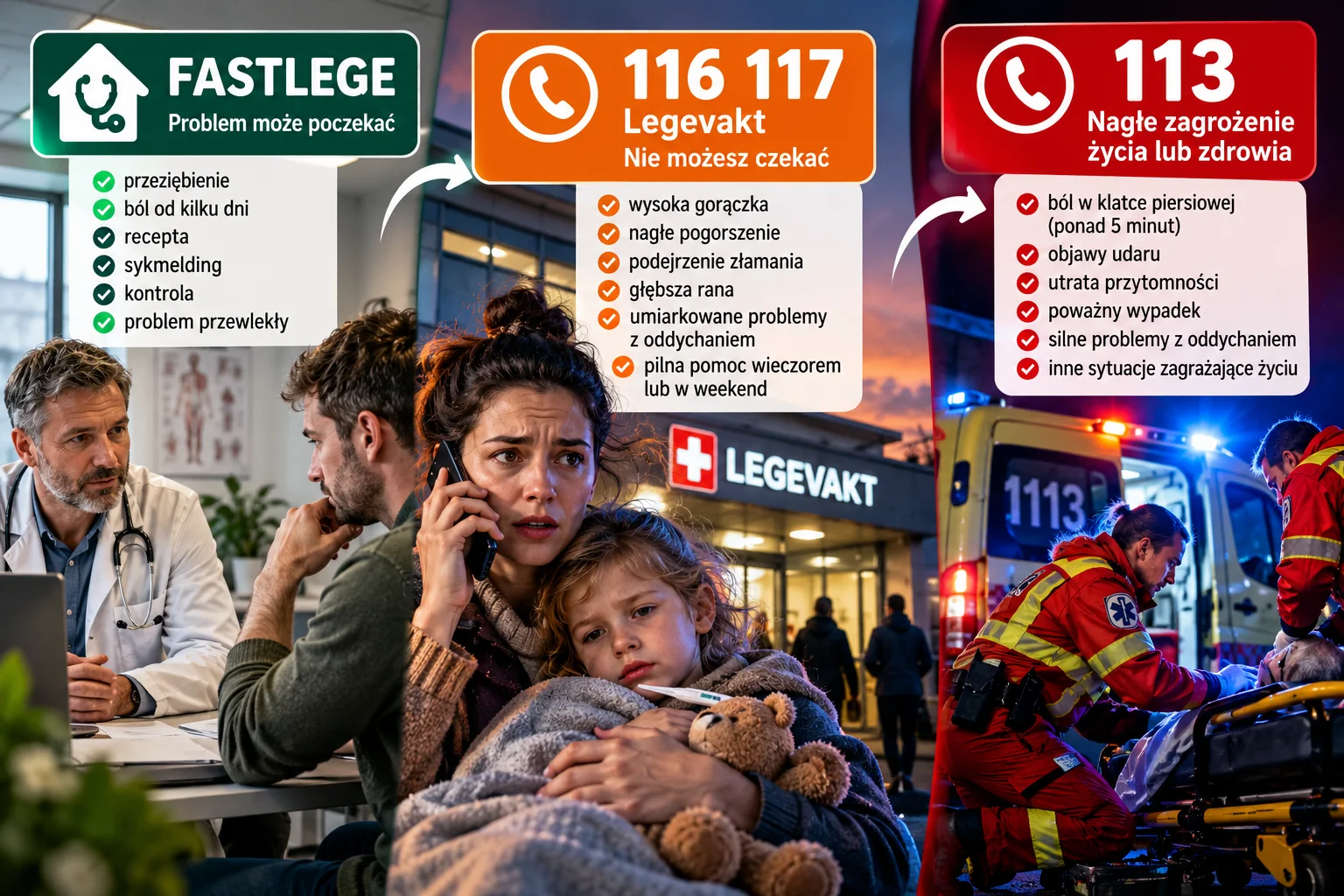
The simplest decision map
The problem is not urgent
REGULAR GP
Examples:
pain for several days,
prescription,
sykmelding,
check-up,
chronic problem,
diagnostics.
Help cannot wait, but it does not look like an immediate threat to life
116 117
Examples:
high fever,
sudden deterioration,
suspected fracture,
wound requiring assistance,
moderate breathing problems,
urgent problem in the evening or at the weekend.
Life-threatening or serious emergency
113
Examples:
loss of consciousness,
stroke symptoms,
serious accident,
severe chest pain lasting more than 5 minutes,
serious breathing problems,
another situation that appears to be an immediate threat to life.
Save these numbers now, not during a crisis
On your phone:
Out-of-hours clinic — 116 117
Ambulance / medical emergency number — 113
You don’t have to remember the address of every out-of-hours clinic in Norway.
116 117 will connect you to the one appropriate for the place where you are.
This is one of those two minutes that could one day really matter.
If you are just starting to use the Norwegian healthcare system
This guide answers only the question:
where to call when something happens.
If you want to understand:
who is entitled to a regular GP,
how to find a doctor,
how to book an appointment,
how much a consultation costs,
what a frikort is,
how to order a translator,
read first:
First visit to a doctor in Norway: how the system works, when you suddenly fall ill