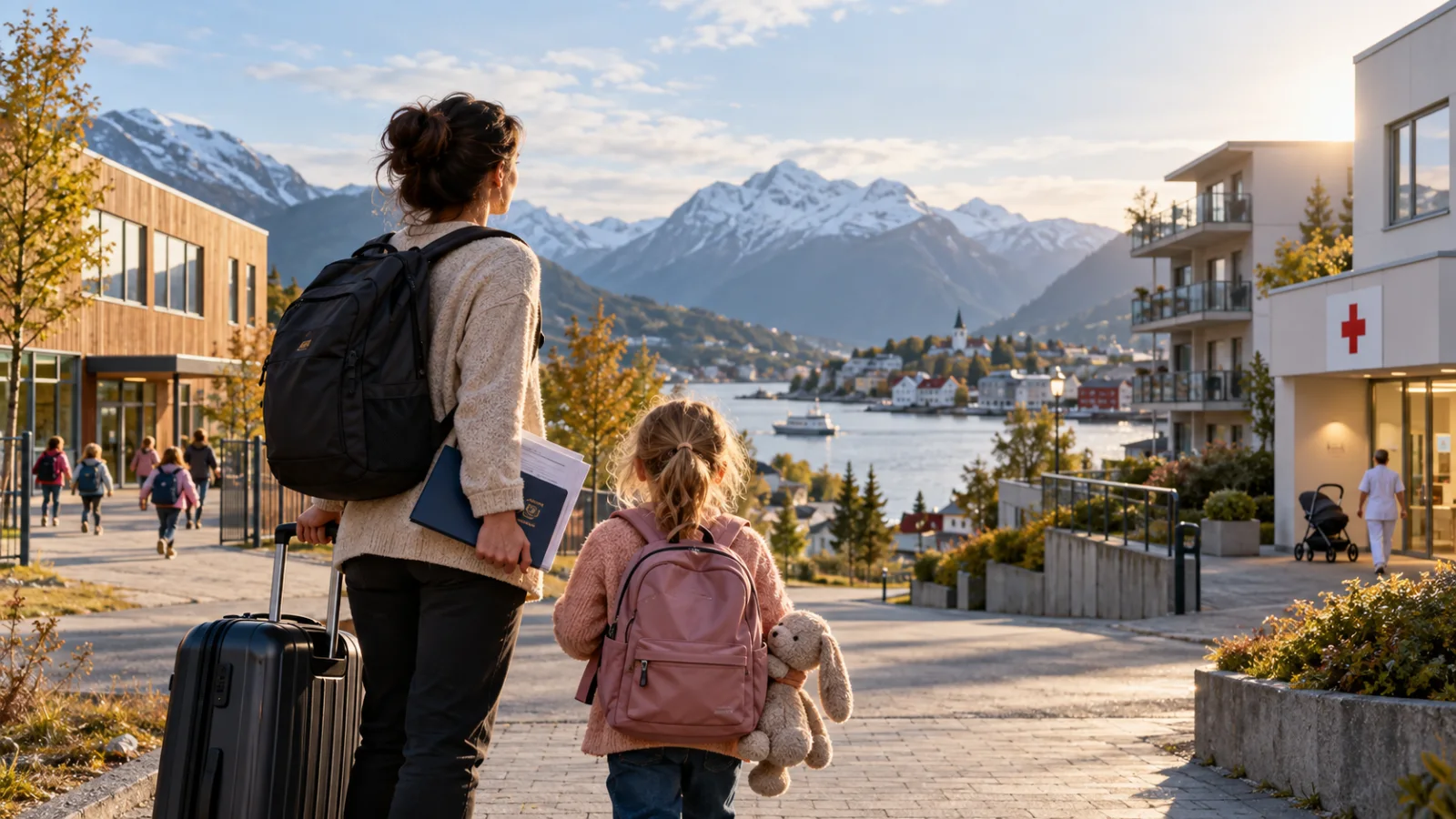
You have arrived. You are thinking about work, and the child simply wants to know where they will go tomorrow
The suitcases are still in the hallway.
You are wondering about:
skattekort,
BankID,
work,
rental agreement.
And the child asks:
“When do I go to school?”
or:
“Where will my kindergarten be?”
And then it turns out that moving a family is a slightly different project than moving a single person.
Not everything is handled in one place.
Not everything has to be done on the first day either.
The most important thing is to establish the order.
1. First check the child's residence status
This is a step you should not guess about.
The child does not automatically receive exactly the same status just because they arrived with a parent.
What matters includes, among other things:
the child's citizenship,
the parent's citizenship,
the parent's basis for residence,
whether the child themselves is an EU/EEA citizen.
If the child is an EU/EEA citizen, the EU/EEA residence rules apply. If the child is a family member of an EU/EEA citizen but is themselves from outside the EU/EEA, they may need a residence card as a family member.
Check the appropriate route here:
UDI — residence under the EU/EEA regulations
If the family is subject to the ordinary family immigration rules:
Do not assume:
“Just because I am registered, the child is also taken care of.”
Check the child separately.
2. Moving for a longer period? Register the child with Folkeregisteret
If you intend to live in Norway for at least 6 consecutive months, the move must be reported to Folkeregisteret in accordance with Skatteetaten's rules.
Start here:
Skatteetaten — reporting a move to Norway
Do not assume that registering the parent automatically takes care of all the child's details.
When registering as a family, pay attention to:
the child's identity document,
address,
the family relationship,
any documents concerning parental responsibility.
3. Did you arrive with the child alone? Check parental responsibility
This is a detail that is easy to overlook.
Skatteetaten explains that for children born abroad, the way parental responsibility is recorded in Folkeregisteret depends on the parents' situation.
If one parent moves with the child without the other parent, parental responsibility may be registered as unknown if the appropriate documentation is not provided.
And parental responsibility matters later in matters such as:
passport,
name change,
information about the child,
bank account,
reporting a move.
Check the rules here:
Skatteetaten — parental responsibility for children born abroad
If you are moving without the other parent, it is better to clarify this immediately than to discover the problem at the first important matter concerning the child.
4. Is the child of school age? Don't wait for “full documents”
This is very important:
A child's right to education is not something that should wait for months while all other formalities are completed.
Children have the right to public primary school if they are likely to stay in Norway for more than three months. The municipality is responsible for providing education. This right applies regardless of citizenship and — importantly — Udir points out that it also applies regardless of whether the child’s or the parents' stay is legal.
Official rules for children who have just arrived:
Udir — rules for newly arrived students
So do not delay contacting the school just because:
“We still don't have everything from the authorities.”
Contact your municipality.
In P0-19 we will cover the entire school start separately.
How quickly should the child start school?
The rule is:
as quickly as possible.
The current text of opplæringsloven § 2-1 provides that the right to schooling shall be implemented as quickly as possible and at the latest within the time limit specified in the regulations. Udir also emphasizes that the municipality should not wait until the last possible day if it can start instruction earlier.
For a parent the practical rule is simpler:
after arrival, contact the municipality immediately.
You do not wait several months to see “if someone will get in touch on their own.”
And which grade will the child attend?
A child who arrives in Norway should, as a rule, be placed at the level corresponding to their age. The municipality can decide otherwise after an individual assessment.
That means:
“He doesn't know Norwegian, so we'll automatically move him back two years”
is not standard practice.
Not knowing Norwegian does not mean the child suddenly becomes two years younger.
“My child doesn't know a word of Norwegian”
That also does not mean that school is impossible.
Newly arrived pupils can receive additional language support. Udir also describes the possibility of temporarily organizing part of the instruction in special groups, classes or introductory schools if this is beneficial for the pupil; such a solution is temporary in nature.
So do not try to teach the child the entire Norwegian education system before arrival.
Tell the school honestly:
what the child knows,
what they have previously learned,
which languages they know.
The rest needs to be built together.
5. Is the child younger? Helsestasjon may be more important than a doctor
If you have a child aged 0–5 years, learn the word:
helsestasjon.
This is a free municipal service for children and parents from birth until the start of school.
You can get help there from:
public health nurse,
a doctor,
a physiotherapist,
and in some places also other specialists.
The service includes, among other things, developmental check-ups, advice and vaccinations.
Check how the child health clinic works:
Helsenorge — child health clinic 0–5 years
You can find the contact details for the local child health clinic on your municipality's website.
You do not have to wait for someone to send you an invitation.
6. Is your child going to school? Learn about the school health service
There is also a free health service for students in Norwegian schools:
school health service.
It can help with, among other things:
physical health,
mental well-being,
development,
vaccinations,
school problems,
family difficulties.
The service is intended for pupils of primary schools, lower secondary schools and upper secondary schools.
More information:
Helsenorge — school health service
This is not only a clinic for a child who has a fever.
A parent can also seek help there when the child's health or well-being affects their functioning at school.
7. Bring the vaccination history
Do not assume:
"Norway will automatically see all the vaccinations performed in Poland."
If you have:
vaccination record,
printout,
a document from a doctor,
other credible documentation,
bring it with you.
Children and young people living in Norway are covered by the Norwegian vaccination programme. Vaccinations for the youngest are organised by the child health clinic, and for schoolchildren by the school health service.
Check the vaccination programme:
Helsenorge — child vaccinations
The staff can then determine which vaccinations the child no longer needs and which ones need to be completed.
8. Kindergarten will not appear automatically after you register your move
If the child is of preschool age, simply reporting the move does not mean:
"we'll have a place in kindergarten from tomorrow."
Kindergartens are organised locally and the application process is carried out through the municipality or specific operators.
Therefore, after you have established your address, check your municipality's website.
Look for:
kindergarten
and also:
apply for a kindergarten place
In P0-20 we will make a full guide about:
kindergarten,
deadlines,
fees,
after-school programme (SFO).
The most important thing here is only:
do not postpone checking for places until the day you start work.
9. And what about Barnetrygd?
This is one of the first questions parents ask:
"Will we receive family allowance?"
The answer is:
It depends on the family's situation.
NAV states that when the whole family lives in Norway and the stay is to last more than 12 months, foreign citizens meeting the appropriate conditions may be entitled to Barnetrygd.
For people subject to EEA rules there are additional regulations, also when the child or the other parent lives in another EEA state.
So do not apply the rule:
“I work in Norway = family benefits automatically”.
Nor:
“the child lives outside Norway = I am entitled to nothing”.
Both can be wrong.
Check your situation here:
NAV — Child benefit / Barnetrygd
P0-21 will be devoted exclusively to Barnetrygd and then we will go through the cases in detail.
10. Don't try to do everything on one Monday
Moving a child is a big enough change in itself.
You don't have to in the morning:
Folkeregisteret,
then UDI,
then the school,
then the health center,
then NAV,
and in the evening still look for football activities.
Organize matters.
First those that determine the child's normal functioning.
The simplest order after arrival
Check the child's residence status.
Report the move / arrange Folkeregisteret, if applicable.
Check parental responsibility if the family situation requires it.
If the child is school-aged — contact the municipality immediately.
If they are 0–5 years old — find a health center.
Provide vaccination records and important medical information.
If you need kindergarten — check the enrollment in your municipality.
Only later calmly check benefits, including Barnetrygd.
That is already a plan.
And a plan means you don't have to take care of everything at once.
What is worth bringing from your country?
Not every office will ask for every document.
But practically it is worth having:
a passport or the child's identity document,
a birth certificate,
documents concerning parental responsibility, if the situation requires it,
school records,
certificates or information about the last grade,
information regarding special educational needs,
vaccination records,
important medical documentation,
a list of regularly taken medications.
Do not automatically send all documents to every office.
Just have them available when the institution needs them.
Don't forget about the child in all this administration
For you a move can mean:
a better job,
a new start,
a financial plan.
For the child it can mean:
no friends,
an unfamiliar language,
a new school,
a new home,
different food,
a completely new everyday life.
Therefore it is good to ask not only:
“Do we have the documents yet?”
but also:
“How do you feel here?”
A Norwegian school, the health centre and the school health service are also places where you can ask for help if adaptation proves difficult.
What next?
Now we have a general map.
The next issue depends on the child's age.
If they are of school age, the most important questions are:
Which school should they attend?
How to enroll them?
What if they don't know Norwegian?
Do they need a school certificate from Poland?
Is the school free of charge?
OFFICIAL SOURCES
Skatteetaten — moving to Norway
Rules for reporting a move to Folkeregisteret.
Skatteetaten — moving to Norway
UDI — the child's and family's residence
EU/EEA rules and family immigration.
UDI — residence under EU/EEA regulations
Udir — newly arrived pupils
Right to school and the municipality's responsibility.
Helsenorge — children
Health centre, school health service and vaccinations.
Helsenorge — healthcare for children
NAV — Barnetrygd
Conditions for benefits for families living and working in Norway and EEA rules.