It's Sunday evening. You have a fever and you don't know where to actually go
That's one of those things you don't think about until you're sick.
You have arrived in Norway.
Work has started.
You have a place to live.
Your documents are more or less in order.
And suddenly, on Sunday evening:
fever,
severe pain,
a child starts to feel unwell,
or something is happening to you.
In Poland you more or less knew where to go.
Here the first thought is:
“Hospital?”
Not always.
The Norwegian system works a bit differently.
For most ordinary health problems, the first person you look for is:
fastlege.
Fastlege is your primary care doctor
This is not a doctor just for colds.
A fastlege is usually the first point of entry into the system.
They can:
examine you,
provide treatment,
prescribe medication,
issue a sick note,
order some tests,
assess whether you need a specialist,
refer you further to a hospital or specialist care.
Helsenorge describes the fastlege as the patient's main point of contact with the Norwegian healthcare service.
So if your knee has been hurting for several days, you have an infection, skin problems, or you need further diagnostics, you usually do not go straight to the hospital.
You start with the family doctor.
Check information about fastlege:
Helsenorge — fastlege
“But I just arrived. Do I even have a fastlege?”
And here you need to distinguish two things.
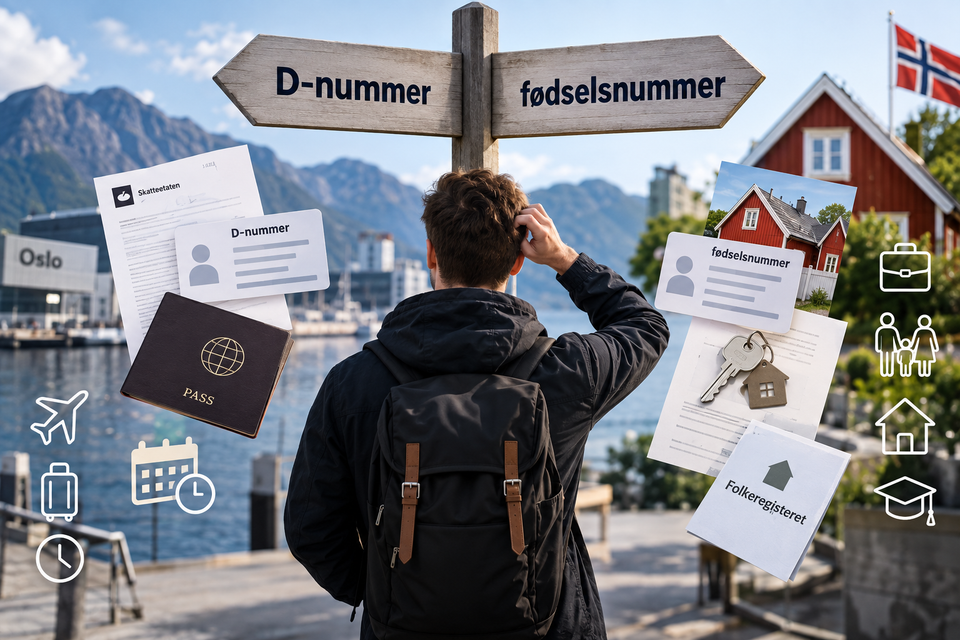
D-nummer
from:
registration as a resident of Norway.
The right to an assigned fastlege applies to people registered in Folkeregisteret as residents of a Norwegian municipality.
So the mere fact that you have a D-nummer does not automatically mean:
“I already have my doctor.”
If you are already registered as a resident, you can check your doctor on Helsenorge.
Check or change fastlege here:
Helsenorge — find or change fastlege
You can also see which doctors have open places.
If your chosen doctor has a full list, you can sign up for the waiting list. The change of doctor takes effect from the first day of the following month.
You don't have a fastlege yet, but you have fallen ill
That does not mean:
“I don't have a doctor, so I have to wait.”
People legally residing in Norway have the right to necessary medical assistance, and anyone present in Norway has the right to assistance in an emergency.
If you do not yet have an assigned doctor and need help, contact the primary care facility in your municipality.
If the problem cannot wait, you contact legevakt.
There is one number across all of Norway:
116 117
The call is free and directs you to the appropriate legevakt.
Official information:
Helsenorge — out-of-hours medical service 116 117
Don't go straight to the out-of-hours medical service just because it's evening
The out-of-hours medical service is not a nighttime equivalent of a regular clinic for every problem.
Helsenorge recommends:
your GP during working hours,
and:
the out-of-hours medical service when your GP is not available and help cannot wait.
That means:
Do you have a problem that has lasted for several weeks and nothing has suddenly changed?
Start with your GP.
Has your condition suddenly worsened and you can't wait until tomorrow?
Then 116 117 makes sense.
In the next guide we will explain in detail:
GP → out-of-hours medical service → 113
so you won't have to decide under stress.
Call first
In the case of the out-of-hours medical service, a phone call is often a good first step.
Don't assume:
"I'll go and someone will see me".
Call:
116 117
Describe what is happening.
The staff will assess the situation and tell you what to do next.
Sometimes it will be:
coming to the out-of-hours medical service.
Sometimes:
contacting your GP the next day.
And sometimes it turns out the situation is more serious and other action is needed.
And when 113?
If there is a threat to life or a serious acute condition, don't look for the local clinic's number.
Call:
113
Helsenorge explicitly emphasizes that in an emergency it's better to call one time too many than one time too few.
113 is for emergencies.
P0-17 will be devoted exactly to this distinction, with specific examples.
Booking an appointment doesn't always mean calling at 08:00
If your GP uses Helsenorge services, after logging in you may have access to:
booking an appointment,
checking appointments,
cancelling an appointment,
messages to the clinic,
renewing a prescription,
e-consultation.
The range depends on what solutions your doctor and municipality provide.
Check your appointments here:
Helsenorge — appointments
This is one of those services worth activating before you actually get sick.
E-consultation is not an emergency chat
Don't confuse e-consultation with the out-of-hours medical service.
If your doctor provides e-consultation via Helsenorge, you can submit your case online, but the response may not appear immediately. Helsenorge states that the reply usually arrives within a few working days.
So:
Do you need an extension of treatment or have a non-urgent question?
An e-consultation can be convenient.
Do you have an acute problem that requires help now?
Don't write a message and wait.
"The doctor said I must go to a specialist. Where do I sign up?"
In Norway you often don't start by searching for a specialist yourself.
The GP assesses the problem and, if necessary, sends referral, that is a referral to specialized healthcare.
This can be:
a hospital,
a specialist,
a specific test,
another form of continued treatment.
For most planned specialist treatments a referral is required. In an emergency it is not required.
If you have a referral, part of its status you can later see on Helsenorge.
Check referrals here:
Helsenorge — referrals
However, not all facilities and regions show the exact same range of data in the system.
How much does a visit cost?
The Norwegian public health service does not mean:
“everything is always free.”
For many visits you pay:
egenandel
which is the patient’s co-payment.
In 2026 the standard egenandel for a regular consultation with a fastlege is 179 NOK.
If the doctor is a specialist in general medicine:
235 NOK.
At legevakt the rate may be higher in the evening. A standard consultation is accordingly 179 NOK during the day and 301 NOK in the evening, and with a doctor who is a specialist in general medicine 235/357 NOK.
Additional fees may also occur, e.g. for certain materials or services that are not covered by the egenandel system.
Check current rates here:
Helsenorge — fees at fastlege and legevakt
“Will I be paying for every visit for the whole year?”
Not exactly.
In 2026, after exceeding:
3278 NOK
in qualifying egenandeler you receive a frikort.
The system is automatic.
After it is granted you do not pay the egenandeler covered by it until the end of the year.
On Helsenorge you can check:
registered payments,
frikort status,
information about reimbursements.
Check here:
Helsenorge — frikort
This is very useful especially when you have many visits, tests or treatments over several months.
Does a child also pay?
From 1 August 2026 people under 18 are exempt from egenandel for services covered by the frikort system.
This is a change, so older articles mentioning the 16-year limit may already be out of date.
So if you are reading a guide from a few years ago:
check the date.
Don’t speak Norwegian well? Say so immediately
This is one of the most important things for someone new to Norway.
You can manage:
in the shop,
at work,
over coffee.
But a conversation about symptoms, medications or test results is something completely different.
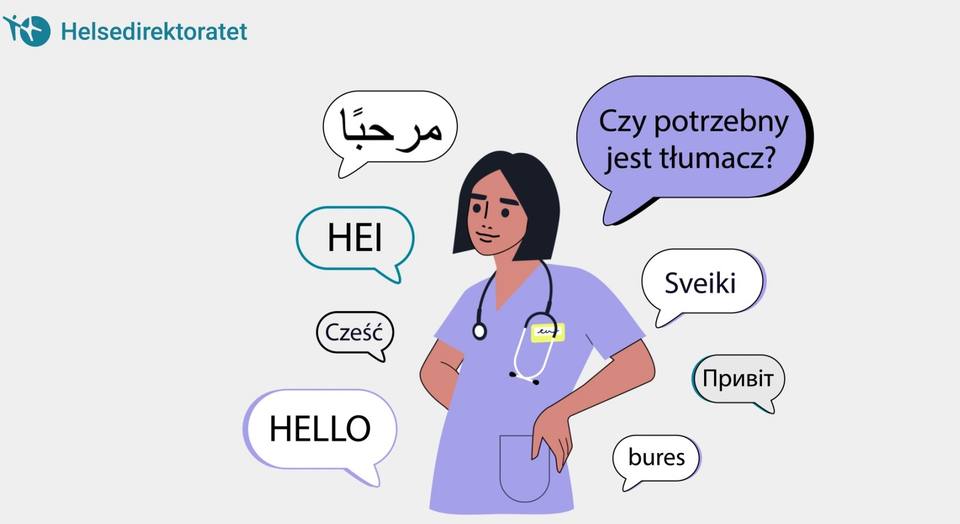
If you do not understand medical information well enough or find it difficult to explain exactly what is happening, you have the right to an interpreter in a language you understand.
Say this right when booking the appointment:
„Jeg trenger polsk tolk.”
„I need a Polish interpreter.”
The facility is responsible for ordering a qualified interpreter. In the public health service, such assistance is generally free for the patient.
Full rules:
Helsenorge — right to an interpreter
Do not use a child as an interpreter
This is especially important.
You have a 12-year-old daughter who speaks Norwegian very well.
The natural thought:
"She will go with me and translate everything."
No.
Helsenorge points out that children should not be used as medical interpreters. Family members should also not replace a qualified interpreter.
Your child may be with you.
But they should not be responsible for translating a diagnosis, treatment risks, or information about medications.
Doctor asks about personal matters? You can speak openly
Health service staff are bound by professional confidentiality, which means professional confidentiality.
Information about your health is not something the doctor freely shares:
your employer,
a neighbor,
a friend,
your family.
Helsenorge reminds that people working in the health service have an obligation to maintain confidentiality.
There are exceptions defined by law, for example situations related to a serious threat to life and health.
But the rule is simple:
the doctor needs truthful information to help you.
Don't hide symptoms because you're afraid that "everyone will find out".
Going for the first time? Prepare five things
You don't need a folder full of documents.
But before your first visit, it's good to know:
1. What are your symptoms?
Since when?
Are they getting worse?
2. What medications are you taking?
Including medications from Poland.
If you don't remember the names, take photos of the packaging.
3. Do you have any allergies?
Including to medications.
4. What significant illnesses or surgeries have you had previously?
You don't need to tell your whole life story.
Only things relevant to your current situation.
5. What do you need from this visit?
Tests?
A prescription renewal?
Assessment of a specific problem?
A referral?
The doctor will be able to help you more easily if you can say what you are coming in for.
Don't expect every problem to end with an antibiotic or a referral
The doctor assesses what you need.
The right to health care does not mean the right to independently choose:
a specific medication,
a test,
an antibiotic,
MRI,
a referral.
It is the medical staff who make the decision based on a medical assessment.
However, you can:
ask questions,
ask for an explanation,
say what you are worried about,
ask what to do if your condition worsens.
This is not bothering the doctor.
It is a normal part of the visit.
Five minutes worth spending before you get sick
Log in to Helsenorge today.
Not when you have a 39-degree fever.
Check:
whether you have a regular GP,
what the clinic is called,
what the phone number is,
whether you can book appointments online,
whether the doctor offers e-consultation,
how prescription renewal works.
If you don't have a doctor yet:
check your situation and the availability of fastlege in the municipality.
It's a small thing.
But when you really get sick, you'll thank yourself for doing it today.
And note two numbers
You don't have to remember the whole Norwegian health system.
Remember:
116 117
legevakt
and:
113
an immediate threat to life and health.
If you don't remember anything else, these two numbers are enough to start looking for the right help.
OFFICIAL SOURCES
Helsenorge — healthcare in Norway
Basic rules of the system and the choice between fastlege, legevakt and 113.
Helsenorge — fastlege
The right to a family doctor and the services available through Helsenorge.
Helsenorge — legevakt
Rules for using the number 116 117.
Helsenorge / Helfo — co-payment and exemption card
Current rates and the exemption card limit for 2026.
Helsenorge — interpreter
The patient's right to a qualified interpreter.