
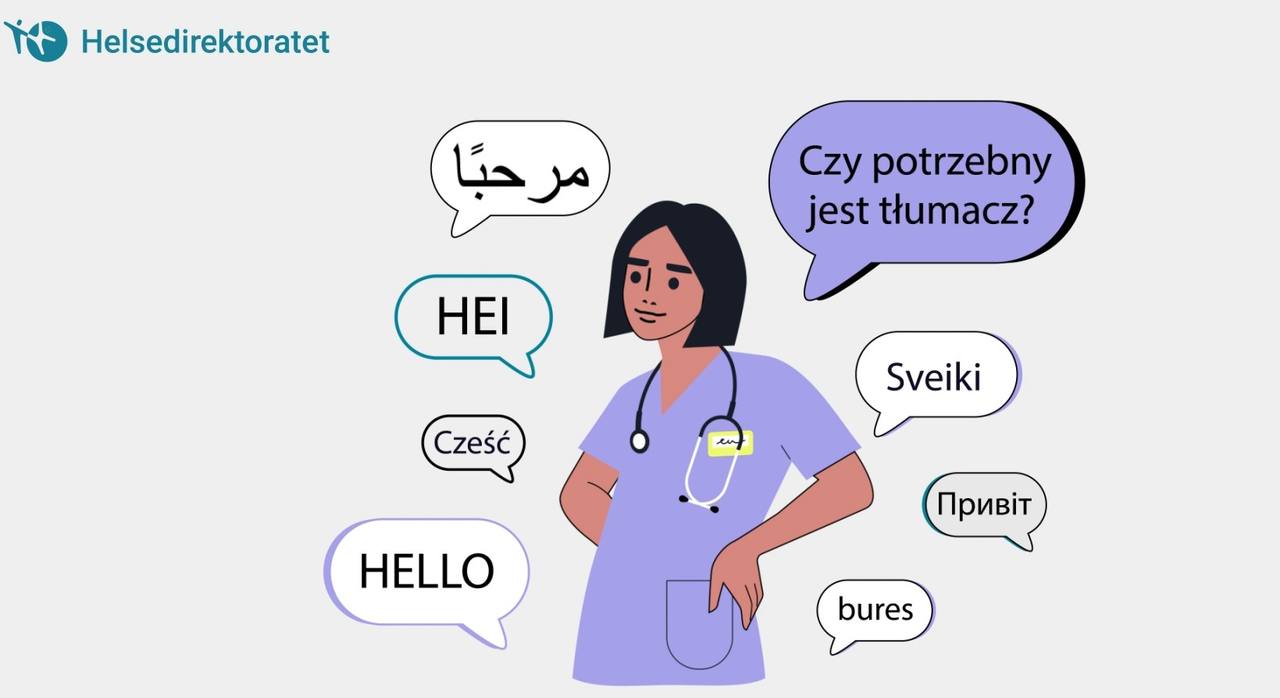
Interpreter at the doctor in Norway – when are you entitled to one?
You may manage well in Norwegian at work and in everyday life, and yet not understand specialist terms when speaking with a doctor.
This is a normal situation.
In healthcare it's not about whether you can do the shopping or chat with a neighbor. It's about whether you really understand information about your health, diagnosis and treatment.
Helsenorge states clearly that a patient should receive information about health, illness and treatment in a language they understand. If you have difficulty understanding or speaking Norwegian, you may be entitled to an interpreter in the language of your choice. This also applies to people who use Norwegian in daily life.
Check your right to an interpreter on Helsenorge
You don't need to know medical Norwegian
Patient rights law requires that information provided be adapted, among other things, to their language and situation.
Medical staff should also, as far as possible, ensure that the patient has actually understood the information given.
Therefore, if you understand everyday Norwegian, but during a conversation about:
surgery,
test results,
medications,
side effects,
pregnancy,
treatment of a child,
chronic illness,
mental health
you feel that you might not understand something — say so in advance.
Don't guess.
Who orders an interpreter?
Not you.
The healthcare service is responsible for ordering a qualified interpreter.
It is the medical staff who assess whether an interpreter is needed, but you can report such a need, preferably already when making the appointment. Helsenorge also points out that you can contact the facility and ask them to order an interpreter in your language.
You can simply say:
"Jeg trenger polsk tolk til timen."
that is:
"I need a Polish interpreter for the appointment."
You should do this well in advance, not only after entering the consultation room.
An interpreter doesn't always have to sit in the room
Depending on the situation, the interpreter can participate:
in person,
by phone,
via video call.
Helsenorge confirms that telephone or screen interpretation can be an appropriate solution when the interpreter is not physically present at the meeting.
The most important thing is the ability to communicate safely and correctly.
Is the interpreter free?
Yes — for a patient in the healthcare service, an interpreter is, as a rule, free of charge.
However, there is an important exception.
If you are receiving dental treatment that you pay for yourself, you may also be charged the cost of the interpreter.
It's worth knowing this in advance, especially before a private dental appointment.
Don't ask a child to interpret for the doctor
This is extremely important.
A child should not act as an interpreter during a medical appointment.
The Norwegian law on interpreters prohibits public institutions from using children to interpret or convey information. Exceptions primarily concern emergency situations and special circumstances.
This is not just a formality.
Imagine a teenage child who would have to translate information for a parent about:
cancer,
surgery,
pregnancy,
mental health problems,
a chronic illness.
This is not a responsibility that should be placed on a child.
What about a husband, wife, or a friend?
This is also not the best solution.
Helsedirektoratet recommends that family members and other unqualified persons do not replace a professional interpreter when an accurate medical translation is required.
A close person can of course accompany you to the appointment if you wish.
But that does not mean they should take on the role of a professional interpreter.
What does a professional interpreter do?
An interpreter is not an advisor.
They should not:
respond on your behalf,
translate to the doctor "what you probably mean",
add their own opinions,
give medical advice,
take sides with the patient or the doctor.
Their role is to faithfully convey what both sides say.
The interpreter also has a duty of confidentiality.
Therefore, you should direct questions during the appointment to the doctor or another healthcare professional, not to the interpreter.
Specify exactly which language you need
It is not enough to say:
"I need an interpreter".
Say precisely:
Polish, Ukrainian, Russian, Lithuanian etc.
In some languages, the specific dialect may also be important.
Helsenorge explicitly recommends that the patient clearly indicate the preferred language.
Have you booked an interpreter? Don't forget your appointment
If an interpreter has already been booked, arrive on time.
If you cannot attend, cancel the appointment in accordance with the facility's rules.
Helsenorge points out that especially when an interpreter has been booked, you should remember to cancel the appointment in advance. The very fact of using an interpreter does not exempt you from the rules regarding failure to show up for a scheduled consultation.
What to do if you were denied an interpreter?
First, tell the staff clearly:
"I do not understand the medical information well enough and I need an interpreter."
If despite a real language barrier an interpreter was not provided or you believe that the interpreter did not have the appropriate qualifications, you can file a complaint.
Helsenorge points out several options:
the facility where you were a patient,
Statsforvalteren in your county,
assistance from Pasient- og brukerombudet,
in certain matters also Likestillings- og diskrimineringsombudet,
for problems concerning the quality of the interpreter you can also notify IMDi.
Helsenorge – interpreter and the possibility to file a complaint
Polish materials are now available
Helsedirektoratet has prepared a brochure „Tolk for deg som er pasient i helsetjenesten” in many languages, including Polish and Ukrainian.
Helsedirektoratet brochures on the right to an interpreter in many languages
You can also show it to someone who lives in Norway but does not know that such a right exists.
Remember one thing
If during a medical appointment you understand 80 percent, but the remaining 20 percent concerns the diagnosis, medication, or surgery, that 20 percent may be the most important.
Therefore, do not be ashamed to say:
"I don't understand. I need an interpreter."
An interpreter in healthcare is not a luxury.
In the right situation it is a tool meant to help the doctor and the patient truly understand each other.
Editorial comment Your Norway
Being familiar with Norwegian at work does not automatically mean being familiar with medical terminology. When it comes to health, it's not worth proving to yourself or others that "I'll manage somehow." If you do not understand something, say so before the appointment and ask for a professional interpreter.
Official sources
Helsenorge – Interpreter in healthcare
The patient's right to an interpreter, rules for arranging one, costs and complaints.
Interpreter in healthcare – Helsenorge
Helsedirektoratet – information for patients in many languages
Brochure about interpreters – Helsedirektoratet
Lovdata – pasient- og brukerrettighetsloven § 3-5
Information for the patient must be adapted, among other things, to their language background, and staff should try to ensure that it has been understood.
Lovdata – tolkeloven §§ 4, 6 and 7
Prohibition on using children as interpreters and the obligation to use a qualified interpreter when it is necessary for legal safety or proper assistance.
Information status checked: 16 September 2026.