Love still begins in a similar way. From a look, a conversation, chemistry, a curiosity about another person. From the moment when someone starts to take up more space in our thoughts than we planned.
But I think more and more people today are reaching a point where simply "I feel" is no longer enough.
Because you can feel a lot and at the same time feel very bad in a relationship.
You can long for someone who does not provide a sense of security.
You can love someone and at the same time constantly wonder whether that person really cares about us.
You can be close to someone and feel lonely.
And perhaps this is exactly where the contemporary conversation about love begins.
Not about whether we still know how to love.
But about what we actually want from love today.
Chemistry alone is no longer enough
Magdalena, the author of the piece that became the starting point for this reflection, writes very clearly that over time it began to matter to her not only what she feels for another person, but above all how she herself feels with him.
Whether she is calm.
Whether she can be herself.
Whether she can say what she feels without fearing rejection, silence, or withdrawal.
Whether the other person's words are backed up by his behavior.
This is a fairly significant change.
Because at a younger age we often ask above all:
Does he want me?
Does she love me?
Does he care?
Am I good enough?
Over time a completely different question emerges:
Do I feel good in this relationship?
And an even harder one:
Do I really want to choose this particular person?
In Magdalena's piece this appears very clearly. It's no longer about waiting for someone to choose us. It's also about reclaiming our own right to choose.
Love should not be a constant guessing game
Everyone needs space.
Everyone has work, problems, fatigue, responsibilities and bad days.
A mature relationship does not mean round-the-clock contact or constantly having to reaffirm feelings.
But there is a huge difference between space and uncertainty.
If someone says they care, sooner or later this should also be visible in their behavior.
Not in grand declarations.
In small things.
In being present.
In remembering.
In showing interest.
In not disappearing every time the relationship stops being easy.
Magdalena writes that she increasingly trusts behavior more than words. She doesn't need grand declarations, just small things done consistently.
And it's hard not to pause on this for a moment.
Because maybe this is exactly what we desire most today.
Not another "I love you" that later has to be deciphered.
Only a feeling that we are truly present in someone's life.
We are no longer looking for someone to save us
In a mature relationship two lives meet.
Not two halves that cannot exist without each other.
Not a person who is meant to fix someone, save them, or fill all their shortcomings.
I have my life.
You have your life.
And between us a "we" is formed.
And it is this "we" that proves to be much harder than falling in love.
Because a healthy relationship should not mean giving up yourself, but it also cannot consist of each partner standing behind their own wall and saying:
This is my boundary. Deal with it.
Magdalena describes the need for something between those extremes. Maintaining one's own identity, but also the willingness to compromise, to listen, to apologize and to admit that sometimes it is we who have hurt another person.
Because boundaries are important.
But relationships are not built by boundaries alone.
They are also built by responsibility for what we do with another person.
We recognize a true partner by what happens later
At first, almost everyone can make an effort.
We are curious about each other.
We write.
We talk.
We plan meetings.
We want to make a good impression.
But a relationship is not made up of first dates.
It mostly consists of ordinary Tuesdays.
Of fatigue.
Of problems.
Of bills.
Of children.
Of differing opinions.
Of illness.
Of situations when one of the partners is not in a good mood.
Of a conflict that cannot be solved with an emoji.
And it is then that we really begin to see the person.
How does he react when something doesn't go his way?
Can he listen?
Does he treat every remark as an attack?
Can he say: I was wrong?
Can he apologize?
In a conflict, does he want to win, or does he want to find a solution?
Magdalena pays attention precisely to that moment. She is no longer interested solely in what a person is like when he wants to win over a partner. She looks at him in everyday life, in fatigue, in conflict and when their opinions differ. At the same time she directs similar questions at herself.
Because love is the responsibility of two people
This is probably one of the most important threads of the whole piece.
It's very easy to create a list of what we expect from a partner.
They should be present.
Mature.
Affectionate.
Communicative.
Stable.
They should be able to talk.
They must not run away.
They should understand our needs.
But there is another part of the question.
And what do I bring to this relationship?
Can I talk about my fear without accusing the other person?
Can I listen?
Can I apologize?
Don't my earlier experiences make me see danger where there is none?
Am I punishing a new person for what someone else did before?
Can I give space?
When loving, am I not also trying to control?
Magdalena asks herself a very strong question:
Not only "is he the right man for me?", but also "am I the woman I myself would like to be with?"
And perhaps it is exactly at this point that the romantic idea of love meets maturity.
Because a relationship is not a reward for finding the right person.
It is the work of two people.
We don't want an ideal. We want a person who can be in a relationship
Nobody is perfect.
Everyone brings their own experiences, mistakes, fears and weaknesses to a relationship.
Maturity therefore does not consist in finding a person without flaws.
Rather, it consists in meeting someone who can look at themselves.
Someone who doesn't run away from a difficult conversation.
Someone who can say:
I messed up here.
Someone who wants to learn.
And someone who understands that problems in a relationship do not automatically mean the end of the relationship.
In Magdalena's piece there is a very apt distinction: it's not about finding two perfect people, but two imperfect people who know how to treat each other well.
Love needs reciprocity
You can't keep carrying a relationship alone indefinitely.
Initiate contact on your own.
Ask on your own.
Plan on your own.
Fix things on your own.
Explain the other person's behavior on your own.
Give another chance on your own.
There comes a moment when a person simply wants to see that someone also chooses them.
Not only when it's exciting.
Also when everyday life begins.
Because that's exactly where a real relationship begins.
Not in butterflies.
Not in chemistry.
Not in the perfect first date.
In what two people do later.
This motif runs strongly through Magdalena's text: the need for reciprocity and the conviction that feelings are not sustained by one person alone.
And what do we actually want today?
Maybe the answer is simpler than we try to make it.
We want to love and at the same time not lose ourselves.
We want closeness without constant fear.
We want attraction, but not chaos.
Emotions, but not an emotional rollercoaster.
Freedom that does not mean indifference.
Security that does not turn into control.
We want a person who has their own life, but can make room in it for another person.
And perhaps above all we no longer want to constantly wonder:
Am I wanted?
Am I wanted?
We want to know that by the way we are treated.
This is the conclusion Magdalena reaches. She is no longer simply searching for love. She is looking for healthy love, in which closeness does not have to mean the loss of one's own identity, and calm does not mean the absence of feelings.
Magdalena stripped love naked. Now she is trying to dress it again
Ma Dzia Lena is the author of motivational texts and a woman who did something very interesting in her piece.
First she stripped love of what we often try to cover it with.
Of grand words.
Of chemistry.
Of fantasies.
Of promises.
Of the need to be chosen at all costs.
And then she began to dress it again.
In calm.
Reciprocity.
Respect.
Presence.
Responsibility.
Conversation.
The ability to repair what has been broken.
And the conscious choice of another person.
So it's not about love devoid of emotion.
On the contrary.
It's about love in which emotions do not have to hurt in order to seem real.
We will talk about love on Radio Wataha
This is just the beginning of this conversation.
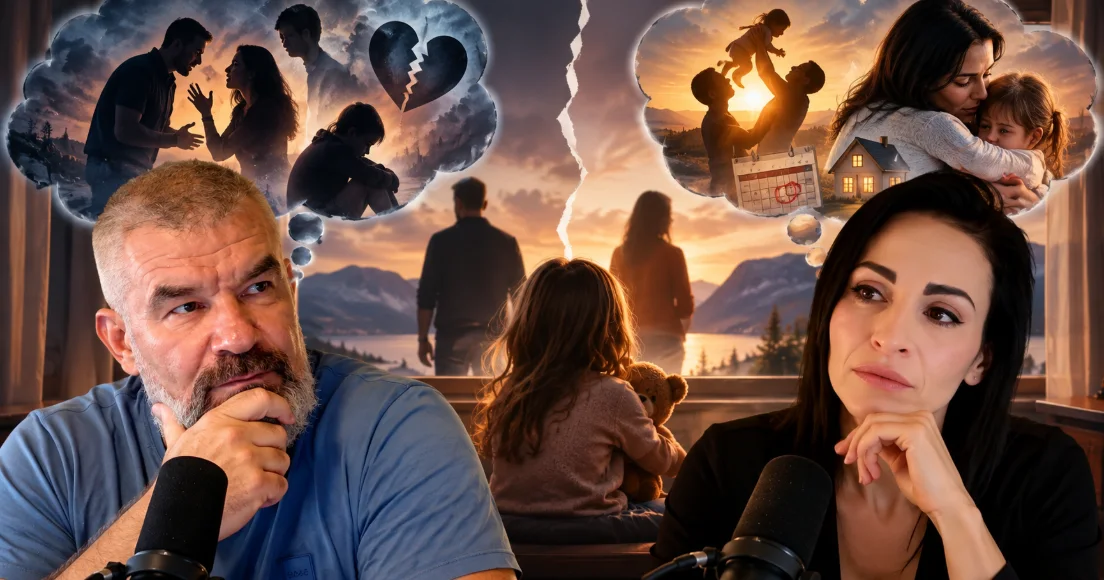
Soon Magdalena will appear on Radio Wataha, where we will talk about love, relationships, needs, mistakes, closeness and about what we learn about ourselves only when we try to create a life with another person.
There will be conversations on Radio Wataha.
There will also be live sessions on TikTok.
Without turning love into an instruction manual.
Without pretending that there is one recipe for everyone.
We just want to talk about it as it really is.
Because perhaps the most important question is no longer:
How to find love?
Maybe it is:
How to love another person and at the same time be good to them?
And how to choose someone who wants to learn exactly the same thing?