
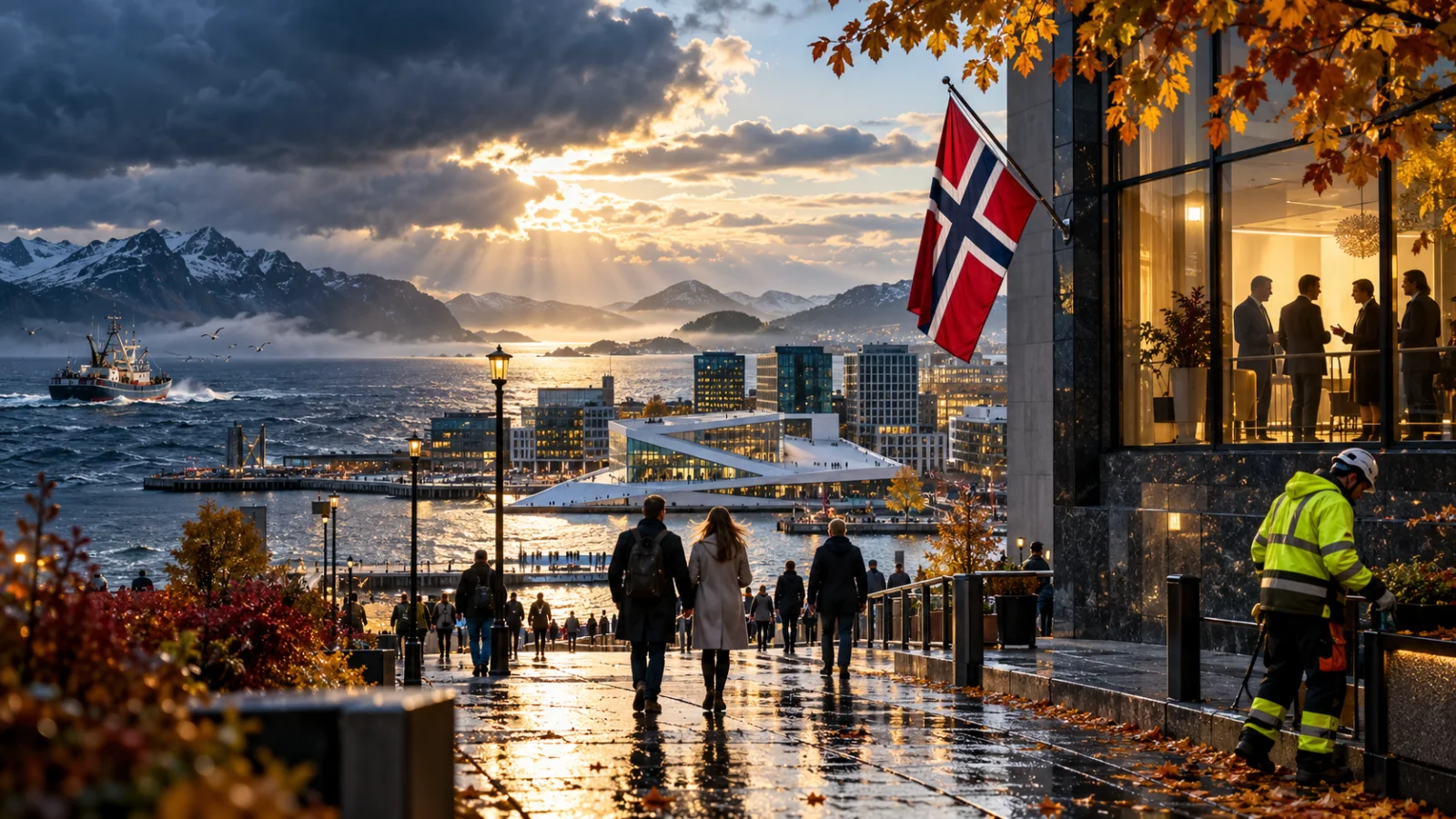
Norway is not slowing down. The past seven days brought events that show how closely international affairs, the economy and residents' everyday lives are connected. Oslo became a place for talks about Ukraine's future, the government intervened in a labor dispute, and decisions on fisheries, occupational health and the digital market may matter for months, even years to come.
In the first edition of the series „Norway in 7 days” the editorial team of TwojaNorwegia.no selects ten events from the period 19–25 October 2026. Without unnecessary sensationalism. With dates, context and links to sources.
1. Oslo at the center of talks on Ukraine. Zelensky, Stubb and Støre at one table
One of the week's most important events was the visit of Ukrainian President Volodymyr Zelensky to Norway on 20 October. In Oslo he met with Prime Minister Jonas Gahr Støre and Finnish President Alexander Stubb.
The talks concerned the situation in Ukraine and further diplomatic actions aimed at ending the war. American envoys Steve Witkoff and Jared Kushner also joined the consultations — the former in person, the latter remotely.
During the joint press conference, Støre spoke about the need to continue diplomatic efforts, Ukraine's security, sanctions and the future security order in Europe.
Why is this important?
Norway has shown that it wants to play an active role not only in supporting Ukraine, but also in talks about future European security. The meeting did not signify the conclusion of a peace agreement — it was part of an ongoing diplomatic process.
Sources: Prime Minister's Office of Norway – Zelensky's visit and the prime minister's remarks after the talks.
2. Norway implemented another EU round of sanctions against Russia
On 20 October the Norwegian government announced that it had implemented into its own law the EU's 21st package of sanctions against Russia. The new regulations came into effect on 21 October.
This is another step in aligning Norwegian economic restrictions with the actions of European partners in connection with Russia's aggression against Ukraine.
Why is this important?
Norway is not a member of the European Union, but remains closely tied to its economy. Sanctions can matter for companies operating internationally, especially if their transactions, goods or counterparties are subject to restrictions.
This does not automatically mean changes for every business. Companies should check the specific regulations relevant to their operations.
Source: Government timeline of Norway's actions regarding the war in Ukraine.
3. Norway and Russia reached a fisheries agreement for 2027
Despite difficult political relations, Norway and Russia have agreed on the rules for jointly managing the fish resources of the Barents Sea for 2027.
The agreement was signed on 23 October after negotiations held in Istanbul.
It was determined that the total catch limit for Northeast Arctic cod in 2027 will be 325,000 tonnes, which is 14% more than in 2026. The saithe quota is set to increase by 18%.
Minister of Fisheries Marianne Sivertsen Næss emphasized the importance of predictable rules for communities that rely on fishing.
Why is this important?
Fishing is one of the pillars of the economy of northern Norway. Catch limits affect business planning, the operation of fishing fleets and processing plants.
It is also an example of technical cooperation maintained between states that are in deep political conflict.
Source: Norwegian Ministry of Trade and Fisheries - agreement for 2027.
4. Government intervenes in strike. Safety of residents at an asylum centre at risk
On 23 October the Norwegian government announced its intention to apply compulsory wage arbitration compulsory wage arbitration (tvungen lønnsnemnd) in the dispute between the Fagforbundet union and the employers' organisation NHO Geneo.
The strike had been in effect since 27 September. From 12 October, 123 people were participating in it.
According to the assessment of the relevant authorities, continuing the conflict could have posed an unacceptable threat to the life and health of residents of one of the centres that receive asylum seekers.
Minister of Labour Kjersti Stenseng announced that she would present an appropriate bill to parliament. The parties were called on to end the strike and return to work as soon as possible.
Why is this important?
In Norway the right to strike is an important element of labour relations. However, there are situations in which the state can take action when a conflict threatens life or health.
It is worth noting that the mere announcement of the bill does not yet mean the entire legal procedure has been completed.
Source: Ministry of Labour and Integration - press release of 23 October.
5. Important news for workers: Norway prepares a new list of occupational diseases
On 23 October it was announced that a new advisory group has begun work on changes to the occupational disease list occupational disease list (yrkessykdomslista).
The current list is based on regulations dating from 1960. According to the government, it no longer fully corresponds to the modern labour market.
The group is to analyse, among other things, occupational cancers, musculoskeletal disorders and the health problems of shift workers.
The new list is planned to take effect from 1 January 2027.
Why is this important?
Recognition of a disease as occupational can have significant implications for NAV benefits and workers' compensation.
For people employed in construction, industry, healthcare or care work, this is a topic deserving of particular attention.
This does not mean, however, that all the mentioned conditions have already been recognized as occupational diseases. Work and assessment of specific measures are still ongoing.
Source: Ministry of Labour and Integration - modernization of the occupational diseases list.
6. Norway wants to curb the dominance of tech giants
On 23 October the government sent a proposal for consultation concerning the implementation of the EU regulation Digital Markets Act (DMA) into Norwegian law.
The aim of the rules is to improve competition conditions in digital markets where the largest technology platforms hold a huge advantage.
The new rules are intended, among other things, to limit the preferential treatment of their own services by dominant companies and to increase users' control over their data.
The deadline for submitting comments on the proposal has been set for 3 December 2026.
Why is this important?
This is not just an issue for Apple or Google. Smaller companies operating online depend on search engines, app stores and advertising platforms.
A change in competition rules could affect their ability to reach customers. For now, however, we are talking about a proposal being consulted by the government, not regulations already in force in Norway.
Source: Ministry of Digitalisation - draft law on digital markets.
7. A further 41 legal acts were included in the EEA agreement
On 23 October, during a meeting of the EEA Joint Committee in Brussels, it was decided to include another 41 legal acts in the agreement on the European Economic Area.
Most of them concerned food and feed, including the protection of people and animals from harmful substances. The others covered, among other things, financial services and transport.
Why is this important?
It is thanks to the EEA agreement that Norway participates in the European single market, even though it remains outside the European Union.
Such decisions can be significant for producers, importers, businesses and consumers. The detailed effects, however, depend on the content of each act and the timing of its application in Norway.
Source: Norwegian Ministry of Foreign Affairs - decisions of the EEA Committee.
8. Strong winds, rain and weather warnings in southern Norway
The end of the week brought weather warnings concerning the southern part of the country.
On 23 October VG reported on yellow warnings issued by Meteorologisk institutt in connection with forecast strong winds, heavy precipitation and the risk of floods and landslides.
In some coastal areas winds were forecast that could reach storm strength.
Why is this important?
Autumn and the start of winter are periods when weather conditions in Norway can change rapidly. The threat is not limited to rain or wind alone - it can also affect roads, ferry services and local infrastructure.
Before traveling, it is worth checking current warnings, because messages from previous days do not automatically describe today's conditions.
Sources: VG - warnings of bad weather in Sør-Norge and Yr - current weather warnings.
9. Sámi Languages Week. Norway reminds of its multilingual heritage
From 19 to 23 October in Norway, Sweden and Finland Sámi Languages Week took place.
The event serves to increase the visibility of the indigenous languages of Northern Europe and to support their presence in culture, education and public life.
Why is this important?
Norway is a multilingual and multicultural country not only because of contemporary migration. Sámi languages and traditions are part of the historical heritage of the state.
For people coming to Norway, learning this history can be an important element in understanding the society in which they live.
Source: Norwegian Ministry of Local Government and Regional Development - Sámi Languages Week.
10. Norway switched to winter time. Night of 24–25 October
On the night from Saturday to Sunday, 25 October, Norway ended the observance of daylight saving time.
At 03:00, clocks were set back to 02:00. This means a return to standard time CET (UTC+1).
Why is this important?
The change has practical significance for working hours, transport, night shifts and schedules of IT systems.
People who work at night should check how their hours are accounted for according to their own contract and the applicable rules.
Source: VG - time change in Norway in 2026.
Ahead: two issues worth watching in the week 26 October - 1 November
1. Norway at the global nature summit
Minister of Climate and Environment Sigrun Aasland is to participate in the COP17 summit in Armenia. The program includes, among other things, an assessment of progress in achieving international goals for biodiversity protection.
It is worth watching what position Norway will present and whether the meeting will produce concrete agreements on environmental protection.
Source: Norwegian Government - announcement of participation in COP17.
2. 27–28 October: Nordic talks in Helsinki
Norwegian Minister of Foreign Affairs Espen Barth Eide and Minister of Nordic Cooperation Åsmund Aukrust are to attend the 78th session of the Nordic Council in Helsinki.
This is an opportunity to discuss cooperation among the northern countries. It is worth following the final statements and any joint initiatives.
Source: Ministry of Foreign Affairs of Norway - programme of the session of the Nordic Council.
Norway in 7 days - more than news
This is the first edition of our new series. Every Monday we want to look together at what really happened in Norway.
We will write about politics, the economy, work, health, safety, society and culture. We do not limit ourselves to matters of the Polish community, because life in Norway means participating in the whole Norwegian society.
Our task is not only to convey information, but also to help understand its significance.
You don't have to follow a dozen Norwegian portals every day to know what is happening in the country where you live.
We plan the next review for Monday, 2 November 2026.
Editorial team TwojaNorwegia.no / Radio Wataha
Prepared based on the cited materials from Norwegian media and public institutions. Information status: 26 October 2026.