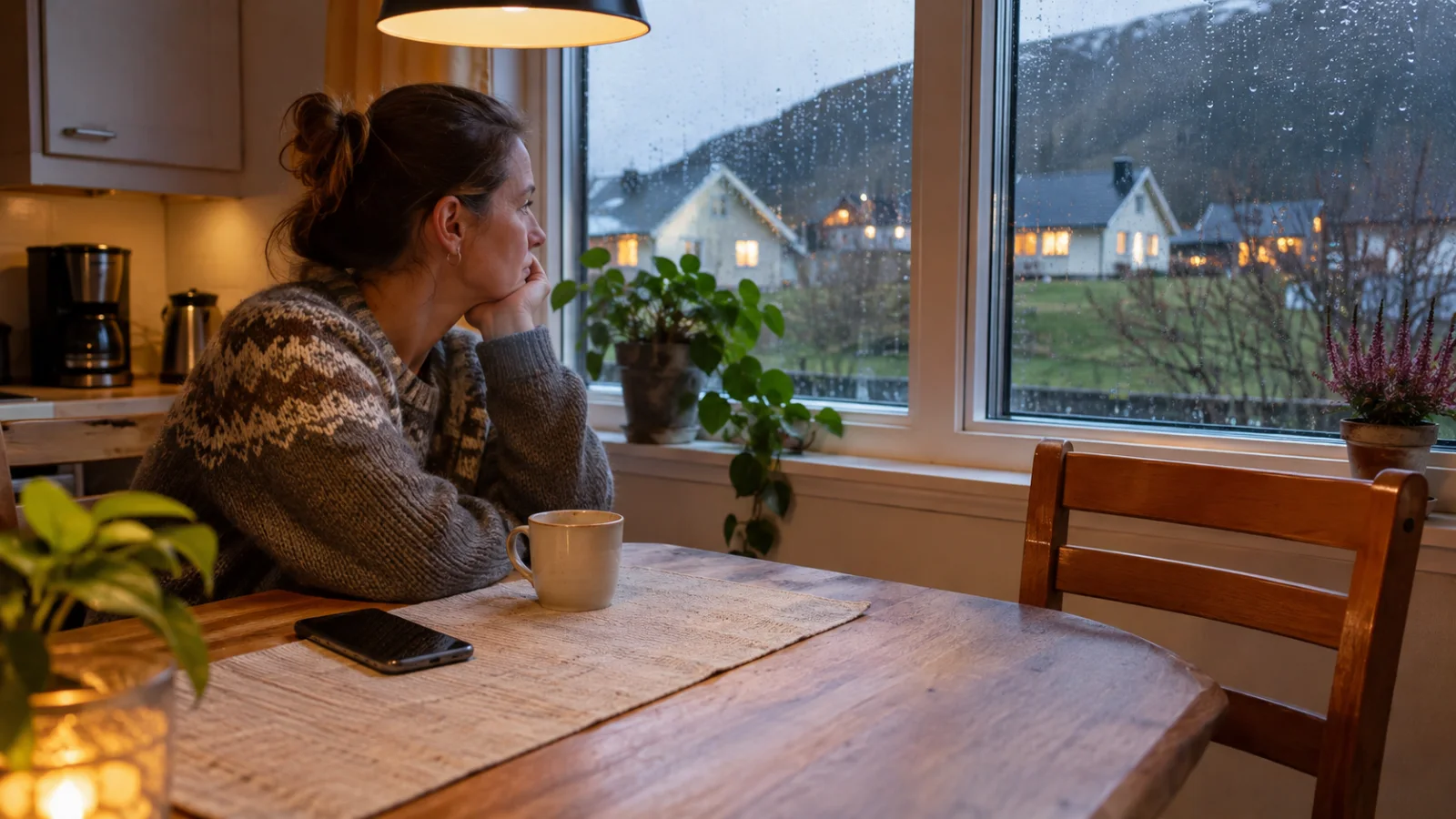
Is it possible to feel lonely while having a partner, children, a job, friends and a phone full of contacts? Yes. From the outside life looks successful. Inside, someone is missing to whom you can tell how your day really went.
Many of us came to Norway for a better life. We wanted security, money, stability and a future for our family. We work, build houses, buy cars, sometimes we financially support relatives in Poland. It's easy to talk about that when someone asks how we are doing. Much harder to say how much it costs us to live far from the people with whom we once shared everyday life.
You can have people around you and still feel lonely
After a day full of conversations you can come home with the feeling that no one really listened to you. You can also spend an evening alone and feel fine about it. Helsenorge describes loneliness as the experience of lacking belonging, closeness or the feeling that someone sees and understands you. Helsenorge - Loneliness
In the Norwegian quality of life survey for 2026 about 15% of adults reported that during the past 14 days loneliness bothered them quite a bit or very much. The result concerns the adult population of Norway. FHI notes that in the cited studies people who emigrated to Norway more often reported loneliness than the population overall. Their situation, however, varies among other things depending on living conditions, the reason for moving and the length of stay. SSB - How many feel lonely in Norway? · FHI - health of people with migration experience
What can't be sorted out by phone
Calls and messaging apps help maintain contact with Poland. They make it harder to have a spontaneous coffee, go shopping together or get quick help when a child becomes ill or you need to go to the doctor. For some children growing up in Norway grandparents are relatives whom you mainly see at holidays and vacations. Friendships from school or university days may also lack shared current experiences. We still care about each other, but increasingly we know less about what our ordinary Tuesday really looks like.
There is also a lack of ordinary neighborly relations. In Poland such contacts could develop over years in the course of everyday matters. After moving many things must be built from scratch. We do not always have the time and energy for that, especially when work takes up a large part of the day and children, a partner and further duties await at home.
Being yourself in a second language
At work you can communicate in Norwegian. You can handle a matter at an office, pick up the phone and ask for directions. But when friends start joking, refer to something you don't know, or the conversation turns to feelings, you may feel that your ease is gone. Before you find the right words, the conversation often moves on.
The language we grew up with is connected to childhood, family sayings and the first experiences of love, fear or shame. For some people it is easier to joke, speak about longing or react spontaneously in Polish. In Norwegian they may choose their words more carefully and appear more restrained than they actually feel. Much depends on how well we know the language, who we talk to and in what situations we use it. Research on multilingual people has shown, for example, that the emotional force of swear words and taboo words can vary depending on the language, proficiency and frequency of use. Jean-Marc Dewaele - a study on the emotional perception of words in different languages
One of the more difficult experiences of emigration can be learning how to remain yourself in a second language. So that, over time, you can also use it to talk about what you are afraid of, what makes you laugh and what you long for.
When life is lived in two countries
Holidays, birthdays and family gatherings can require more effort when you are living abroad. Even familiar traditions take on a different meaning when part of the family is far away. Sometimes we miss weddings, births, anniversaries and funerals. When we come to Poland, we discover that everyday life there has changed too. It can happen that for years we try to feel at home in both places.
Practical matters add to this. A phone call to the clinic or a conversation at a government office can take more energy when it has to be conducted in a second language. Some people, after arriving, restart their careers or work below their qualifications for a while. Further moves or living in constant readiness to change jobs can make it harder to feel that you have your own place and people you can rely on.
You can live in Norway for many years and still experience this discrepancy. Here we go to work and raise children, while in Poland there are people we would still like to have by our side in important moments.
Loneliness takes many forms
When we take care of everyone. Someone works, runs the household, raises children and remembers what others need. In the evening there is no one to tell that they themselves need help.
When we have to show that we can cope. Some men feel pressure to earn money and to solve problems on their own. Asking for help can be difficult for them. It is easier to extend the working day or spend the evening online than to tell a close person what is happening.
When there are fewer people to share the day with. Children move out, grandchildren grow up, a partner leaves or dies. The number of ordinary conversations and meetings that once formed part of the week changes.
When there are many contacts but it is hard to be yourself. A young person may exchange dozens of messages every day and at the same time not know who to turn to in a difficult moment.
Shame often accompanies loneliness. We are afraid that someone will judge us as weak, or we do not want to worry our family. To the question "How are you?" we answer "Everything is fine." Sometimes we become so accustomed to that answer that loved ones do not know when we really need a conversation.
Loneliness in a relationship. When we only talk about what needs to be done
Who will pick up the child? What to buy after work? When to pay the bill? Shared life needs conversations like these. However, if for a long time we limit ourselves to them, we may lose curiosity about what the other person is experiencing. One of the partners may feel invisible, even though both return every day to the same home.
It can happen that what hurts most is the closeness of someone we would like to talk to, but whom it is hard to address. If we feel safe in the relationship, it is worth starting by naming our own experience. “Lately we mainly talk about chores. I miss a moment when we could tell each other what’s going on with us.” Such a conversation can begin with a few minutes after dinner.
Where to start when we miss people?
Sometimes what we lack most is someone for an honest conversation. Sometimes it is contact with people during an ordinary day or someone who can help locally. It is worth naming what we need, because each of these situations suggests a different first step.
You can write directly to someone you trust. “Lately I find it hard to spend evenings alone. Do you have a moment to talk?” If we need more frequent meetings, it may help to have a place to return to and see the same people. This can be a walking group, a library, language classes or volunteering. It is worth starting with what our schedule, travel and energy allow. Helsenorge - Loneliness
When to talk to a specialist?
We may need to be alone for a while, miss our loved ones and go through a tougher period. It is worth paying attention, however, when for a long time after work we have no energy for anything, avoid phone calls and meetings, and daily life is reduced to performing duties. Sometimes we increasingly drown difficult emotions with work, alcohol or hours of scrolling on our phone. Problems with sleep, appetite or concentration may appear. These are signals worth discussing with a professional, especially if they intensify or interfere with daily life. Helsenorge - Depression in adults
You can contact a psychologist earlier, when you notice it is increasingly difficult to cope on your own. In Norway you can also start by talking to your family doctor, that is, the general practitioner, or check the offer of psychological help in your municipality. Some municipalities run Rapid mental health help, free assistance without a referral, for example in cases of anxiety and mild or moderate depression. If it is difficult to talk about your condition in Norwegian, you can indicate the need for an interpreter when arranging the appointment. Helsenorge - mental health help for adults · Helsenorge - interpreter in healthcare
Urgent help in Norway
If you are having thoughts of taking your own life or harming yourself, urgently contact medical services and tell a trusted person what is happening. In case of immediate danger to life call 113. If the situation requires urgent help but does not pose an immediate threat to life and cannot wait for contact with your GP, call the out‑of‑hours emergency medical service legevakt at 116 117. Helsenorge - Do you have suicidal thoughts?
Editorial summary of TwojaNorwegia.no
In Anna Willder’s text the question “Do I have anyone here?” concerns whom we can turn to on an ordinary day. Abroad it is easy to talk about work, bills and plans. It is harder to say that we miss daily contact with loved ones, that we feel invisible in a relationship, or that in our second language we still can’t talk about ourselves as freely as we would like.
Start by asking what you miss the most. It might be an honest conversation, regular meetings, or someone you can ask for help locally. If withdrawal, low mood or lack of energy begin to make daily life difficult, it is worth talking to a psychologist or your GP. You can also check what support the municipality offers.
Norwegian sources
Statistics Norway (Statistisk sentralbyrå (SSB)) - results of the quality of life survey for 2026 and the method of measuring loneliness. How many are lonely in Norway?
Norwegian Institute of Public Health (Folkehelseinstituttet (FHI)) - health, loneliness and social inclusion of people with migration experience. Health and health service use among people with immigrant backgrounds
Helsenorge / Norwegian Directorate of Health - what loneliness is and what can help. Loneliness
Helsenorge / Norwegian Directorate of Health - symptoms you should consult a professional about. Depression in adults
Helsenorge / Norwegian Directorate of Health - GP, municipal mental health support and Rask psykisk helsehjelp. Mental health care for adults
Helsenorge / Norwegian Directorate of Health - using interpreter assistance in health care. Interpreter in health services
Helsenorge / Norwegian Directorate of Health and NSSF - how to get help with suicidal thoughts. Do you have suicidal thoughts?
Author's bibliography
Bauman, Z. (2003). Together, Apart. Krakow, Literary Publishing House.
Cacioppo, J. T., and Patrick, W. (2008). Loneliness: Human Nature and the Need for Social Connection. New York, W. W. Norton & Company.
Cacioppo, J. T., and Hawkley, L. C. (2009). Perceived social isolation and cognition. Trends in Cognitive Sciences, 13(10), 447–454.
Hawkley, L. C., and Cacioppo, J. T. (2010). Loneliness matters: A theoretical and empirical review of consequences and mechanisms. Annals of Behavioral Medicine, 40(2), 218–227.
Heinrich, L. M., and Gullone, E. (2006). The clinical significance of loneliness: A literature review. Clinical Psychology Review, 26(6), 695–718.
Berry, J. W. (1997). Immigration, acculturation, and adaptation. Applied Psychology, 46(1), 5–34.
Berry, J. W. (2005). Acculturation: Living successfully in two cultures. International Journal of Intercultural Relations, 29(6), 697–712.
Ward, C., Bochner, S., and Furnham, A. (2001). The Psychology of Culture Shock, 2nd ed. Hove, Routledge.
Putnam, R. D. (2000). Bowling Alone: The Collapse and Revival of American Community. New York, Simon & Schuster.
Perlman, D., and Peplau, L. A. (1981). Toward a social psychology of loneliness. In: R. Gilmour and S. Duck (eds.), Personal Relationships in Disorder, pp. 31–56. London, Academic Press.
Holt-Lunstad, J., Smith, T. B., Baker, M., Harris, T., and Stephenson, D. (2015). Loneliness and social isolation as risk factors for mortality: A meta-analytic review. Perspectives on Psychological Science, 10(2), 227–237.
World Health Organization (2021). Social Isolation and Loneliness Among Older People: Advocacy Brief. Geneva, WHO.
European Commission (2023). Loneliness in the European Union: A Pilot Survey. European Commission.
Supplementary source regarding language: Dewaele, J.-M. (2004). The Emotional Force of Swearwords and Taboo Words in the Speech of Multilinguals. Journal of Multilingual and Multicultural Development, 25(2–3), 204–222. Academic article