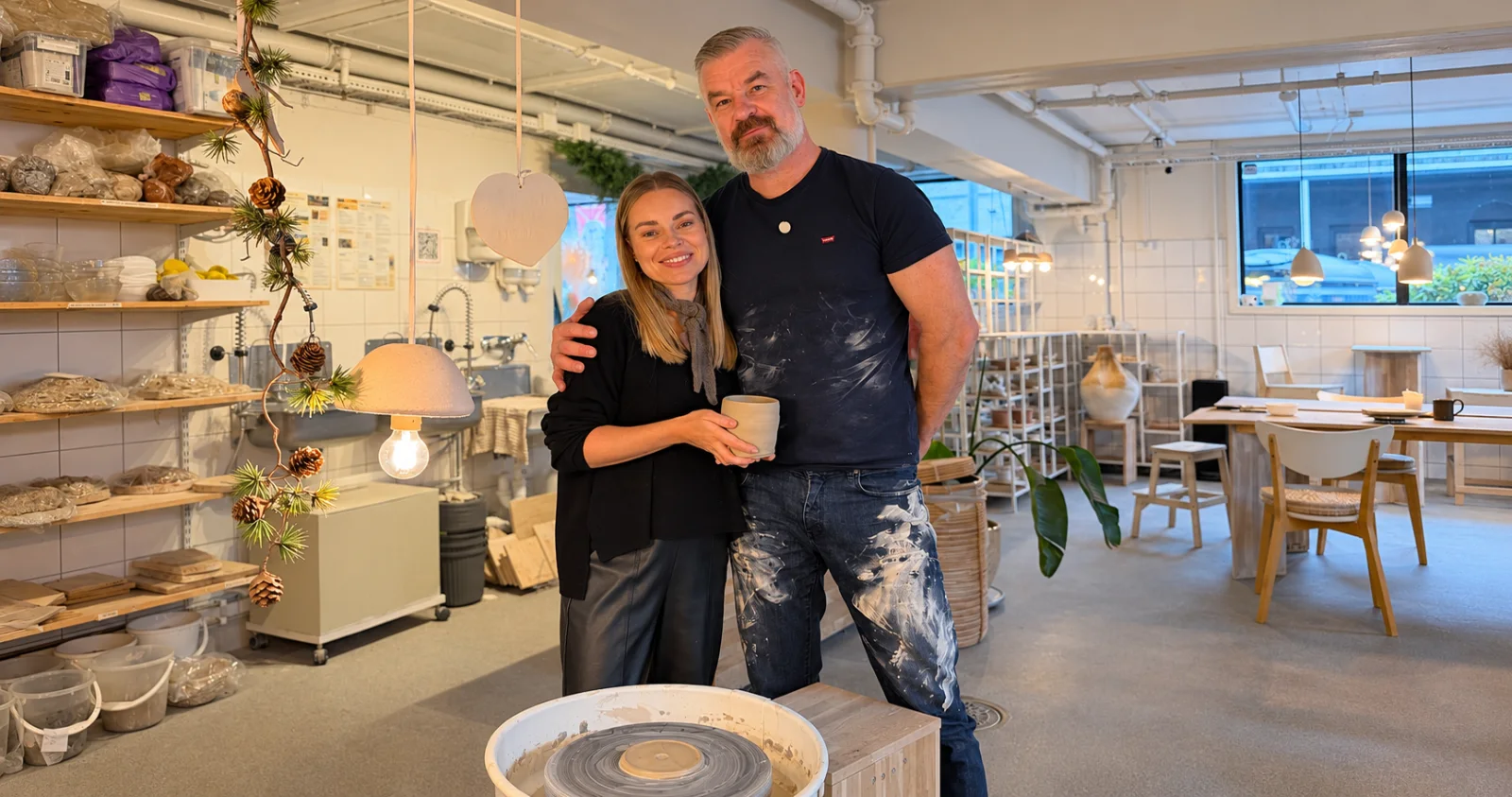
Magdalena Koseda wanted to make a large bowl in which you can grate garlic and immediately toss the salad. While looking for a way to make the vessel, she ended up at a ceramics studio in Frogner in the municipality of Lillestrøm. After a few months the owners offered her to take over the equipment. Today Coseda Studio operates in the same premises, and at the potter’s wheels people meet who want to learn something new or simply work in silence for a while.
Text and interview - Steve Joobs, Radio Wataha / TwojaNorwegia.no
The bowl she couldn’t find
It was to have a grater built into the bottom. Big enough to grate garlic on, add olive oil and balsamic vinegar, and then throw in lettuce for the whole table. Besides, it had to look good and serve daily purposes, for example as a fruit bowl. The inspiration came from small ceramic plates with a grater that Magdalena associated with Sicily. Her version was meant to hold much more.
At the time of the interview Magdalena had lived in Norway for over twelve years. She moved here with her husband, a former hockey player, and lives here with her family. For several years she worked on food styling. She prepared food for photos that appeared in leaflets, on billboards and on television. As she recalls, she worked on materials for brands such as Bama, Salma and Kiwi. She therefore knew how much a vessel changes the way a dish is presented. Now she wanted to design one herself.
She talked to ceramic manufacturers in Poland and abroad. When it came time to send the design, it turned out there was a lot of work between the idea in her head and the documentation for the manufacturer. She decided to try to make the bowl herself.
When the studio was about to close
She found a studio in Frogner. At the clay she could forget about the rest of the day for several hours. Over time she also began to help with organizing the studio. After about two months she was offered the role of assistant. Soon after she heard that the owners were considering closing the place. They ran a larger studio in Oslo and lacked time for both locations.
Magdalena had already become friends with the people she worked with. She was therefore even more surprised when she was invited to a meeting and offered to run the place herself. She had a job, a family and limited experience in ceramics. The owners, however, saw how she managed the studio’s organization. When she told her husband about the offer, she felt she could count on his support.
- Okay, I close my eyes and jump into this adventure - that is how she recalls her decision.
The purchase included the equipment and the possibility of continuing the lease. Magdalena had to negotiate contracts, launch signups and build the business under her own name. A dozen people from the previous studio decided to stay. According to the studio, the premises were previously part of Viarte Keramikkverksted, and since January 2026 operate independently as Coseda Studio. History and address of the studio
The first mug and a lesson in patience
When I visited the studio, I wanted to make a tall, simple mug. Lena showed me how to sit at the wheel and how to position my hands. I also tried it my way. After a moment I returned to her method. In the video it looks as if it were enough to place your hands on the clay and slowly lift them. At the wheel I understood how much depends on what you do at the very beginning.
Magdalena says that many people sit at the wheel intending to make a mug, and end up with a bowl. The first challenge is centering, that is positioning the clay so it spins evenly around the wheel’s axis. Only then can you open the mass and gradually pull up the walls. Lena gave me space to feel the difference myself between her instruction and my idea. From that attempt I got a mug and a much greater respect for an activity that on screen takes only a few seconds.
How to get started at Coseda Studio
In the basic throwing course participants learn work at the wheel and try to make a simple form, for example a bowl, a mug or a small vase. Magdalena says that in the classes she describes the group at the wheel numbers up to seven people. Finished works remain in the studio to dry, be fired and glazed. Collection takes place after a few weeks.
Hand-building clay allows you to start with a different set of movements. From coils you can build the walls of both a small vessel and a larger vase. Flat forms, such as undulating platters, are created among other methods from rolled-out clay. The same material therefore offers completely different possibilities at the table and at the wheel.
For people who have already had their first throwing attempts, Magdalena describes the DEL 2 course. There it is time for taller forms, removing the formed work from the wheel and trimming the base when the clay has dried a little. The studio also offers private lessons, during which you can focus on a single technique. The conversation also mentions a drop-in format. For current dates and the rules of this form it is best to ask the workshop. Course calendar and registration
What membership includes
The studio describes two membership options, three-month and annual. Both provide access to the same equipment. Members can use the workshop between 8.00 and 22.00 within the time limit set by the studio. They have access to pottery wheels, hand-working tables, tools and their own shelf. The price includes clear glaze and firings within an agreed range. The studio discusses details at an introductory meeting. A ceramics course is optional. Membership terms
Clay is purchased separately. In the self-service shop you can pay via Vipps and choose material suited to the firing conditions. The studio uses one kiln and two firing temperatures, the higher of which, according to Magdalena, reaches 1230°C. The choice of clay and glaze matters for the whole load. Loading is handled by the workshop. There is also a small exhibition space where members can show their works, and passersby sometimes find a present.
They came for silence, they stayed for the people
- I think that is the greatest gold of this place - says Magdalena about the people who meet in Frogner.
Some come after a demanding workday, put on headphones and attend to their own project. Another time one person invites another to work together at the wheel. “Come, sit by me at the wheel, I’ll show you how to do it” - Magdalena recalls such a scene when she talks about sharing knowledge.
Most members, she says, are Norwegians. A few people from Poland have also joined the studio. Next to each other the first mugs and much bolder works are being created. Magdalena told me about a participant who only a few months earlier doubted whether she could shape anything. During my visit I saw a dragon made by her.
At the time of the interview the studio had about 47 members. When Magdalena started with a dozen or so people, she wondered whether it would be enough to cover the costs. Now she keeps a waiting list because she wants to preserve space at the tables and wheels and efficiently handle the firings. She herself encourages starting with a single class and seeing whether one wants to return. In the interview she also announced classes in Polish and the participation of the ambassador in one of them. The date and details of the event remain to be confirmed.
Pottery in Norway. What came before contemporary studios?
In Norwegian materials you can encounter the words pottemakeri and keramikk. The first means pottery, the second covers the broader world of ceramics, from utilitarian vessels to artistic works. In Frogner you can see both sides of this work. Beside kitchenware, figurines are also created there, such as the dragon I saw during my visit. Store norske leksikon - ceramics
Trøndelag. The Norwegian encyclopedia devotes a separate entry to trønderkeramikk, ceramics grown out of the regional pottery tradition. Among the objects illustrating it is a drinking vessel decorated with figures and text. The story of ceramist Grete Wexels Riser tells how this tradition was passed on in the 20th century. In 1960 she was offered to run a pottery workshop at the Norsk Folkemuseum, where in summer she was to demonstrate traditional ceramics from Trøndelag. Trønderkeramikk · Grete Wexels Riser
Sandnes. In Rogaland clay became the basis of the local industry. According to a study by the municipality of Sandnes, the Gamlaverket works purchased a pottery kiln in 1794 and brought in a specialist named Zimmermann. The later history of the town is connected, among other things, with the Hana and Gann-Graveren works. Municipal documentation shows how, alongside the production of building materials, the manufacture of vessels developed in Sandnes. Municipality of Sandnes - history of the clay-based industry
Egersund. In 1847 Johan Feyer founded Egersunds Potteri, the later faience factory. The idea was connected to the discovery of local clay deposits. Feyer went to Newcastle upon Tyne to learn the technology, and he brought English specialists to train workers in Egersund. After the factory closed in 1979 its archive and collection were taken over by Dalane Folkemuseum. The history of the plant can be learned today at Egersund Fayancemuseum. Dalane Folkemuseum - history of the factory · Egersund Fayancemuseum
In the history of Magdalena’s studio, clay appeared for a very domestic reason. She wanted to put a bowl on the table that she couldn’t find. Today someone else opens the door of the same workshop because they want to make their first mug. Perhaps at the wheel they will meet a person who will take off their headphones and say: “Come, I’ll show you.”
Address, contact and registration
Coseda Studio - Frognerveien 1, 2016 Frogner, municipality of Lillestrøm, Akershus.
Contact - hei@coseda.no.
Workshops and individual lessons - Coseda Studio calendar.
Membership and availability of places - Coseda Studio information.