
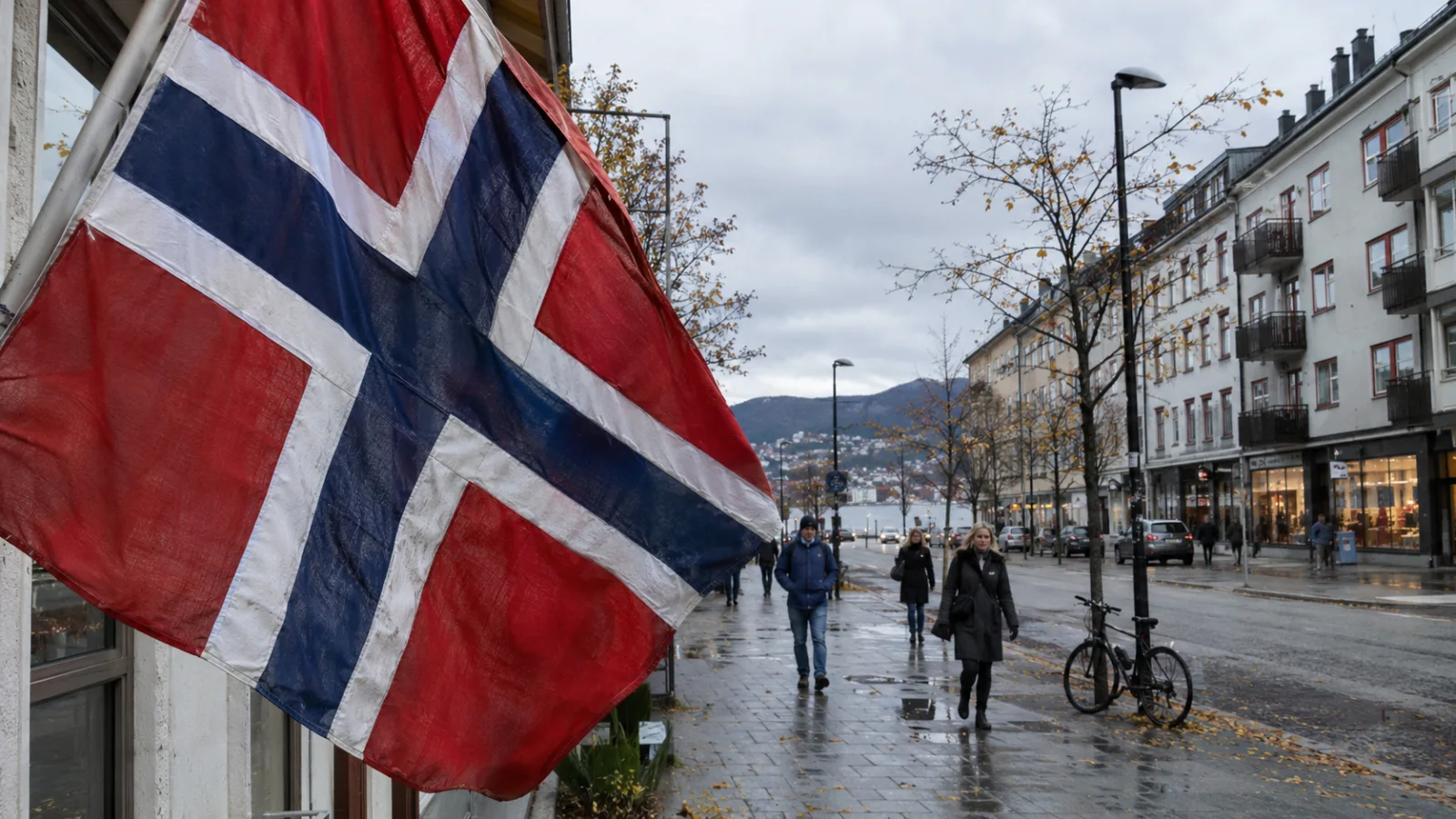
Norway in 7 days is a weekly roundup of information that matters for people living and working in Norway. No sensational headlines and no paraphrasing of Norwegian newspapers. We select events, check sources and explain what they may mean in practice.
In the edition from 9 November 2026 we return to events from 2 - 8 November. This time the focus is on money, benefits, education, municipal infrastructure and safety.
1. Norges Bank did not cut interest rates. Borrowers still need to be patient
5 November | Economy and finance
At the start of the month many people with a mortgage again looked to Norges Bank. Will there be a chance for cheaper loans?
The answer is: not yet.
The Norwegian central bank decided on 4 November to keep the key interest rate at 4.5%. The bank justified the decision by persistent inflationary pressure. In September the price increase was 3.4%, while the bank's inflation target is about 2%.
Moreover, Norges Bank does not rule out another rate hike if it proves necessary to curb inflation.
What does this mean for residents of Norway?
People repaying mortgages should not treat the November decision as a sign of immediate rate cuts. The central bank rate and the interest rate on a specific loan are two different figures, but Norges Bank's decisions have a significant impact on banks' offers.
For families this means a continued need for careful budgeting. For those considering buying an apartment — the necessity of calculating borrowing capacity based on actual costs, not on the expectation that loans will soon become cheaper.
It is also worth remembering that a high interest rate is an attempt to limit price growth. From the economy's perspective it is therefore not only about loans, but also about the prices of goods and services.
Editorial sources: Norges Bank - decision from November 2026 and E24 - discussion of the decision and economists' reactions.
2. Changes in sykepenger for some people on disability pension. The government presented a proposal
6 November | NAV, work and benefits
This is one of the most important news items of the week for people who receive a disability benefit and at the same time take up employment.
The Norwegian government has proposed limiting the right to sykepenger for people receiving full disability pension and who are employed for pay.
The reason is a change in the rules allowing people receiving disability pension to earn income from work up to the level of 1G - set by the government as 136 549 NOK - without reducing the benefit. According to the government, the current combination of rules may in some cases lead to the payment of full disability pension and additional sykepenger for the same period of reduced work capacity.
Important: the proposal does not mean that sykepenger will be taken away from all people on disability pension.
According to the government statement:
the proposed restriction concerns people receiving full uføretrygd;
people combining partial uføretrygd with work will still have the right to sykepenger for loss of income not covered by the benefit;
an exception is provided for participants in the Varig tilrettelagt arbeid (VTA) program.
What does this mean for you?
If you receive uføretrygd and at the same time work, it's worth following further developments of the proposal. However, you should not assume based on the announcement alone that the current benefits have already changed.
The issue concerns a broader question: how should Norway encourage people with reduced work capacity to participate in work activity without at the same time creating unclear rules for benefit payments?
This is a topic worth returning to when a concrete draft of regulations and further decisions appear.
Editorial source: Arbeids- og inkluderingsdepartementet - proposal to limit sykepenger.
3. Artificial intelligence is changing Norwegian universities. Is this the end of traditional take-home assignments?
6 November | Education and technology
In recent years artificial intelligence has become a common tool for writing, translating and analyzing information. Now Norwegian universities must answer a difficult question: how to check what a student really knows?
On 6 November a commission of experts presented a report on the use of AI in higher education.
One of the main recommendations proposes a gradual move away from short exams taken alone at home in favor of assessment forms that better verify a student's knowledge.
The experts propose, among other things:
greater use of supervised and oral exams;
supplementing large papers, such as master's theses, with an element of an exam conducted under supervision;
developing academic teachers' competencies in AI;
expansion of Norwegian computing infrastructure.
The commission does not claim that artificial intelligence should be removed from education. On the contrary — it recognizes it as a tool that can support learning, provided it is used responsibly.
What does this mean for students in Norway?
In the future the importance of exams in which one must independently explain one's line of thought and defend the presented solutions may increase.
This also applies to Poles studying in Norway and to families whose children plan further education here.
For now these are the commission's recommendations, not a binding nationwide reform. The report is to be subject to consultation, and the government will decide later which proposals to implement.
Editorial source: Kunnskapsdepartementet - commission report on AI in higher education.
4. Norway must modernize waterworks. The stakes are billions and future municipal fees
6 November | Housing, municipalities and cost of living
There are expenses we do not think about every day. As long as clean water flows from the tap and the sewage system works, the infrastructure remains invisible.
However, the Norwegian government reminded this week how enormous a challenge the modernization of water supply and sewage systems will be.
According to estimates by the organization Norsk Vann, cited by the government, the necessary investments in 2025–2045 could amount to between 411 and 535 billion kroner.
The problem concerns, among other things, old pipes, water losses and the need to modernize treatment plants.
The government points out that on average about 30% of treated drinking water leaks from the network before it reaches consumers.
A commission of experts has been appointed to analyze how water and sewage services are organized and financed. The report is scheduled for 1 December 2027.
Why should this interest residents?
In Norway, the costs of water supply and sewage services are largely covered by user fees. Modernizing the infrastructure therefore matters not only for the environment and safety, but also for household budgets.
This does not mean the government has just announced a specific increase in bills. There is no such decision in the statement.
It does mean, however, that the state of the infrastructure and the way investment financing is handled will be among the important topics for municipalities in the coming years.
Editorial source: Klima- og miljødepartementet - the future of the water supply and sewage sector.
5. Northern Norway under pressure from the weather. Warnings of rain, floods and landslides
7–8 November | Weather and safety
November in Norway can very quickly remind you that the weather is not just a topic for conversation.
Over the weekend meteorologists warned of intense rainfall in Troms and the northern part of Nordland. In some places 70 - 90 millimeters of rain were forecast within 48 hours, and an additional threat was snowmelt.
Norwegian services warned of the possibility of rising river and stream levels, local flooding, landslides and difficult road conditions.
For people working in transport, construction or traveling in the north of the country, these are particularly important pieces of information.
What should you do?
Check current warnings before traveling, and during heavy rainfall avoid being near swollen rivers and streams.
It is important to distinguish forecasted hazards from confirmed damage. Weekend warnings do not automatically mean that flooding or landslides occurred in every indicated location.
Editorial sources: VG - warnings of heavy rain and landslides and Varsom - current warnings from Norwegian services.
What to watch for in the week of 9 - 15 November?
Energy and data centers - 9 November
The Norwegian ministries of energy and digitalisation announced a press conference regarding data centers and electricity for Monday, 9 November at 9:30.
This is an important topic for a country where energy availability matters for industry, the development of new investments and local communities.
It's worth watching what concrete solutions will be presented and how they may affect energy demand.
Source: Regjeringen.no - conference on data centers and energy.
Ministers of Defence of the Nordic countries will meet in Oslo - 11 - 12 November
On Wednesday and Thursday Oslo will host a meeting of the defence ministers of the Nordic countries within the framework of NORDEFCO cooperation.
The agenda includes regional security, the development of defence cooperation within NATO and continued support for Ukraine.
This event is important for all residents of Norway - regardless of nationality - because it concerns the security of the entire region.
Source: Forsvarsdepartementet - NORDEFCO meeting in Oslo.
Norway in 7 days - the most important is not always the loudest
We have just had a week in which many important pieces of information concerned everyday matters: how much a loan costs, how the benefits system will work, what is expected of students and who will pay for the modernization of infrastructure.
Not all of the changes presented are already in effect. Some are decisions, some are proposals, and some are warnings. Therefore on TwojaNorwegia.no we will follow not only the headlines but also the further developments of the matters.
Because in news from Norway the most important thing is not only what happened, but also what it means for the people who live here.
Editorial compilation: Steve Joobs / TwojaNorwegia.no - Radio Wataha. The review covers events from 2 - 8 November 2026. Information was verified based on the cited Norwegian media and institutional sources.