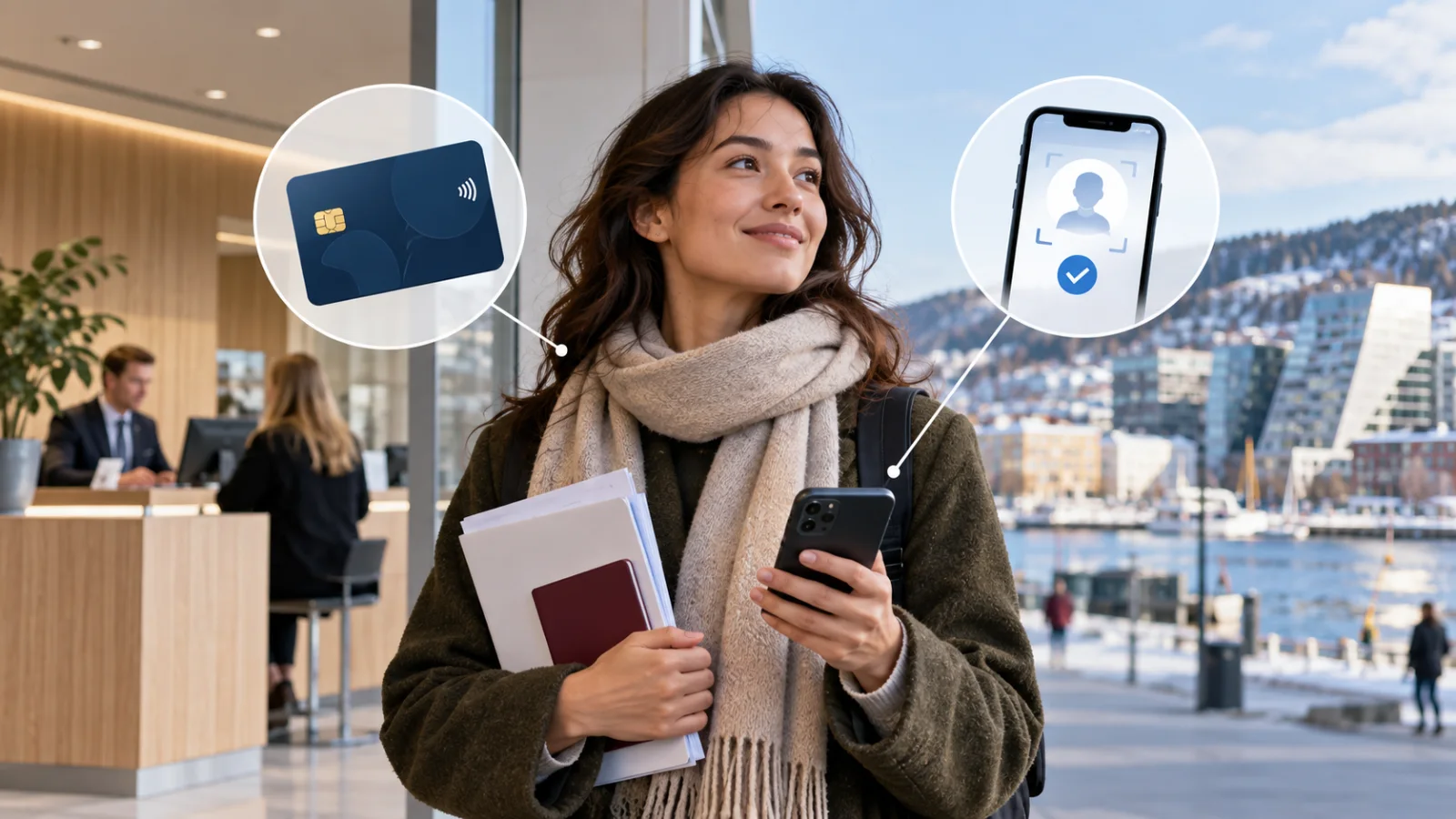
You have a D-nummer. You have a job. And suddenly it turns out that you still can't do everything
The first formalities are behind you.
You have a Norwegian identification number.
You are working.
Your skattekort is working.
The first paycheck arrives.
And that's when the next stage of life in Norway begins.
You need an account.
Then BankID.
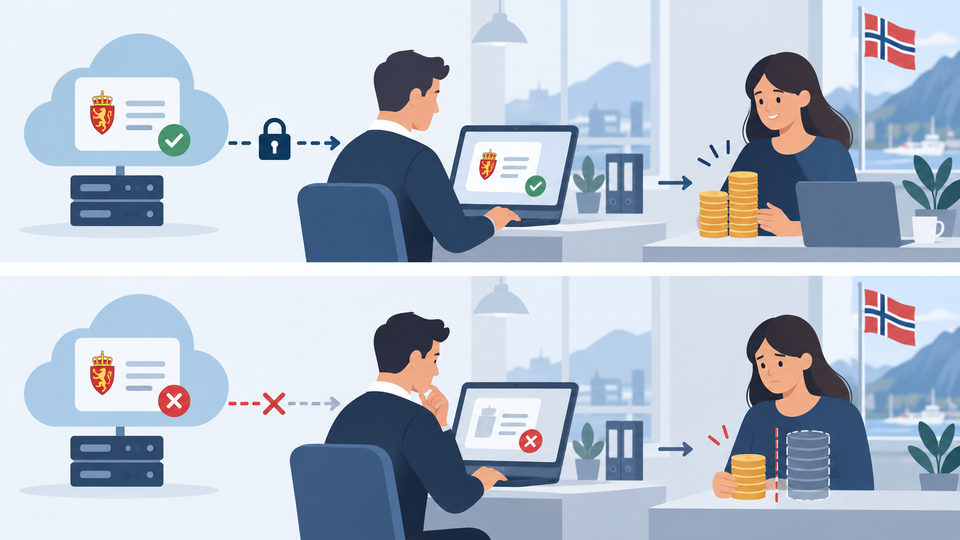
You want to log in to a public agency, sign a document, change a contract, arrange something at the bank or use one of dozens of digital services.
And here many people encounter their first surprise:
a bank account does not automatically mean BankID.
These are two different things.
Account, card, online banking and BankID are not a single package
Finans Norge describes basic banking services as, among others:
a bank account,
a debit card,
access to online banking.
These basic services are in principle available to people living in Norway regardless of citizenship. The bank still has to know its customer, confirm their identity and determine how the account will be used.
BankID, on the other hand, is an additional service requiring stronger identity verification and a separate assessment by the bank.
Therefore, a situation is possible:
you have an account, a card and access to the bank, but you do not have BankID.
And this does not have to mean that something has gone wrong.
What exactly does BankID provide?
BankID is Norwegian electronic identification.
In the physical world you show your passport and sign a document with a pen.
In the digital world BankID confirms that you are really you, and at the same time allows you to sign documents electronically.
BankID is used, among other things, for:
logging into banks,
many public services via ID-porten,
NAV,
Skatteetaten,
signing contracts,
insurance services,
some housing matters,
many private services.
One BankID can also be used in other banks and services, not only in the bank that issued it.
That's why BankID quickly stops being an „add-on to the account”.
In practice it becomes one of the most important keys to digital life in Norway.
Step 1. First the account. Don't wait for BankID in order to become a bank customer
This is a common paradox.
You want BankID.
The bank says: you must be our customer.
You try to become a customer online.
The website asks for BankID.
And the loop closes.
Fortunately, lack of BankID does not mean that you cannot open an account.
Banks have procedures for new customers without BankID.
For example, DNB allows submitting a separate application without BankID, and later requires additional identity verification. DNB also has a procedure for new people in Norway who have a D-nummer.
This does not mean that every bank uses an identical form.
It just means:
not having BankID does not close the way to an account.
Step 2. Prepare for the bank's questions
The bank does not ask you about your job, income and the source of your money because you are a foreigner.
It has an obligation to know its customer and to counter money laundering.
Finans Norge indicates that the bank may ask, among other things:
what you need the account for,
where incoming money will come from,
what you will use the bank services for,
what your address is,
which documents prove your identity.
Therefore the question:
„Where will the money in the account come from?”
does not have to mean a problem.
If the account is to be used for receiving salary, the answer is simple:
salary from an employer in Norway.
If you are also transferring your own savings from Poland, say so.
The worst solution is giving random answers just to get through the form faster.
What to prepare before opening an account?
Requirements depend on the bank, but it is worth having prepared:
a valid identity document,
D-nummer or fødselsnummer,
a Norwegian address,
contact details,
information about employment,
an employment contract, if the bank requires it,
information about the source of the funds,
documents regarding residence rights, if the bank requires them.
Finans Norge indicates that banks may accept, among other things, valid foreign passports and, after appropriate assessment, national identity cards of EU/EEA countries. However, a bank may require additional documentation.
Therefore, before you go to a branch, check the website of the specific bank.
Do not assume that the list of documents is identical everywhere.
And now the most important: can you get BankID with a D-nummer?
Over the years, many conflicting pieces of information have accumulated here.
One person says:
„With a D-nummer, BankID is impossible”.
Another:
„I received it without any problems”.
Both may be telling the truth.
Banks apply different rules.
This is not theory. It is visible directly in their current requirements.
DNB
DNB currently states directly that a D-nummer is sufficient to become a customer, but BankID is not issued with only a D-nummer. The bank requires a fødselsnummer for BankID.
So:
D-nummer → account possible.
D-nummer → BankID at DNB currently: no.
Nordea
Nordea states, however, that to obtain BankID you can have:
fødselsnummer or D-nummer registered in Folkeregisteret, provided the other identification requirements are met.
SpareBank 1
Also, some banks belonging to SpareBank 1 state directly that people holding a D-nummer can receive BankID after personal verification and presenting the required documents.
And this leads to an important practical rule:
if one bank says „no”, ask whether the problem is the law or your identity, or only that bank's policy.
Do not automatically assume that the answer of one bank applies to all of Norway.
Do not choose a bank solely because someone wrote on Facebook „they give BankID there”
A bank assesses a customer individually.
The fact that a friend got BankID with a D-nummer does not automatically mean you will receive it under identical conditions.
The following may be significant:
the method of identity verification,
the identity document,
the status of the D-nummer,
the documentation provided to the bank,
the internal procedures of the specific bank.
Therefore, treat information about banks as a starting point, not a guarantee.
Step 3. Create an account and ask for BankID right away
Don’t wait several months just because the bank didn’t offer you BankID on its own.
During account opening, ask directly:
“Can I receive BankID with my identification number and documents?”
If the answer is no, ask a follow-up:
“What exactly am I missing?”
These can be two completely different answers:
“We need an additional document.”
or:
“Our bank does not issue BankID to people with D-nummer.”
You can solve the first problem by providing a document.
The second may mean it’s worth checking another bank.
Step 4. You get BankID from the bank, not from Skatteetaten
This is another thing that is easy to confuse.
Skatteetaten can assign you:
D-nummer,
fødselsnummer.
But BankID is not issued by Skatteetaten.
You receive BankID via your bank.
The official BankID website states that before issuing BankID, identity must be verified and an appropriate identity document must be presented.
If you have questions about the issuance of BankID itself, your first contact should therefore be your bank.
Downloading the BankID app alone doesn’t accomplish anything
This is one of the most practical details.
You see the BankID app in the App Store or Google Play.
You download it.
You try to register.
And nothing.
Why?
Because the BankID app is not a way to create BankID from scratch on your own.
First you must have an active BankID issued by the bank.
Only then is the app a way to use it. The official BankID instructions state that when activating the app you must connect it to an existing BankID.
So:
bank → BankID → app
and not:
app → BankID.
You can later activate the app using a passport
After receiving BankID, the app can be activated in several ways.
BankID allows, among other things, scanning a passport or national identity document during app activation. Official information also indicates support for foreign documents in part of the activation process.
But once again:
this is an activation of the app for an existing BankID, not the procedure for issuing the first BankID.
This distinction saves a lot of frustration.
Don’t have BankID yet? You are not completely cut off from public agencies
BankID makes life much easier, but not having it does not mean that all Norwegian public services are inaccessible.
One alternative is MinID.
Altinn informs that people holding D-nummer can order activation of MinID and use it to log in via ID-porten.
MinID provides access to many public services, but it has a lower security level than BankID.
Therefore some operations will be available via MinID, and some will require stronger identification.
Altinn: how to obtain MinID with D-nummer
This can be very useful during the period when you are waiting for the bank and BankID.
A bank account without BankID can still operate normally
If the bank opened an account for you but did not issue BankID, that does not automatically mean the account is useless.
Some banks have their own login solutions for people without BankID.
For example DNB allows a client with D-nummer to use an alternative login method, even though it does not issue BankID to them.
SpareBank 1 also describes a "Uten BankID" solution that provides access to online and mobile banking, although some functions requiring a BankID signature remain unavailable.
This is important because it allows separating two objectives:
I need an account for daily life and salary payments.
from:
I need full electronic identification.
You will not always be able to achieve both on the same day.
What if the bank refuses to open an account?
First determine exactly what the refusal concerns.
The account?
BankID?
A loan?
These are three different things.
Finans Norge points out that basic banking services are, in principle, available to all persons living in Norway regardless of citizenship. However, a bank may refuse if, for example, it cannot properly verify identity, the client does not provide the required documentation, or the bank does not receive sufficient information about how the services will be used.
The Norwegian Ministry of Finance also reminds that a payment service provider cannot refuse to provide ordinary payment services without an objective reason.
Therefore the answer:
"We cannot open an account"
should lead to the next question:
"What is the specific reason and which document or information is missing?"
This gives you much more than arguing at the counter.
BankID is your identity. Do not lend it to anyone
This is not a Netflix code.
BankID represents you and can be used to conclude binding agreements.
BankID warns never to give passwords or codes to family, friends, "advisors", people claiming to be the bank, or the police. The bank and the police will not call you to ask for your password or BankID codes.
If someone says:
"give the code, I'll help you log in",
don't do that.
If you need language assistance, someone can stand next to you and translate.
But you must handle BankID yourself.
A realistic plan for someone who has just arrived
Don't make it more complicated than necessary.
You have a D-nummer
Choose a bank and check the procedure for a person without BankID.
Prepare identification documents and the information required by the bank.
Apply for an account.
Ask right away whether the bank issues BankID to people with D-nummer.
If not, determine whether this is a limitation of that bank.
If you need access to public authorities in the meantime, check MinID.
You have a fødselsnummer
Choose a bank.
Open an account according to the procedure.
Complete the required identification.
Order BankID.
After BankID is issued, activate the application.
You don't have to do everything in one day.
The most common mistake? Treating BankID as a banking product that comes with the account
This is what leads to the biggest confusion.
Someone opened an account.
They received a card.
The bank's app works.
So they assume:
"I have BankID".
Not necessarily.
BankID is a separate electronic identification.
BankID itself warns that even having a code device or another way to log into the bank does not automatically mean that an active BankID has been issued.
If you are not sure, ask the bank:
“Do I have an active BankID, or only access to online banking?”
That one question clears up many misunderstandings.
What should you have at the end?
Ideally after this stage you have:
a bank account for receiving salary,
a debit card,
access to online or mobile banking,
BankID, if the bank can issue it to you,
or temporarily MinID and bank login without BankID.
Not everyone will achieve all these points at the same time.
And that is normal.
The most important thing is to know, what exactly you are really missing.
An account and BankID make everyday life much easier.
OFFICIAL AND PRIMARY SOURCES
BankID: how to get BankID
Official information regarding issuing BankID, identification and contact with the bank.
BankID: what BankID is
Use of BankID as an electronic identity and signature.
Finans Norge: how to become a bank customer in Norway
Basic banking services, customer identification, required information and KYC rules.
DNB: new customer in Norway
An example of the account opening procedure with D-nummer and the rules regarding BankID.
Nordea: BankID
Current Nordea requirements, including the possibility of using D-nummer.
SpareBank 1: BankID and logging in without BankID
An example of a bank that allows some people with D-nummer to have BankID and offers alternative login.
Altinn / ID-porten: MinID
An alternative electronic identification for some public services.
Information checked on: 27.09.2026