"You have to decide today, because I have five other people"
Sound familiar?
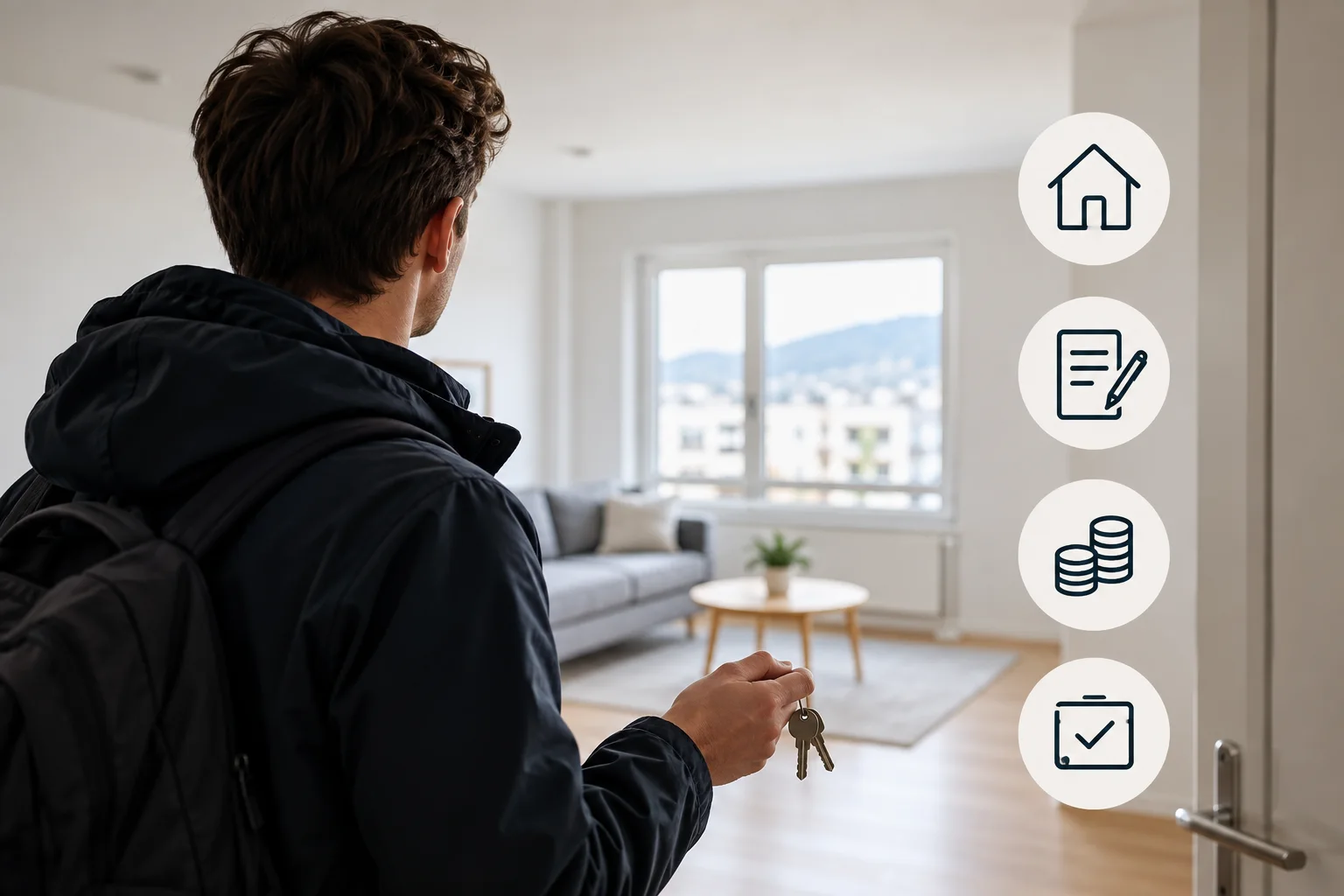
You finally found an apartment.
The location fits. The price still fits your budget. Inside it looks pretty good.
You talk to the landlord and suddenly you hear:
"If you want it, you have to decide now. There are a lot of people interested."
That may be true.
The rental market in many places can be fast.
But it is precisely at that moment that a person is most likely to do something they normally wouldn't:
sends between a dozen and several dozen thousand kroner to a person they met an hour earlier.
Therefore the first rule is not:
"be faster than others".
It sounds:
before you pay, make sure what you are paying for and to whom.
See the apartment first, not just the photos
Nice photos in the ad won't tell you that:
there is a damp smell in the bedroom,
the window doesn't close properly,
the washing machine belongs to the previous tenant,
the parking is not part of the rental at all,
and "10 minutes from the center" means 10 minutes by car on an empty road.
If you have the opportunity, see the place in person.
Open the cupboards.
Check the bathroom.
Look by the windows.
Ask what exactly remains in the apartment.
If you are renting furnished, agree on which items are included with the furnishings.
Also check the basement, storage unit, parking space and other elements if they were part of the listing.
You don't have to act like a building inspector.
You simply need to know, what exactly you are renting.
And what if you are still in Poland and cannot come?
That happens very often.
You start work on Monday, you are still in Poland and you need a roof over your head from day one.
In that situation the risk is greater, so at least ask for a video call from the apartment.
Not just a recording.
A live conversation.
Ask the person to show:
the building entrance,
the apartment number or address,
the kitchen,
the bathroom,
the view from the window,
the rooms you are going to rent.
Of course this doesn't give a 100% guarantee.
But a person who supposedly rents out an apartment in Oslo and cannot join you on video from that apartment gives you a good reason to be cautious.
Check if the person renting out the property is connected to the apartment
You don't have to conduct a private investigation.
In Norway there is a public property register.
In Eiendomsregisteret Kartverket you can search for a property by address and see information originating from matrikkelen and grunnboken. Grunnboken shows, among other things, the formally registered owner of the property.
Check the property here:
Kartverket — Eiendomsregisteret
If the owner's surname matches the person signing the contract, you have another piece of the puzzle.
If it does not match, it does not automatically mean fraud.
The apartment may be rented by a spouse, a family member, a company, an agent or a person acting with the owner's authorization.
But then just ask:
"The registered owner is a different person. On what basis are you renting this apartment?"
A normal situation should have a normal explanation.
"Send the money, and we'll sign the contract later"
No.
This is the moment when it's worth saying:
first I want to see the terms of the agreement.
Not because every such offer is a scam.
Because after sending the money your position is much worse.
Forbrukerrådet recommends concluding written rental agreements, and Husleietvistutvalget points out that a written agreement allows both parties to later verify what was actually agreed upon.
You even have a ready template.
Official Forbrukerrådet rental agreement:
Forbrukerrådet — rental agreement
An English version is also available.
This does not mean the landlord must use this exact form.
But if you're getting your first Norwegian contract and don't know what to look for, the official template is a very good reference point.
Five things to find in the contract before you sign it
Don't start by reading every paragraph three times.
First, find the answers to five simple questions.
1. How much do you actually pay per month?
Not just:
"rent 14 000 NOK".
Ask:
What is included in that 14 000?
Electricity?
Heating?
Water?
Internet?
Parking?
Forbrukerrådet points out that the landlord cannot arbitrarily add additional charges beyond the agreed rent. Separately, one can agree on costs for energy consumption and, under certain conditions, water and sewage.
Check the official rules regarding charges:
Forbrukerrådet — what rent may include
If the landlord says:
"rent 13 000, and then an administration fee, condo association, garbage, property tax and keys",
don't take that as a given.
Check exactly what may be charged separately.
2. How long does the contract last?
Look for the words:
tidsbestemt
or
tidsubestemt
The first means an agreement made for a fixed period.
The second does not have a predetermined end date.
For ordinary tenancy of an apartment the main rule for a fixed-term contract is a minimum of three years. There are exceptions, among others some apartments in a house where the owner also lives, and situations where the landlord has a specific justified reason for a shorter tenancy. Such a reason should be appropriately disclosed.
See the rules for fixed-term and open-ended contracts:
Husleietvistutvalget — types of tenancy agreements
If you receive a contract:
"for six months and without the possibility of termination"
don't automatically assume that this is simply how renting in Norway looks.
Check the basis for such a short period.
3. Can you terminate the contract?
This is very important.
Imagine you find a job in another city after two months.
Either your family situation changes.
Or it simply turns out that the apartment does not suit you at all.
Check in the contract:
whether you can terminate it,
when,
with what notice period.
If an open-ended contract does not specify otherwise, the statutory notice period is generally three months and ends at the end of the calendar month. However, the parties may agree on a different arrangement.
Check the termination rules:
Forbrukerrådet — termination of tenancy
Don't wait to read this point until the day you want to move out.
4. How much is the deposit?
And this is where we pay special attention.
If the landlord wants security, it should be agreed in the contract.
The deposit can be a maximum of the equivalent of six months' rent.
But another thing is more important.
The deposit should not be transferred to the landlord's private account.
It should be placed in a separate, blocked deposit account in your name. The landlord bears the cost of opening such an account.
Official rules for deposits:
Husleietvistutvalget — deposit and guarantee
If you hear:
“Transfer 30 000 NOK deposit to my account, everyone does that”
do not transfer it just because you are afraid of losing the apartment.
In the next guide P0-10 we will break down the deposit account in detail, including what to do if the money has already been sent to the landlord.
5. Exactly what are you renting?
It sounds trivial.
But if the ad included:
parking space,
storage room,
furniture,
washing machine,
basement,
garden,
internet,
then it's good for the contract or an annex not to leave room for later discussion.
Forbrukerrådet recommends that the contract clearly specify, among other things, which rooms are included in the tenancy.
If you agreed on something important verbally, write it down.
The memories of two people after a year can be completely different.
Moving in? Before you unpack your suitcase, take out your phone
Not to post your new apartment on Instagram.
But to document it.
A photo of a scratch on the floor.
A photo of a damaged countertop.
A stain on the wall.
Broken doors.
The condition of the oven.
The energy meter, if it matters for billing.
Husleietvistutvalget recommends conducting an inspection of the apartment's condition when moving in and moving out and documenting it with a report.
It takes a dozen or so minutes.
In two years it may determine whether you will hear:
“You damaged the floor.”
or you will be able to answer:
“No. It looked like that on the day of move-in. Here is the photo.”
Forbrukerrådet also provides forms concerning the takeover of the apartment and inventory lists.
Materials for tenants can be found here:
Forbrukerrådet — renting an apartment
Renting a room with friends? One sentence in the contract can make a big difference
Let's assume:
You, a friend and his girlfriend are renting an apartment together.
Everyone thinks:
"I only pay my one third."
But what does the contract say?
If several people sign one joint contract, joint liability may arise. This means the owner can claim the debt from one of the signatories if the others do not pay. If everyone is to be responsible only for their own share, this should be clearly stated.
So before you sign:
"We're all renting the apartment together"
find out whether you are responsible only for your room and your share of the rent, or also for the debts of the others.
This is not a minor detail.
"The owner seems fine"
And that's very good.
Most landlords are not trying to cheat anyone.
But a good contract is not needed because you don't trust someone.
It's needed because in a year both of you may remember today's conversation differently.
Good rules protect both parties.
The best tenancy is not one where there are never any problems.
It's one where, when a problem arises, it's clear:
what was agreed,
who is responsible for what,
how much the rent is,
how termination works,
and where the deposit money is.
Red flags before the first transfer
One thing by itself does not always mean fraud.
But if several appear at the same time, stop.
Be especially wary when:
you can't view the apartment or speak to anyone from the place by video,
the person pressures you to pay immediately,
they don't want to show the contract before the transfer,
the surname has no visible connection to the property and they cannot explain it,
the deposit is to be sent to a private account,
the price is unusually low without a logical reason,
the terms change during the conversation,
you hear "this is how it's done here", but no one wants to put anything in the contract.
Sometimes the best decision about an apartment is:
"No. I'll keep looking."
Simple check before signing
Before you say "I'll take it", ask yourself:
Have I seen the apartment?
Do I know who I'm signing the contract with?
Do I have the contract in front of me?
Do I know exactly how much I pay monthly?
Do I know what extra charges apply?
Do I know how I can terminate the contract?
Will the deposit go into a deposit account?
Do I know exactly what is in the apartment?
Will I take photos and make an inspection report upon move-in?
If the answer to all of them is "yes", you are in a completely different situation than someone who simply sent money because someone promised them the keys.
If you don't yet have a Norwegian account
This may also come up during the first weeks.
First read our previous guide about accounts and the digital start in Norway:
Bank account and BankID in Norway — how to really get started?
Don't solve the problem of not having an account by sending large sums through random methods just because someone is insisting on a quick payment.
What's next?
You signed the contract.
The landlord says:
"The deposit is three months, here's the account number."
And this is exactly where we make the next guide.
Because in Norway a deposit account has very specific rules.
We will explain:
who opens the account,
in whose name,
who pays for its opening,
who can withdraw the money,
what the maximum deposit can be,
what to do if the owner wants the money into their own account,
and how to recover funds after the tenancy ends.
This will be P0-10: Deposit and deposit account in Norway.
OFFICIAL SOURCES
Forbrukerrådet — renting an apartment
Contracts, rent, handover protocols and the basic rights of the tenant.
Husleietvistutvalget
Rental agreements, deposit, the obligations of the parties and dispute resolution.
Kartverket — Eiendomsregisteret / Grunnboken
Public information regarding properties and registered owners.
Lovdata — husleieloven
Current regulations regarding the length of tenancy and termination.
Information checked: 28.09.2026