
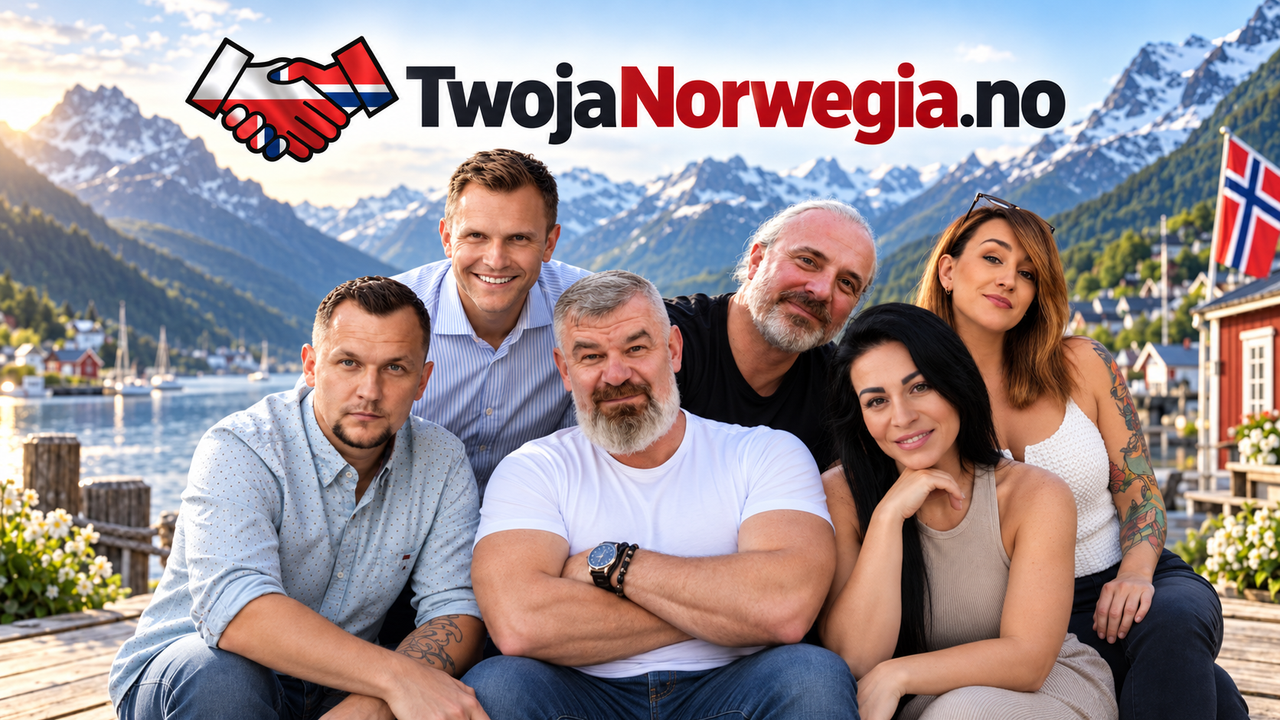
Who are we today as Poles living in Norway?
This question is much broader than it was a dozen years ago. We are no longer only people who came here to work for a few months. We work, run businesses, raise children, create schools, organizations and local communities. We buy houses, start families, build careers, help each other and increasingly have children for whom Norway is the place of birth or the only country they really remember.
At the same time we still have the Polish language, culture, family, experiences and our own perspective.
Your Norway was created precisely for this world.
Not as another portal collecting random news. Not as a place that exists only when someone has a problem with NAV or taxes.
This is meant to be a space about our life in Norway — about problems and solutions, work and entrepreneurship, schools, companies, relationships, successes, integration, hobbies, everyday life and people.
A portal created by the Polish community, but at the same time open so that Norway can also get to know us.
We have been here for years. And we are part of this country
Poles have for many years remained the largest group of immigrants in Norway. This is no longer a story solely about labor migration.
Behind the statistics are concrete people.
Mechanic.
Doctor.
Driver.
IT specialist.
Construction worker.
Teacher.
Entrepreneur.
Accountant.
Engineer.
Artist.
A parent taking their child in the morning to a Norwegian school, and on Saturdays to a Polish one.
Someone who has lived here for three months and someone who has lived here for twenty years.
There are also young adults who arrived in Norway as small children, and those who were already born here. Their question often is not: "Poland or Norway?". For many the answer is simply: both.
And their voice should also be present here.
A portal that does not show a Pole only when they have a problem
For years, Polish media in Norway have inevitably focused on practical matters.
How to get sick pay?
What to do after losing your job?
How to file taxes?
Can you drive a Polish car?
How to register a company?
What to do if an employer doesn't pay you?
This is still extremely important and will remain one of the foundations of Your Norway.
But the Polish community is not just a collection of bureaucratic issues.
We equally want to showcase people who have succeeded.
A Polish woman who founded a company.
A Polish man running a workshop.
Parents building a Polish school.
A person with an unusual hobby.
An organization that integrates the local community.
A young person raised in Norway who is starting their own path.
An artist.
A specialist.
An employee.
An entrepreneur.
Someone who has a problem.
And someone who has found a solution to the same problem and can pass it on.
Your Norway should show the whole picture.
The guide should lead you to a solution
From a technical standpoint, we have also very deliberately designed the way our guides are supposed to work.
If you type a question into Google because you have a specific problem, you probably don't need twenty minutes of general theory.
You need to know:
what to do, where to go, which document to prepare, which form to fill out and what will happen next.
That's why we rebuild our guides according to one simple rule:
problem → answer → next steps → the right agency → the right form.
If we write about NAV, we link directly to the appropriate NAV service.
If we write about Skatteetaten, the link leads to a specific procedure or form, not just to the agency's homepage.
If something needs to be reported to Statens vegvesen, we show exactly where.
Without leading the reader through five random pages.
And without the model:
“We have the answer, but first pay, and then we'll tell you.”
If we can clearly explain the procedure — we explain it.
Step by step.
Only where a lawyer, accountant, mechanic, advisor or another specialist is actually needed, we help find the right person.
This is a huge difference.
No time to read? Listen
The portal is also created with how we actually live in mind.
Not everyone has time to sit down in the evening and read a long article.
You're commuting to work.
You're stuck in traffic.
You're working at your computer.
You're cooking.
You're going for a walk.
That's why Your Norway articles can also be listened to.
You don't have to sit with your phone in your hand.
You play the material and listen.
Moreover, when a link to an article appears on Facebook or other social media, its preview also indicates that the material can be read or listened to.
And it does so in the language of the current version of the article.
Technology here should serve one purpose:
make access to information easier.
Not complicate it.
Five languages – because we don't want to speak only to ourselves
Your Norway currently operates in five languages:
Polish, Norwegian, English, Ukrainian and Russian.
This is not a cosmetic addition.
It is one of the most important parts of the entire project.
A Polish person should be able to find the answer in Polish.
But the story of a Polish entrepreneur should also be readable by a Norwegian customer.
Information about a Polish school may interest the municipality.
The story of a local organization may reach a Norwegian partner.
A company run by a Polish person does not have to be visible only to Polish customers.
And that is exactly why all language versions are part of one designed structure.
The same place.
The same company.
The same story.
But the language tailored to the audience.
This way we don't create another closed Polish bubble.
We are building a bridge.
Companies should be found, not just listed in a directory
We approached Polish companies operating in Norway the same way.
A simple business directory doesn't offer much today.
A list of hundreds of names without context does not solve the user's problem.
That's why a company's profile in Your Norway should answer simple questions:
what you do, where you operate, which languages you can be contacted in and how to find you?
Companies are linked to a location.
On the map you can see their position.
A pin leads to a specific place, and a company's identification can use its own logo, so the map is not an anonymous collection of points.
The user sees:
company,
location,
industry,
contact,
language,
offer.
And can immediately move on.
This solution is especially important outside the largest cities.
If someone lives in Drammen, Hokksund, Rjukan, Stavanger or Trondheim, they should not have to wade through companies from all over Norway.
They should find people where they actually need them.
A Polish entrepreneur should not be visible only in Polish
Here we return to multilingualism.
Imagine a Polish car repair shop.
A Polish customer types:
Polish mechanic in Norway.
But a Norwegian customer may search for the exact same company in Norwegian.
An English-speaking resident will search differently.
If a company exists only in the Polish part of the internet, a huge part of the market will never see it.
That is why business solutions in Your Norway are built so that an entrepreneur can be visible beyond their own language community.
It is precisely in such a place that technology and integration truly meet.
Not at a conference.
Not in a declaration.
Only when a Norwegian customer finds a Polish company and uses its services.
SEO is not a magic word for us
Your Norway has been designed so that content is not only published, but above all found.
This means working on the structure of topics, languages, linking, locality, company descriptions, articles and the relationships between them.
If someone today searches for information about dagpenger, and a month later about meldekort, both resources should be logically connected to each other.
If they read about a car from Poland, they should easily find the article on insurance.
If they discover a Polish school, they may later find its event, people, or another story.
The portal is not meant to be a collection of thousands of random subpages.
It should be a network of knowledge.
Additionally, a multilingual architecture allows search engines to understand that a given piece exists in different language versions, without accidentally mixing Polish content with Norwegian for the user.
These are things the reader does not need to see.
And that is exactly how it should be.
Good technology is often most valuable when the user does not even notice that it is working.
Your Norway should guide a person, not stop them
The simplest example:
someone loses their job.
They land on an article about dagpenger.
They find out whether they meet the eligibility criteria.
They receive a link to the registration.
They know they must send a meldekort.
They now need instructions for filling out the meldekort.
They move on to the next guide.
This is the user's natural path.
Similarly with a business.
You search for a mechanic.
You find them on the map.
You open the listing.
You check the language and the range of services.
You contact them.
The portal has done its job.
It's not about keeping a person on the site for ten minutes just because that is a marketing metric.
It's about the person, after those ten minutes, being closer to solving their problem.
This place is also for people who simply have something to say
Your Norway is not meant to be an editorial office closed to a few people.
Quite the opposite.
The editorial team is already growing and we want it to keep growing.
You don't have to have a degree in journalism.
You don't have to run a large organization.
You don't have to be an expert appearing on television.
You don't have to agree with Steve Jobs.
We are not interested in what your political preferences are, what your worldview is, or who you vote for.
Do you live in Norway? You are part of the Polish community.
Do you have a problem?
Describe it.
Have you found a solution?
Share it.
Do you run a business?
Show it.
Do you have a hobby?
Tell us about it.
Are you creating an organization?
Say why.
Is something making you angry?
Write.
Is something delighting you?
Write about that too.
Have you experienced misfortune?
Perhaps your story will warn others.
Have you achieved success?
Let's not hide it just because sometimes it's easier to talk about problems than about the fact that a Polish person has succeeded.
We want to show the whole of life
Because the life of the Polish community is not just NAV.
It is also:
work,
business,
love,
loneliness,
family,
children,
divorces,
school,
friendship,
passion,
sport,
culture,
problems,
successes,
failures,
integration.
Sometimes we'll talk about taxes.
Another day, with a mechanic.
Later with the principal of a Polish school.
And on another, about loneliness and relationships.
And that's exactly how this portal is supposed to look.
That's what life looks like.
The generation raised in Norway becomes especially important
The first large generation of children of Poles who arrived after 2004 is already grown up or is just entering adulthood.
This is an extremely interesting part of our story.
Some of these people came to Norway as young children.
Others were born here.
They speak Norwegian like Norwegians.
They heard Polish at home.
They went to Norwegian schools, some also to Polish Saturday schools.
Their friends are from different countries.
Their identity is often completely different from the identity of the parents who came here as adults.
We want to listen to them.
Not only write about them.
We want them to also start writing about themselves.
Polish schools, organizations and local integration
Equally important are the places where the Polish community really meets.
Polish schools.
Associations.
Clubs.
Events.
Organizations.
Local initiatives.
Parent meetings.
Sport.
Culture.
Integration does not start in an official document.
It starts when people get to know each other.
Sometimes during a big project.
And sometimes over coffee, when parents are waiting for children coming out of a Polish school.
We also want to show these small things.
Wataha.no goes broader. Your Norway remains our place
At the same time, Wataha.no is changing.
The portal will increasingly cover migrants and migration in Norway, regardless of nationality.
This is a natural direction.
Norway is not home to just one migrant group.
But that's precisely why the Polish community needs its own place.
Your Norway remains a portal focused on us.
On Poles.
On our activities.
On our problems.
On entrepreneurs.
On children.
On schools.
On organizations.
On life.
Radio Wataha can talk more broadly about migration.
Your Norway can show concretely:
who Poles are today in Norway.
Integration is not about stopping being Polish
This is very important.
Integration does not mean getting rid of your own language, culture or identity.
You can be Polish.
Speak Polish at home.
Have family in Poland.
Send a child to a Polish school.
Celebrate Polish traditions.
And at the same time be an active part of Norwegian society.
Work.
Run a business.
Pay taxes.
Talk to neighbors.
Act locally.
Raise children here.
Build a future here.
These are not two opposing worlds.
This is our life.
And we want Norway to be able to see this
That is why five languages are so important.
If the beautiful story of a Polish entrepreneur remains only in Polish, mainly Poles will read it.
If it also appears in Norwegian, its audience may be a customer, municipality, organization, employer or an ordinary resident of the same town.
Then integration begins to work both ways.
We get to know Norway.
And Norway begins to get to know us.
Your Norway is not to be a portal "about Poles"
We want it to be a portal of Poles in Norway.
That's a big difference.
We do not want to stand aside and describe a community to which we ourselves do not belong.
We live here.
We work.
We run businesses.
We raise children.
We know the advantages of this country.
We also know its problems.
We have gone through public offices ourselves.
We learned the system ourselves.
We made mistakes ourselves.
And that's precisely why one person's knowledge can help another.
Have a problem? Come with your problem
Perhaps someone knows the solution.
Do you have a solution?
Share it.
Do you run a business?
Show it to people.
Are you creating something interesting?
Let yourself be found.
Want to write?
Join the editorial team.
Are you organizing an event?
Tell us.
Do you want to show a success?
Show it.
Do you want to talk about something difficult?
There is also space for that here.
We are not building a catalog of perfect Poles.
We are building a picture of the true Polish diaspora.
With its successes and mistakes.
With joy and sadness.
With love and loneliness.
With strength and weakness.
Because it's time
It's time to stop viewing integration solely as the responsibility of the person who came to Norway.
Integration also starts with getting to know each other.
From visibility.
From conversation.
From people.
From showing:
who we are,
what we can do,
what we create,
what we struggle with
and what we can give to the place where we live.
Your Norway is meant to be a tool precisely for that.
An advice portal when you need answers.
An industry portal when you need a company.
A local portal when you are looking for people in your area.
For the Polish diaspora, when you want to know what is happening in our community.
For multilingual audiences, when we want to reach beyond our own bubble.
For the modern-minded, because information should be available the way people actually use it today.
You can read.
You can listen.
You can search.
You can find a company on the map.
You can follow step by step to a solution to a problem.
You can get to know a person.
You can become one of the authors yourself.
Your Norway does not belong to a single person.
The name actually says it all.
It is:
Your Norway.
Mine.
Magda's.
A mechanic from Hokksund.
A teacher from a Polish school.
An entrepreneur from Oslo.
A parent from Drammen.
A young Pole born in Bergen.
Someone who has just arrived.
And a person who has been here for twenty years.
Anyone who lives here and is part of our community.
We are the Polish diaspora.
We live in Norway.
We are part of Norway.
And it's high time to show it as it really is.
Your Norway is also your place
If you have a story, activity, problem, solution, company, hobby, school, organization or simply a topic that you think is worth talking about - get in touch.
You don't have to be a professional journalist.
The editorial team will help shape the material.
Call to action
Meet the editorial team of Your Norway
→ link to the Editorial team page
I want to co-create the portal
I run a business in Norway