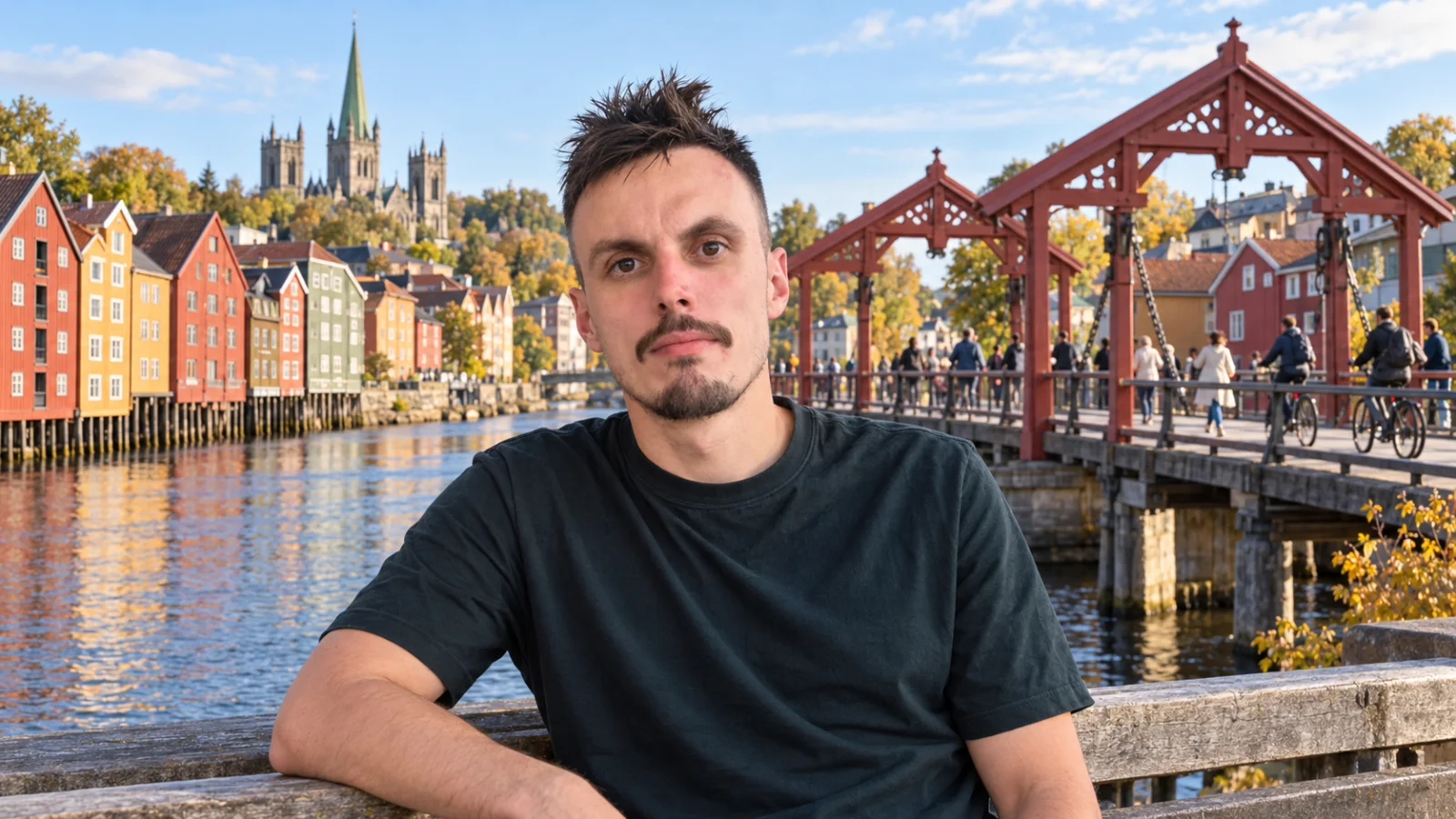
He came to Norway from Wrocław as an eleven-year-old. He grew up here, attended school, studied and took up work. Today Krystian Cuper shares his perspective on TikTok as NORSKOWO. Now he is joining the Wataha.no team to create with us materials about Norway that help understand everyday life and find your place in the local society.
The first conversation with Steve Joobs is an introduction of the new team member, but also a preview of the topics we will address on the pages of Twoja Norwegia.no, Wataha.no and Radio Wataha. From education and work, through contacts with institutions, to integration understood as participation in the life of the country in which we live.
From Wrocław to Trondheim. Norway from childhood
Krystian is 29 years old. In 2008 he moved from Wrocław to Trondheim and has lived in that city ever since. He was eleven then — old enough to remember Poland, but with almost his entire adolescence ahead of him in the Norwegian reality.
“I am 29 years old, I moved to Norway in 2008 from Wrocław and have lived in Trondheim since then.”
In Norway he experienced the successive stages of education. As he says, he attended the last two years of primary school, then a school corresponding to the former Polish lower secondary school, then explored vocational and general education paths. He also studied for three years.
“I did various things. Later I worked in different places.”
This experience allows him to view Norwegian life from several perspectives: child, teenager, pupil, student and worker. He currently works in a factory where he is involved in the production of packaging for the fish industry.
Asked about finding his way in the Norwegian system, he answers without hesitation:
“For me it is more natural in Norway than in Poland.”
And he adds a sentence that best describes his relationship with this country:
“Norway is my natural environment.”
NORSKOWO: from school experiences to social issues
The NORSKOWO on TikTok channel was created spontaneously. Krystian wanted to share knowledge and experiences, and found topics in everyday life, the news he read and his own observations.
“I wanted to share my knowledge, various experiences.”
He does not confine himself to one category. He talks about school and work, comments on politics, notices promotions in stores, and also takes up topics that spark discussion.
“I try to be open to everything, so here I do not limit myself to anything.”
Among the issues he raises are inequalities and situations he considers unjust — legally or systemically.
“I try to raise injustices or things that people do not hear about every day.”
This direct way of speaking caught the attention of Steve Joobs. The invitation to collaborate was a consequence of watching the channel and noticing its potential for conversations important to the Wataha.no audience.
“Looking at your channel on TikTok as a whole, I decided I must have you. I said, this has to be our Wataha.no, our group” — says Steve.
Experience matters. Facts require verification
The issue of practical knowledge returns repeatedly in the conversation. Krystian knows Norway through his own life, not solely through descriptions read on the internet.
Steve emphasizes the value of such a perspective:
“People who speak from practical experience are more valued because they themselves have gone through those paths.”
Krystian notes that his experiences sometimes meet with resistance because they do not fit other people's ideas of how the system should work.
“I myself know what I went through, I myself know what I saw.”
This perspective will be the starting point for our materials. Personal experience helps to perceive the problem and ask the right questions. Determining which regulations apply and what happened in a specific case also requires sources and documents.
Therefore in our publications we will juxtapose people's accounts with official information. For example, on work-related topics the reader will find links to Polish-language materials of the Norwegian Labour Inspectorate — Arbeidstilsynet. The institution provides information about contracts, working hours, vacations and the rights and obligations of employees. arbeidstilsynet.no
On benefits without lumping everyone together
The conversation also touches on social assistance and reactions to controversial statements. Krystian clearly distinguishes between using entitled support and situations in which someone takes money without entitlement.
“Besides, I don't reproach anyone.”
“Anyone can slip up.”
He explains that he's more interested in cases in which — in his opinion — the money does not belong to someone, yet is nevertheless taken. He does not point to a specific, documented case in this conversation.
This distinction matters for further materials. The mere fact of using benefits does not tell us why a person needs them or what possibilities they have to take up work. We will write about specific entitlements based on the rules concerning a given benefit.
Integration: feeling like part of society
For Krystian, integration is not only a topic to comment on. It is part of his biography. He grew up in Norway and says that Norwegians often perceive him as one of them.
“They see me as a Norwegian.”
This is not a declaration of citizenship, but a description of how he feels and how he is sometimes perceived in his surroundings.
Krystian also admits that he sometimes feels a greater distance toward a Polish person he meets than toward a Norwegian. It is a personal observation of a person whose daily environment has been shaped by Norway since childhood.
Steve steers the conversation toward the activity of the Polish community: presence in Norwegian social life, cultural events and using opportunities to influence the surroundings. Krystian wonders what may hinder such participation:
“Maybe because people lack self-confidence, [and] knowledge.”
This is an important question for our joint work: how to convey information so that the recipient knows where to go, what to check and how to take the first step?
Voting is one way to influence
In the conversation Steve utters a strong sentence:
“Anyone who does not go to vote has no right to complain, because they consent to it.”
Krystian replies:
“Yes, that is true, that is true.”
This is the interlocutors' opinion and an appeal for civic engagement. Abstaining from voting does not deprive one of the right to criticize, and before encouraging participation in elections it is necessary to explain who may take part in them.
In Norway the rules differ depending on the type of election. According to information from the Norwegian government on local elections, citizens of Poland may vote in elections to municipal councils and fylke authorities if they meet the age requirements and have been continuously registered as residents of Norway in Folkeregisteret for the last three years before election day. Being listed on the electoral roll is also required. The age requirement means turning 18 no later than the end of the election year. regjeringen.no
For parliamentary elections Norwegian citizenship is required. The general conditions also include age and current or previous registration as a resident of Norway. The rules are set out in the Norwegian Electoral Act — valgloven, § 2-1. Lovdata
For our readers this means a concrete topic to clarify: checking one’s own eligibility and possibilities to participate in elections, instead of assuming that every resident has identical voting rights.
Regulations and practice. We will ask, check and explain
Steve announces that the joint materials are intended to show what follows from the law and how the rules are applied in everyday life. Any discrepancies that appear will be described on the basis of specific cases, documents and responses from the relevant institutions.
Readers should be able to recognise what is a personal account, what is commentary, and what is confirmed information about the regulations.
Practical help may also include showing the appeals route. Sivilombudet explains the rules for filing complaints against public administration: as a rule you must first use the available appeal options within the administration and obtain a final decision. A complaint to Sivilombudet must be submitted within one year of the final decision. The institution itself decides which cases it will examine. Sivilombudet
Such information helps move from a feeling of helplessness to an understanding of what actions are available in a specific situation.
Guides, conversations and videos that help take action
Cooperation with Krystian will be developed around the experiences and needs of the audience. He himself does not yet declare one narrow specialization:
“I’m still not entirely convinced what people can actually expect from me in terms of help.”
At the same time he points to what he knows from everyday life:
“I know how to behave in Norway, how to speak.”
Steve defines the direction of the joint work:
“That we deliver this information in the form of guides, in the form of instructional videos.”
Plans include conversations about education, work, contact with institutions, everyday life and participation in Norwegian society. We want the materials to give audiences the knowledge needed to act independently.
“I do real integration and I do it for real” — Steve says.
Krystian accepts the invitation with enthusiasm:
“I am really very pleased.”
“I hope that together we’ll create great materials and that they’ll be really enjoyable to listen to and interesting.”
Krystian, welcome to Radio Wataha!
Radio Wataha, Wataha.no and Twoja Norwegia welcome Krystian Cuper to the team. He brings experience of growing up in Norway, knowledge of local everyday life and a readiness to talk about matters that are not always easy.
“I hope the next ones will be even more interesting, that we’ll cover really cool topics” — he says in conclusion.
Discover his perspective on Norway: visit NORSKOWO on TikTok and follow further materials on Twoja Norwegia and on Radio Wataha.
The piece was created based on a conversation between Steve Joobs and Krystian Cuper. Quotes come from the provided transcript; punctuation has been corrected and some repetitions omitted. Biographical information is based on the interviewee’s statements. Official sources regarding elections, work and complaints about the administration were checked on 13 October 2026.
Source of information
Conversation between Steve Joobs and Krystian Cuper — transcript provided to the editorial office; source of the biography, quotes and information about the collaboration.