
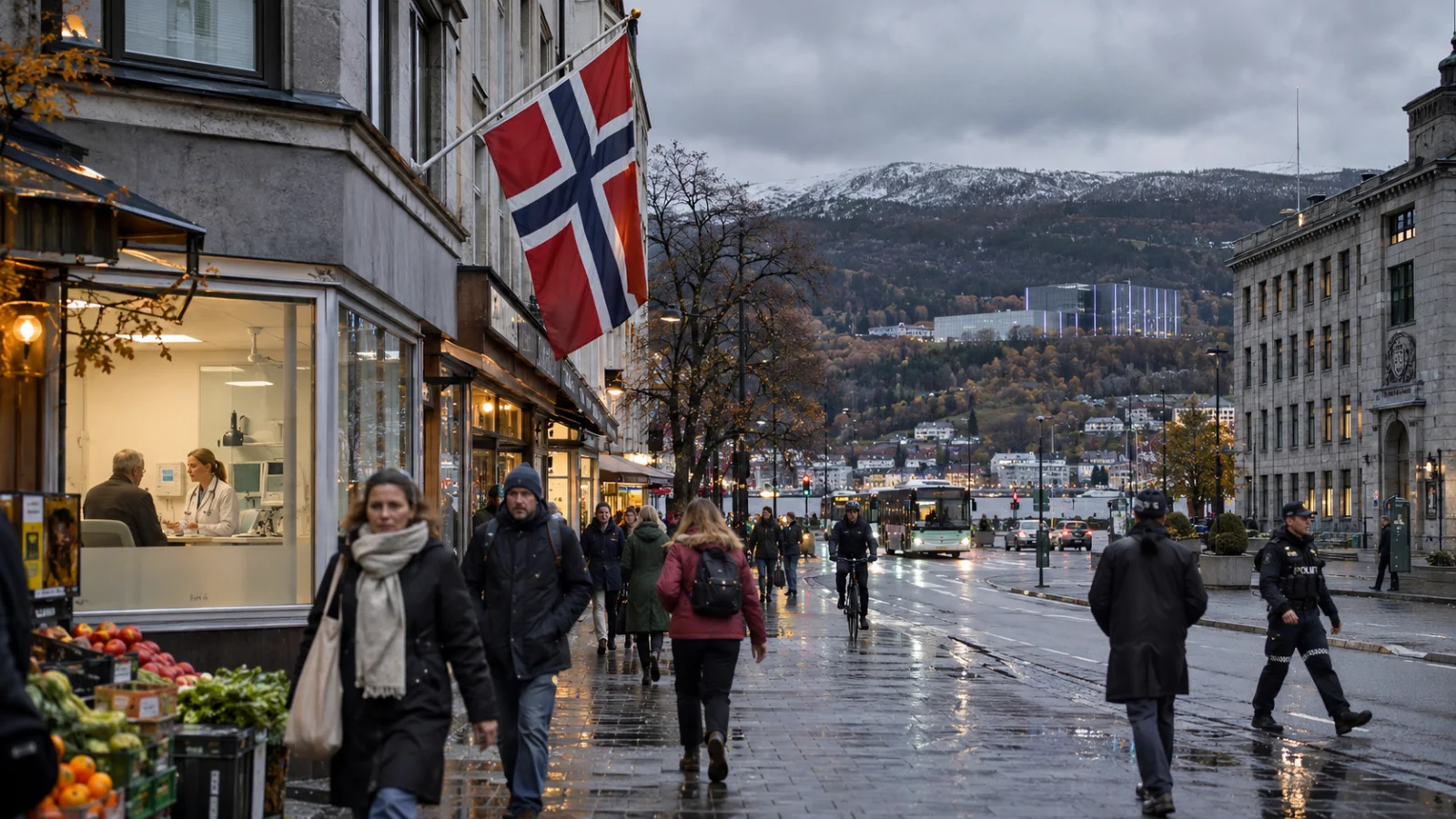
Norway is not slowing down. The past week brought news affecting both residents' everyday expenses and the country's long-term security. New inflation data, funding for family doctors, a dispute over power for data centers and closer cooperation among the Nordic countries show the challenges Norway faces today.
In the next edition of the series „Norway in 7 days” we present five events from the period 9–15 November 2026. We provide sources and explain what they mean for people living and working in Norway.
1. Prices are rising faster again. Inflation in Norway was 3.6 percent
On 10 November the Norwegian statistics office Statistisk sentralbyrå (SSB) published the latest inflation data. In October 2026 the prices of consumer goods and services were on average 3.6 percent higher than a year earlier. This is an acceleration from 3.4 percent in September.
Electricity prices were particularly significant. In October they fell much less than in the same period the previous year, which raised the annual inflation rate. Core inflation, calculated excluding energy and adjusted for tax changes, was 2.7 percent.
This does not mean that every product became 3.6 percent more expensive. Individual categories developed differently: housing, energy and fuels were 5.1 percent higher than a year earlier, transport by 5.4 percent, and food by 1.6 percent.
What does this mean for residents?
High inflation makes a quick return to lower interest rates more difficult. People repaying mortgages still have to reckon with high financing costs, and households should carefully scrutinize spending on energy, transport and insurance.
However, the inflation reading should not be equated with a decision to raise interest rates. Interest rate decisions are made by Norges Bank, which analyzes many economic factors.
Sources: SSB - Electricity prices pulled up price growth in October and E24 - Prices continue to rise.
2. Half a billion kroner for family doctors. Will it be easier to get an assigned GP?
On 15 November the Ministry of Health announced further measures to strengthen primary healthcare.
According to preliminary data, more than 270 Norwegian municipalities are to receive a total of about 500 million kroner from the ALIS program. The support is intended to help in the specialist training of more than 2,680 doctors.
The ALIS program allows doctors to gain a specialization in general medicine, and helps municipalities organize such training pathways.
This is particularly important for smaller towns, where access to a permanent family doctor is often more difficult than in large cities.
What does this mean for residents?
Strengthening the training of doctors may help improve the availability of primary care, but it does not automatically mean that from tomorrow all patients will receive their assigned GP.
The effects of the program will depend on the recruitment of doctors, completion of specialization and the situation in individual municipalities.
If you still do not have an assigned general practitioner or want to change one, check availability of places in the Helsenorge system.
Source: Ministry of Health - 500 million kroner to strengthen the general practitioner service.
3. Data centres under greater control. Norway must decide who to allocate energy to
On 9 November the government presented plans for the further development of Norwegian data centres.
Norway attracts digital investors thanks to access to power, a cool climate and developed infrastructure. However, data centres require enormous amounts of electrical power, and the capacity of the power grid is limited.
According to figures cited by the government, data centres already connected to the grid account for about 800 MW of power. A further 4200 MW are reserved, and projects with a demand of 9100 MW are in the queue.
The government announced work on a licensing system for data centres. It intends to assess their usefulness to society, energy needs, security and impact on economic development.
What does this mean for residents?
This is an important debate about the future of Norway. On one hand, investments can bring jobs, tax revenues and technological development. On the other hand, high energy consumption can limit the possibilities for expanding other industrial facilities.
For regions where large technological investments are planned, local benefits will be particularly important: the number of permanent jobs, use of waste heat, taxes and the burden on infrastructure.
New licences have not yet been introduced. The government has announced the start of work on the rules for such a system.
Source: Regjeringen - The government wants a controlled growth of socially beneficial data centres in Norway.
4. Norway and four Nordic countries want a new defence agreement
On 12 November, during a meeting of defence ministers in Oslo, it was announced that work has begun on a new defence agreement between Norway, Denmark, Finland, Sweden and Iceland.
The aim is to remove barriers that hinder joint military action and to increase the Nordic countries' ability to respond in the event of a threat.
The cooperation includes, among other things, operational planning, military exercises, logistics and movement of forces across national borders.
After Finland's and Sweden's accession to NATO, the possibilities for military cooperation in the region have increased significantly.
The initiative was also reported by Aftenposten and Reuters, and the news was conveyed by Norwegian VG.
What does this mean for residents?
Norway's security depends not only on its own armed forces but also on effective cooperation with neighbours.
The new initiative may mean more joint exercises in the future, investments in military infrastructure and closer defence coordination.
However, this is not information about the start of a war or the introduction of new obligations for residents. The countries have started work on an agreement, and have not signed a finished pact yet.
Sources: VG - The Nordic countries will create a new defence agreement and Ministry of Defence - Begins work on a Nordic defence agreement.
5. What will happen if GPS stops working? Norway strengthens preparations
On 11 November the Norwegian government announced the start of work to update the national strategy on positioning, navigation and timing.
Satellite navigation systems are used not only in phones and cars. They are also important for maritime transport, aviation, telecommunications and many technical services.
Signal interference can have consequences far broader than simply making it harder to use maps in a car.
The government wants to analyse how to reduce critical infrastructure's dependence on such systems and what contingency solutions should be in place in case of disruptions.
What does this mean for residents?
For ordinary phone users this is not an announcement of an imminent GPS shutdown. The aim is to increase the resilience of the entire country.
This is especially important for professional drivers, transport, fisheries, aviation and businesses that use precise location data.
Source: Regjeringen - The Government will make Norway less vulnerable to GPS failure.
Two things to watch in the week 16 - 22 November
1. COP31 climate summit - final talks in Turkey
The UN climate conference in Antalya will run until 20 November. Norwegian Minister of Climate and Environment Sigrun Aasland is participating in the final stage of the negotiations.
It is worth watching what commitments states will make and what the consequences will be for Norwegian energy policy.
Source - Norwegian Ministry of Climate and Environment.
2. 18 November - opening of a new quay in Mo i Rana
On Wednesday 18 November Minister of Fisheries and Oceans Marianne Sivertsen Næss will open a new deepwater quay at Langneset.
The investment is intended to improve navigation safety, increase the port's capacities and strengthen industrial development in the Helgeland region.
Source - official announcement of the minister's visit.
Editorial summary TwojaNorwegia.no
Norway faces several interconnected challenges today. Rising living costs affect households, the health system needs new doctors, and technological development is increasing demand for energy.
At the same time the state is strengthening defence cooperation and preparing for threats to critical infrastructure.
The common denominator of these events is simple: Norway is investing in the future, but must decide how to divide limited resources and ensure the safety of residents.
For people living here, the most important thing is to distinguish between what is already in force and what has only been announced. Therefore, in our weekly reviews we consistently separate facts, proposals and forecasts.
Compiled by: Steve Joobs, TwojaNorwegia.no / Radio Wataha.
The review covers events from 9-15 November 2026. Announcements concern the period 16-22 November 2026.