
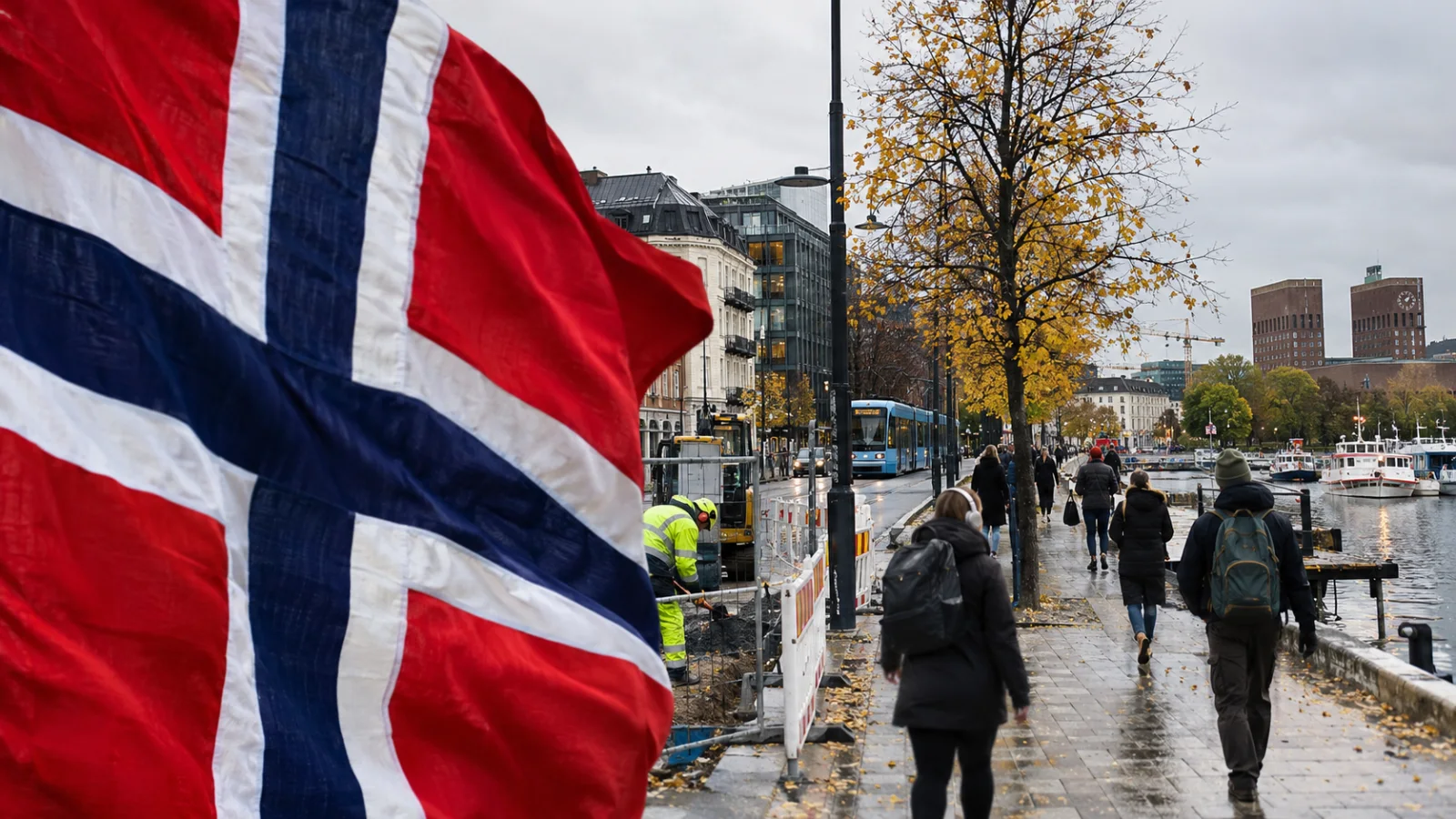
Norway found itself at the center of important diplomatic talks, warned citizens about a growing threat of cyberattacks, and presented new information regarding next year’s energy bills. At the same time, the government announced measures against abuses in labor immigration, changed the way housing projects are financed, and opened the way for new tourist fees.
The week from 26 October to 1 November 2026 showed that security, the economy and the everyday life of Norway's residents are more closely connected than might appear.
In the second edition of „Norway in 7 days” we select 12 events. We use materials from Norwegian newsrooms, including VG, Aftenposten and E24, and compare the most important findings with statements from public institutions.
1. Støre spoke with Putin. Norway found itself at the center of a diplomatic dispute
On 27 October Prime Minister Jonas Gahr Støre and President of Finland Alexander Stubb held a phone conversation from Helsinki with President of Russia Vladimir Putin.
It was the Norwegian prime minister's first direct contact with the Russian leader in more than four years.
According to the Norwegian government, the conversation was a continuation of the meeting on 20 October in Oslo and took place in coordination with Ukraine. Its topics were the possibilities of resuming negotiations to end the war and security in Europe.
VG reported that the conversation lasted about 90 minutes.
Not everyone welcomed this initiative.
Danish Prime Minister Mette Frederiksen expressed skepticism about the independent actions of Norway and Finland. The doubts concerned, among other things, the coordination of European diplomatic efforts and the intentions of the Russian leader.
Støre defended the decision to speak, arguing that Europe should have the opportunity to present its position directly.
The matter also provoked a dispute with the British newspaper „Financial Times”.
Why is this important?
Norway and Finland border Russia. For both countries, the course of the war in Ukraine has a direct impact on the security of Northern Europe.
The conversation with Putin did not signify a breakthrough or the conclusion of a peace agreement. However, it showed that Norway wants to participate in diplomacy at the highest level, even when this involves criticism from some allies.
Editorial sources:
Confirmation: Prime Minister's Office of Norway - official statement.
2. Norway announces a high level of cyberattack risk. Warning also for ordinary residents
On 27 October the Norwegian security service NSM announced that it had raised the national level of cyberattack risk to the category HØYT - high.
This is the second-highest level on the five-step scale.
NSM publicly released this assessment for the first time in the form of an open statement.
As VG reported, NSM representatives said there had been a threefold increase in the number of successful cyberattacks on Norwegian organizations in the previous six months.
On 29 October NSM and Direktoratet for samfunnssikkerhet og beredskap (DSB) also appealed to the public to prepare for possible consequences of cyberattacks targeting critical infrastructure.
What could happen?
In a serious attack scenario, disruptions could affect, among other things:
power supply,
mobile phone networks,
internet access,
water supply systems,
public services.
This does not mean that such disruptions are currently occurring across the entire country. NSM points to an increased threat and the need for appropriate preparedness.
Why is this important?
Norway is a country highly dependent on digital services. BankID, electronic payments, communication with government agencies and many health services operate primarily over the internet.
High convenience at the same time means the necessity to prepare for a situation in which digital systems stop functioning.
Residents should familiarize themselves with the official recommendations for household preparedness in emergency situations.
Editorial sources:
Primary sources:
3. Norgespris 2027: it is known when it will be possible to order a fixed energy price
On 29 October Minister of Energy Terje Aasland announced that ordering Norgespris for 2027 will start on 5 January 2027.
People who decide to join the program on that date will be able to benefit from billing applicable from 1 January.
According to E24 the government proposed for 2027 a price of 45 øre per kilowatt-hour before taxes and network fees.
It should not be confused with the total cost of energy on the bill.
Why is this important?
Norgespris is intended to provide households with predictability of energy costs.
However, the cost-effectiveness of the choice depends on the region, electricity consumption, future market prices and the rules of the program.
For some households a fixed price may be beneficial. In other cases a traditional contract and the support system may yield a better result.
What should you do?
Before making a decision you should compare your own historical energy consumption and the applicable terms of the scheme. It is also worth verifying the final price and the rules for 2027, because the budget proposal itself is not yet equivalent to a legally binding change of all the rules.
Editorial source: E24 - Norgespris order date and next year's rules.
Official sources: Government statement and NVE - Norgespris rules.
4. UDI reports abuses. The government wants to tighten control of labor immigration
On 30 October the government announced a change of approach to abuses related to the issuance of work permits.
According to UDI, false documents confirming education and fictitious job offers were uncovered, especially in procedures concerning skilled workers from countries outside the EEA.
The government wants to make it easier to reject applications associated with irregularities.
Why is this important?
Abuses also affect people who act lawfully, because they can contribute to longer processing times for applications.
However, this information should not be presented as a tightening of rules affecting all EU and EEA citizens.
This is also not the same as the issue of recognition of Polish professional qualifications by HK-dir, which we describe separately on TwojaNorwegia.no.
Source: Ministry of Labour and Integration - statement on abuses.
5. More money for housing projects. Husbanken changes priorities for the use of funds
On 30 October the government announced the reallocation of part of Husbanken's available loan pool to housing projects.
The reason is lower-than-expected demand from municipalities for startlån and increased demand for other types of financing.
The funds are intended to support the construction of apartments, including units intended for rental, and projects that improve the quality of the housing stock.
The government also assures that qualifying applications for startlån can still be processed at the end of the year.
Why is this important?
The Norwegian housing market needs increased availability of housing units.
The financial decision itself does not guarantee a drop in prices or rents. However, it can help in the implementation of further construction projects.
Source: Ministry of Local Government and Regional Development.
6. Water crisis in Kirkenes. Residents had to limit water consumption
In the last days of October, residents of Kirkenes and surrounding towns in Sør-Varanger faced serious problems with their water supply.
Following two failures in the water supply infrastructure, the municipal authorities urged residents to suspend private water use.
The situation was so serious that there were concerns about the depletion of reserves needed, among others, by care facilities and healthcare services.
The problems also affected the operation of the hospital in Kirkenes.
As VG reported, on the evening of 27 October the main water supplies were restored. At the time of publication of that statement, however, a recommendation to boil water remained in place.
Why is this important?
This story shows how quickly a failure of local infrastructure can turn into a problem affecting the whole community.
The municipal government emphasized the importance of cooperation between residents and technical services.
Important: information about the restrictions comes from 27 October. The current water situation should always be checked in municipal announcements.
Editorial source: VG - water crisis in Sør-Varanger.
7. New tourist fees? Tromsø, Vågan and Stranda have received approval for their plans
On 28 October, the government approved plans enabling Tromsø, Vågan and Stranda to introduce a fee for tourist overnight stays.
The besøksbidrag system is intended to finance part of the burdens arising from high tourist traffic.
The first collection of fees can begin no earlier than 1 January 2027.
Why is this important?
Norway's growing popularity attracts tourists and supports local businesses, but it also generates infrastructure costs.
The new fees can help municipalities finance some tourism-related needs, while at the same time raising accommodation costs.
This is not a uniform tax automatically covering every municipality in Norway.
Sources: Tromsø, Vågan and Stranda.
8. Norway will provide 500 million NOK to support Ukraine's energy sector
On 27 October Norway announced the allocation of a further 500 million kroner to support Ukraine's energy infrastructure ahead of winter.
The decision was announced during the visit of Energy Minister Terje Aasland to Kyiv.
The funds are intended to support repairs to damaged infrastructure and to ensure continuity of energy supplies.
An agreement on energy cooperation between the two countries was also signed.
Why is this important?
Energy security is a fundamental element of a functioning state. It concerns hospitals, transport, businesses and ordinary households.
For Norway, the cooperation also means the possibility of exchanging experiences related to the protection of critical infrastructure.
Source: Ministry of Energy - 500 mln NOK support.
9. Pensions in Norway to Be More Understandable
On 28 October the Norwegian government sent a draft strategy for improving pension information out for consultation.
The aim is to make it easier for residents to understand future benefits, entitlements and the consequences of decisions regarding the timing of starting to receive a pension.
Why is this important?
This is of particular interest to people who have worked in several countries.
The Norwegian pension from NAV, occupational pensions and rights accrued abroad are different elements that must be analysed taking into account specific rules.
The draft concerns pension information — it does not mean an automatic increase in benefits.
Source: Ministry of Labour and Integration - strategy for informing about pensions.
10. From 1 November new trade opportunities for Norway in South America
On 1 November a free trade agreement between Norway and Brazil and Uruguay entered into force as part of the agreements with the Mercosur countries.
The agreement aims to improve Norwegian companies' access to Latin American markets.
Why is this important?
Norway is closely linked to international trade. New agreements can improve export conditions and strengthen companies' competitiveness.
The scope of the facilitation depends on the type of product and the detailed provisions of the agreement.
Source: Ministry of Foreign Affairs - entry into force of the agreement.
11. The Norwegian krone is strengthening. Norges Bank announced the plan for foreign exchange operations for November
On 30 October Norges Bank announced the planned foreign exchange transactions for November.
According to E24 the central bank intends to sell a net 176 million NOK daily, maintaining the level from the previous two months.
The editorial team also noted a clear strengthening of the krone in 2026. At the end of October the euro cost about 10.30 NOK, and the Norwegian currency was its strongest in nearly four years.
Why is this important?
The krone exchange rate affects, among other things, the value of money sent to Poland, the prices of imported products and travel costs.
It should be remembered, however, that Norges Bank's transactions related to managing state revenues are not the same as foreign exchange interventions aimed directly at steering the exchange rate.
Editorial source: E24 - Norges Bank maintains the scale of krone sales.
12. World summit on nature protection. Norway participated in negotiations in Armenia
On 31 October a UN summit on biodiversity concluded in Armenia.
According to the Norwegian Ministry of Climate and Environment, an agreement has been reached on important issues related to implementing the global nature protection goals by 2030.
Norway, together with Zimbabwe, led negotiations on an international financing mechanism linked to the use of digital genetic information.
Why is this important?
The arrangements on nature protection can, in the longer term, affect agriculture, fisheries, industry and the way natural resources are managed.
The ultimate significance of the meeting will depend on how countries implement its provisions.
Source: Ministry of Climate and Environment - summit results.
Coming up: two important events in the week 2-8 November
1. 6 November: the future of Norwegian food to 2050
The expert group Matsystemutvalget is to present a report on the future of Norway’s food system.
The focus is on food security, sustainable production and the challenges facing the future of agriculture and the food industry.
Source: Government of Norway - preview of the report Matsystemet mot 2050.
2. 6 November: report on AI in higher education
The Malthe-Sørenssen committee is to deliver a report to the government on the use of artificial intelligence at Norwegian universities.
The document could become an important reference point in discussions about teaching methods, examinations and the role of technology in education.
Source: Ministry of Education - announcement of the report publication.
Norway in 7 days. More than a news roundup
Over the course of one week Norway conducted talks on ending the war, warned about threats to digital infrastructure, prepared changes to the labour market and made decisions affecting the economy.
These are events of varying scale. Some concern the whole country, others specific regions or groups of residents.
They have one thing in common: they show how Norway functions and what challenges society faces.
You do not need to read a dozen Norwegian newspapers every day to understand the most important events. However, you do need to know which information matters, what is an established fact, and what is still only a plan.
This is precisely what "Norway in 7 days" is for.
The next roundup is planned for Monday, 9 November 2026.
Editorial team TwojaNorwegia.no / Radio Wataha
Editorial compilation: 3 November 2026. Publications used: VG, Aftenposten, E24 and press releases from Norwegian public institutions. Source links are included directly with individual items.