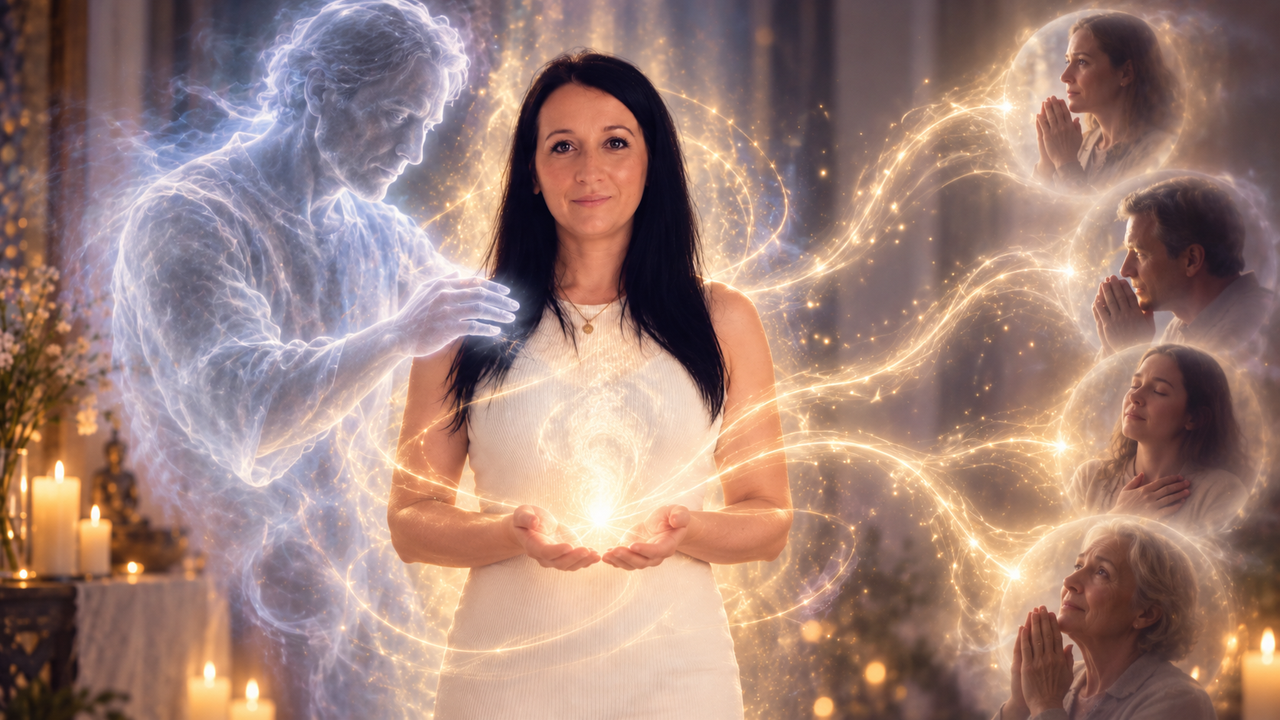
On YourNorway we want to show the entire Polish community. Also when the topic is not obvious
Poles in Norway work on construction sites, run companies, teach children, create culture, help others, develop passions and engage in things some of us may never have heard of before.
Not all stories can be fitted into a simple division of "I believe" or "I don't believe".
This is the case with Dominika, known as Domi, living in Sarpsborg.
Dominika describes herself as a person who experiences contact with the spiritual world. She speaks about seeing and feeling the presence of people whom others do not see.
One can believe that.
One can approach this skeptically.
One can also say: I don't know and I want to listen first.
And it is from such a place that we want to begin this conversation.
We do not intend to ridicule Dominika. We also do not intend to present contact with the deceased as a scientifically proven fact.
We want to do something much more interesting.
To get to know the person, her experience, and to confront it with what we actually know.
What exactly is a medium?
Simply put, a medium is a person who claims to be able to receive information or communicate with deceased persons or other immaterial beings.
The way of describing such experiences varies greatly.
One person talks about images.
Another about voices.
Someone describes sudden thoughts or information that, they claim, they did not have before.
Yet others talk primarily about a very strong sense of someone's presence.
Precisely for this reason, the most important question in studies on mediumship is not:
"Does this person really experience something?"
A much harder question is:
"Where does this experience or information come from?"
And here the dispute begins.
Science studies mediumship, but the answer is not unequivocal
Mediumship has indeed been and still is the subject of experiments.
Some studies were conducted under conditions in which the medium had no direct contact with the person awaiting the reading, and researchers tried to limit the possibility of obtaining information by ordinary means.
Some such experiments yielded results statistically above chance.
Meta-analysis including 18 experiments published between 2001 and 2019 showed an average result above chance level. The authors considered this consistent with the hypothesis that some mediums may obtain information in a way not explained by mechanisms known to them. See the study on PubMed
There are also studies conducted with multi-level blinding in which judges of readings more often assigned the correct material to the correct person than would be expected by chance. Example of a triple-blind study on PubMed
But that's only one part of the picture.
There are also studies in which mediumship failed the test
Controlled experiments also produced negative results.
In a study published in British Journal of Psychology the methodology employed did not provide confirmation of the actual mediumistic abilities of the people tested. Read the study description
Similarly, in a controlled study concerning so-called mediumistic writing, the judges were unable to distinguish messages intended for them from control materials in a way that would indicate access to an extraordinary source of information. Study on PubMed
And this is what should be said honestly:
contemporary science has not established that people can communicate with the dead.
There are studies with interesting results, there are negative results, and there is an ongoing discussion regarding methodology and interpretation of the data.
We currently do not have a widely accepted scientific mechanism that would explain real communication between people and the deceased.
But feeling the presence of the deceased is surprisingly common
Here the topic gets even more interesting.
Because one thing is a person who professionally identifies as a medium, and another is the experience of someone who, after the death of a close person, suddenly feels their presence.
Such experiences are well described in the scientific literature.
People after a loss say, among other things:
"I felt that someone was standing next to me,"
"It seemed to me that I heard her voice,"
"I saw him for a moment,"
"I smelled her scent,"
"I had a very vivid sense that she was in the room."
A large interdisciplinary review of studies reports that in the papers analyzed the occurrence of at least one such experience after a loss was estimated in some groups at 47 to 82 percent. The authors emphasize at the same time that the vast majority of such experiences are of a mild nature and should be assessed in the context of the person's history, the relationship with the deceased and the culture from which they come. Read the scientific review
Another review shows that what occurs particularly often is simply the feeling of the presence of the deceased, although people also describe visual, auditory, tactile and dream-related experiences.
This is important because it shows one thing:
An unusual experience should not be automatically ridiculed nor automatically treated as a symptom of illness.
Does this mean that the dead really come to us?
We don't know.
And that is probably the most honest answer that can currently be given.
Science can study:
what a person sees,
what a person hears,
how often such experiences occur,
in what situations they occur,
how they affect grief,
whether a medium conveys information more accurate than would be expected by chance.
It is much more difficult to demonstrate, what the source of the experience is.
For one person it will be a deceased family member.
For another, processes occurring in the brain.
For another, intuition or the subconscious.
Someone else will leave the question open.
Research also shows that the way such experiences are interpreted strongly depends on a person’s culture and beliefs. The same experience can be understood in one community as a natural contact with the deceased, and in another as an unusual psychological phenomenon. Read the cross-cultural analysis
So, can one believe a medium?
You can believe.
You can not believe.
But it is good to separate three things.
A person’s experience.
Dominika may genuinely experience images, presences or information that she interprets as contact with the dead.
An interpretation of that experience.
The statement “I feel someone's presence” describes the experience.
The statement “this particular deceased person is conveying a message to me” is already an interpretation of its source.
Evidence.
To recognize communication with the dead as an established scientific fact would require results that can be independently, repeatedly confirmed and an explanation that rules out more ordinary sources of information.
Science has not reached a consensus at that level.
And therefore the reader does not have to take a side before our interview.
They can simply listen.
Who might a meeting with a medium be meaningful for?
Most often interest in such contact appears in people who:
have lost someone close,
are looking for answers after the death of a family member,
are interested in spirituality,
have themselves experienced something difficult to explain,
want to check whether their own experiences are similar to the experiences of other people.
For some, such a meeting has primarily emotional or spiritual significance.
But this is exactly where responsibility comes in.
Grief makes a person particularly vulnerable
A person after the death of a partner, child, parent or friend may strongly desire one more conversation.
One sentence.
One confirmation:
“he is still somewhere”.
Such a person can be easily hurt.
Therefore one of the most important topics of our conversation with Dominika will be the limits of a medium’s responsibility.
Does she tell a person:
“it's definitely your mother”?
Or rather:
“this is how I perceive this information, but I could be mistaken”?
Does she accept every person?
What does she do when she sees a person immersed in very deep grief?
Has it happened that she said:
“I can't pick up anything”?
Should a medium admit to a mistake?
This is much more interesting to us than creating an atmosphere of mystery around her.
There are limits a medium should not cross
If someone says:
“the spirit told me that you should stop taking your medication”,
“don't go to the doctor”,
“you must leave your partner”,
“give me more money, because you are burdened by bad energy”,
then it ceases to be solely a conversation about spirituality.
We begin to talk about decisions concerning health, finances or someone else's life.
In Norway activity presented as health treatment outside the public healthcare system is subject to separate regulations regarding alternative treatment. The regulations are intended, among other things, to protect patients and consumers and set limits for people who are not authorized medical personnel. Information from the Norwegian Ministry of Health about alternative treatment
This does not automatically mean that every medium session is "alternative treatment". It depends on what exactly the person offers and how they present their service.
But one boundary should remain clear:
a medium does not replace a doctor, a psychologist, or professional help in a crisis.
Or can everything be explained by psychology?
We will ask Dominika that too.
Because there is a fundamental difference between the question:
"Does Dominika believe she is contacting the dead?"
and:
"Can we demonstrate that the information actually comes from deceased people?"
Therefore, during the interview a very simple question will be asked:
How do you know that what you see or feel comes from a deceased person, and not from your intuition, memory, subconscious, or observation of the person sitting in front of you?
This is not a question meant to ridicule anyone.
Quite the opposite.
If we take Dominika seriously, we can also ask her difficult questions.
We do not want to decide this for you
YourNorway is a portal for Poles living in Norway.
The Polish community is not one person with one worldview.
There are Catholics among us.
Atheists.
People who believe in life after death.
People interested in spirituality.
Skeptics.
And people who simply say:
I don't know.
Each of these people can read this text.
We don't have to agree with each other to talk to each other.
Therefore we will not write:
"Dominika proves that ghosts exist".
We will also not write:
"Dominika is making everything up".
We have no basis for either of these claims.
We can, however, say:
Dominika is a Polish woman living in Sarpsborg. She says she experiences something she interprets as contact with the dead. We want to find out what it looks like from her perspective and confront this story with the questions that many people ask themselves.
And these are exactly the things we will ask Dominika
When did the first such experience occur?
Was she a child or an adult?
Was she afraid of it?
Does she see a figure as she would see a living person?
Does she hear a voice?
Does she receive images?
Can she "turn off" such an experience?
Can any deceased person contact her?
Are there mistakes?
Can someone come to her with a specific question?
Does it happen that she receives no information at all?
How does she react to skeptics?
Has she ever wondered whether all of this could be produced by her own mind?
And most importantly:
what would you say to a person who is suffering greatly after the death of someone close and would do anything to hear that person once more?
This will be a conversation about mediumship.
But even more it will be a conversation about the human being, death, grief, faith, skepticism and our need to know whether everything truly ends with life.
Do you have a question for Dominika?
If you yourself have ever felt the presence of a deceased person, had an unusual dream, heard a voice or experienced something you still cannot explain, you can write about it under the article.
If you are a skeptic, you are also welcome.
You can ask Dominika directly.
And if the topic is personal and you do not want to give your name, you can join the conversation anonymously.
We are not looking for people who will all answer the same.
We are looking for a good conversation.
Editorial comment TwojaNorwegia
Showing the Polish community means for us showing it in all its diversity. Not only entrepreneurs, schools and organizations, but also people who have unusual experiences, views and interests.
Respect for a person does not require uncritical belief in everything they say. Skepticism also does not require ridicule. That is why we want to present Dominika's story precisely between these two extremes.
We will listen to her. We will ask difficult questions. And we will leave the judgment to the reader.
Information verified: September 21, 2026.
Sources
PubMed: meta-analysis of experimental studies on mediumship
PubMed: mediumship study using the triple-blind method
PubMed: controlled study of mediumistic writing with a negative result
PMC: cultural context of seeing, hearing and sensing the presence of the dead
Regjeringen.no: rules regarding alternative treatment in Norway