
Norway - Know Your Rights
Norway - Know Your Rights. Thanks to the "Know Your Rights" campaign, foreign workers in Norway were made aware of their rights and obligations. This helps them be less vulnerable to exploitation. The campaign focused on providing
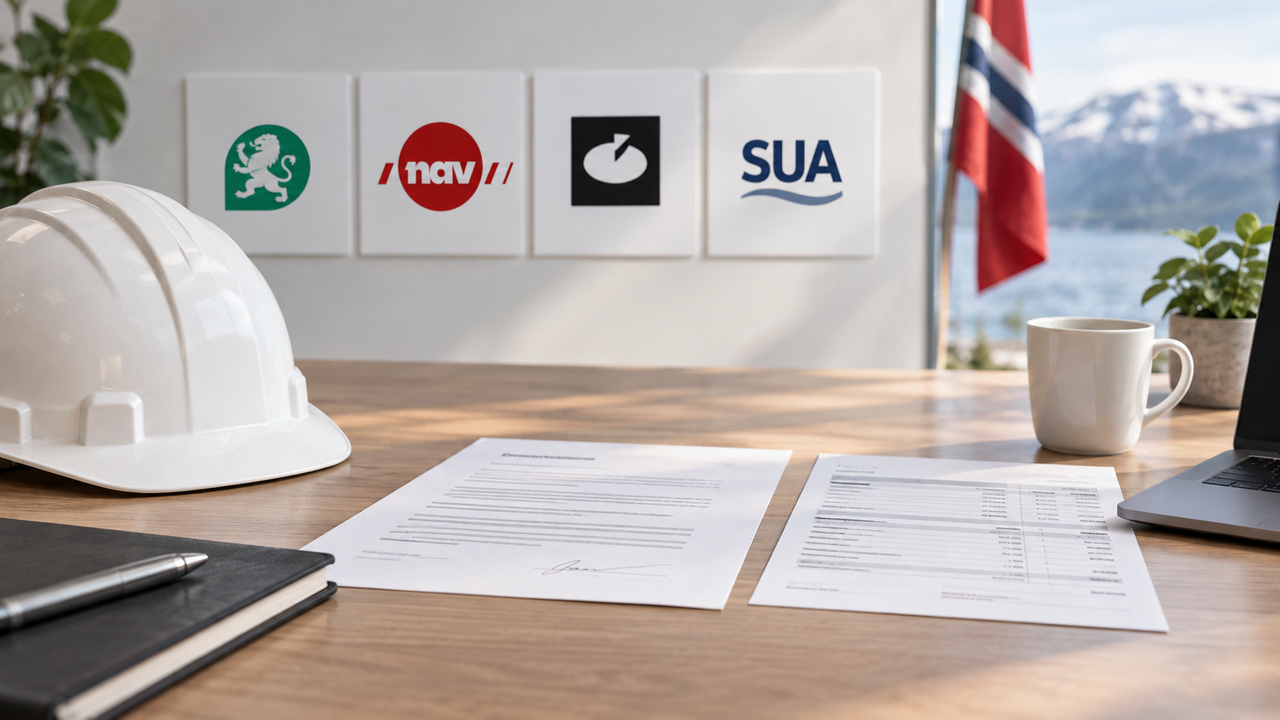
In brief
Every employee in Norway should have a written employment contract. For employment longer than one month, the contract should be ready no later than seven days after starting work. Norway does not have a single statutory minimum wage for everyone, but minimum rates currently apply in ten sectors. The employee should receive a lønnsslipp with information about pay and deductions. The basic limit for ordinary working hours is, as a rule, 9 hours per day and 40 hours within seven days. The statutory overtime supplement is at least 40%. The employee is entitled to a minimum of 25 working days of holiday according to the rules of the Ferieloven. The statutory minimum rate of feriepenger is 10.2%. In certain industries, an HMS-kort is mandatory. Irregularities can be reported to Arbeidstilsynet, also anonymously. Arbeidstilsynet also provides information about workers' rights in Polish.
Working in Norway does not mean you must know the entire Norwegian Labour Code. However, you should know, what employee rights in Norway protect you from the first day of employment. Lack of a contract, unpaid wages, unaccounted overtime or payroll deductions do not become legal just because the worker is a foreigner. The most important thing is to know what you can require, what to document and where to look for help.
The best starting point is the official guide of the Norwegian Labour Inspection Authority, also prepared in Polish, "Rights and obligations of the employee". Rights and obligations of the employee – Arbeidstilsynet in Polish
"Know Your Rights" showed why knowledge matters
The "Know Your Rights" campaign was launched by Arbeidstilsynet with foreign workers in mind, who often arrived in Norway without knowledge of the local labour law.
Over approximately two years the campaign reached with information in the recipients' languages more than 350,000 foreign workers.
In a survey conducted among the campaign's recipients, 80 percent of respondents indicated that the ability to receive information in their own language was an important reason for using the site. About one third of respondents, after reviewing the materials, discovered irregularities in their own working conditions, and 66 percent of that group stated that they had already taken or planned to take action to improve their situation.
This clearly shows that knowledge of employee rights is not theoretical.
Sometimes only after reading a few basic rules does a person realize that what they had considered for months to be the "company's normal rules" does not have to comply with Norwegian law.
You have the right to a written employment contract
In Norway every employee must have a written employment contract – arbeidsavtale.
This applies to work that is:
permanent,
temporary,
full-time,
part-time,
and even very short-term employment.
It is the employer who is responsible for preparing the contract.
If the employment is to last longer than a month, the contract should be ready as soon as possible, at the latest within seven days from the start of work.
If the employment lasts a month or less, the contract should already be ready on the day work starts.
You can find the full requirements for the contract in Polish on the Arbeidstilsynet website. Employment contract – Arbeidstilsynet in Polish
The contract should specify, among other things:
place of work,
position or scope of duties,
start date of employment,
whether the work is permanent or temporary,
working hours,
rules on breaks,
salary amount,
payment date,
allowances,
rules on leave and feriepenger,
probationary period, if applicable,
notice period.
If you do not understand something, ask before signing.
Signing a contract also does not mean that a provision that contradicts applicable law suddenly becomes legal. Arbeidstilsynet states directly that a contract cannot deprive an employee of rights arising from the regulations.
Is there a minimum wage in Norway?
Norway does not have a single statutory minimum wage for all workers.
Minimum rates do apply, however, in industries where the relevant provisions of collective agreements have been made generally applicable.
Currently the statutory minimum applies to ten sectors, among others:
construction,
cleaning,
hotels, gastronomy and catering,
agriculture and horticulture,
fish processing,
electricians,
freight transport,
tourist transport,
shipbuilding industry,
the automotive industry.
From 15 June 2026 the statutory minimum wage also applies in certain parts of the automotive industry.
Always check the current industries and rates directly with Arbeidstilsynet, as they may change. Current minimum wage rates – Arbeidstilsynet
Therefore the question:
“What is the minimum salary in Norway?”
There is no single answer.
First you need to determine which industry you work in.
After you are paid you should receive lønnsslipp
Pay is not just the amount that appears in your bank account.
Your employer should also give you a lønnsslipp, that is a payslip.
Among other things, you should find on it:
gross salary,
tax deducted,
other deductions,
net payment,
information regarding the basis for calculating feriepenger.
Arbeidstilsynet points out that an employee should receive such a document at the time of pay or directly in connection with it. If you do not receive it, you should ask your employer for it.
INTERNAL LINK
In the panel, select the fragment:
Lønnsslipp in Norway – how to read the Norwegian payslip
and use the “Internal link” function to our existing guide.
Do not enter the URL manually.
An employer cannot arbitrarily deduct money from a salary
This is a very important rule.
An employer cannot simply state:
“You damaged the equipment, so we will take 5000 NOK from your next pay.”
As a rule, deductions from salary or feriepenger are only possible when they have an appropriate basis, for example when they arise from the law, a collective agreement, or have been properly agreed in writing.
A general provision in the contract alone is also not always sufficient to carry out a specific deduction. Arbeidstilsynet describes additional requirements regarding consent to deductions and the protection of the employee's financial situation.
Full rules regarding pay, pay slips and deductions can be found here: Pay and deductions – Arbeidstilsynet
If you notice an unexplained deduction:
check your pay slip,
ask your employer for an explanation in writing,
check the contract,
keep the correspondence,
do not hastily sign a document confirming consent to a deduction that you do not understand.
How many hours can you work in Norway?
The basic statutory limits for ordinary working time are, as a rule:
9 hours within 24 hours,
40 hours within 7 days.
For some workers lower limits apply, e.g. for certain shift, night or rotational work.
The official rules regarding working time can be found at Arbeidstilsynet. Working time – employee rights
The employer is required to have a system for recording working time.
Therefore you should also keep your own simple record.
Record:
the date,
the starting time,
the finishing time,
breaks,
overtime.
If after a few months a dispute about pay arises, your own history of hours may prove very important.
Overtime is not free work
Not every hour beyond your contractual schedule is automatically statutory overtime.
However, if the work exceeds the statutory limits of ordinary working time and qualifies as overtime, the employee is entitled to an allowance of at least:
40 percent of the agreed hourly rate.
The employer and employee can agree in writing to take the overtime hours as time off, but the statutory supplement of at least 40 percent still must be paid.
Full rules, including overtime limits, can be found here: Overtime – Arbeidstilsynet
It is also important that overtime should not be a permanent operating model for a company. The law provides for it primarily in cases of special and time-limited need.
You have the right to breaks and rest
If you work longer than 5.5 hours, you are entitled to at least one break.
During an eight-hour workday, breaks should total at least 30 minutes.
As a rule, the employee is also entitled to:
a minimum of 11 hours of uninterrupted rest within 24 hours,
a minimum of 35 hours of uninterrupted rest within 7 days.
There are exceptions and special working time systems, so for rotational or shift work you must check the rules concerning the specific arrangement.
Holiday leave and holiday pay are not the same
Every employee is entitled to at least 25 working days of leave per year in accordance with the Norwegian Holiday Act.
In this system Saturday is counted as a working day, so the statutory 25 days usually corresponds to four weeks and one day's leave.
Detailed rules on leave are available in Polish: Annual leave – Arbeidstilsynet in Polish
Feriepenger is, on the other hand, a holiday pay benefit calculated from the wages earned in the previous year.
The minimum statutory rate is:
10.2 percent of the calculation basis.
In workplaces covered by an arrangement providing five weeks' holiday the rate very often applied is:
12 percent.
Employees over 60 years of age have additional entitlements.
Details about feriepenger can be found here: Holiday pay benefit – Arbeidstilsynet in Polish
A safe workplace is the employer's responsibility
The employer is responsible for ensuring that the work environment is safe and appropriate.
Among other things, they should:
assess hazards,
take measures to reduce risk,
provide appropriate training,
convey information in a way that is understandable to the employee.
Arbeidstilsynet states explicitly that the employee has the right to a proper working environment, and the employer is responsible for measures preventing work-related illnesses and injuries.
If you do not understand the safety instructions, it is not a reasonable solution to say:
“Sign it, and then someone will show you.”
For work that can affect health or life, understanding the instructions is an actual safety requirement.
HMS-kort – mandatory in some sectors
HMS-kort, that is the HSE card, is mandatory, among others, for workers performing work in:
construction,
cleaning,
manual car care,
tire replacement and storage,
certain transport of goods by passenger car or delivery van.
The obligation applies to both Norwegian and foreign workers. It is the employer's responsibility to provide the required card.
From 1 January 2026 the HMS-kort requirement was also extended to certain companies engaged in the transport of goods by light vehicles.
Always check the current rules here: HMS card – Arbeidstilsynet
Termination of employment must meet certain requirements
An employer cannot legally terminate an ordinary employment relationship by saying:
“Don't come to work from tomorrow.”
Termination by the employer must be in writing and meet certain formal requirements. The employee can also demand the reason for the termination in writing.
If you consider the termination to be incorrect, act quickly.
A request to negotiate with the employer must, as a rule, be submitted in writing within two weeks of receiving the notice.
Find details here: Dismissal from employment – Arbeidstilsynet
In cases concerning a specific dispute over a dismissal, it is advisable to contact a trade union or a lawyer as soon as possible.
Didn't receive your salary? Act immediately
If your salary, holiday pay or due remuneration have not appeared in your account, don't wait for months.
Arbeidstilsynet recommends first contacting the employer in writing as soon as possible, explaining the missing payment and agreeing a payment deadline.
If no agreement can be reached, it is worth requesting a written justification and considering legal assistance.
The official procedure is here: What to do when an employer does not pay – Arbeidstilsynet
Keep:
the employment contract,
payslip,
work schedule,
your own record of hours,
SMS messages,
emails,
bank transfer confirmations,
documentation regarding overtime.
It is also worth knowing that Arbeidstilsynet does not automatically recover every unpaid salary on behalf of an employee. Many such disputes are civil-law in nature and require pursuing a claim by other means. In certain situations, for example in industries covered by statutory minimum pay or in cases concerning due overtime allowances, the Inspectorate may have additional powers.
You can report irregularities
If regulations concerning safety, working time or other employer obligations are violated in the workplace, you can report the matter to Arbeidstilsynet.
For problems related to the working environment, it is usually recommended to first report the matter internally – to a supervisor, safety representative or a trade union representative.
If the problem is not resolved or the situation is serious, you can report it to Arbeidstilsynet.
The report can also be anonymous.
You can find the official form here: Report irregularities to Arbeidstilsynet
Where to get help in Polish?
Arbeidstilsynet also provides information about employee rights and obligations in Polish.
Phone number:
+47 73 19 97 00
Current opening hours and contact forms can be found on the Arbeidstilsynet website.
You can also use Servicesenter for utenlandske arbeidstakere – SUA, the Service Centre for Foreign Workers. SUA provides foreign workers with information about, among other things, labour rights and Norwegian formalities.
SUA – assistance for foreign workers
A foreign worker does not have 'fewer rights'
This is the most important conclusion of the entire guide.
A Polish worker should not receive worse conditions just because:
they do not know the language well,
they have just arrived in Norway,
they work on a rotational basis,
they are employed by a foreign employer,
they use company-provided accommodation.
A worker posted to Norway also has a wide range of rights under Norwegian regulations.
Lack of familiarity with the system is one of the reasons why foreign workers may be more vulnerable to abuse.
Therefore the basic rule is:
check, document and ask.
Check your working conditions in 10 minutes
Take your contract, your last payslip and your schedule.
Check:
Do you have a written contract?
Are the rate and amount of pay correct?
Do you receive a payslip?
Are all deductions explained?
Are actual working hours recorded?
Are overtime hours correctly accounted for?
Is holiday pay being calculated?
Do you have the required HMS card?
Is the workplace safe?
Do you know whom to report a problem to?
If the answer to any point is:
"I don't know"
— start with that one.
Also read on Your Norway
At this point in the panel use the "Internal link" function.
Link to:
Payslip in Norway – how to read the Norwegian payslip
and:
Occupational diseases in Norway
if the article has already been published in the appropriate language version.
Do not use manual URLs.
Editorial comment Your Norway
The greatest advantage of a dishonest employer is often not complicated law but the employee's lack of knowledge. The contract, pay, working hours, overtime and safety are not matters of employer goodwill — in many cases they stem directly from Norwegian regulations. If something is wrong, documentation and a quick response are usually much more effective than waiting for months.
Official sources and useful links
Arbeidstilsynet – Rights and obligations of the employee in Polish
The most important information about salary, contract, working time, overtime, leave, HMS and contact with the Inspectorate.
Open the official guide
Arbeidstilsynet – Employment contract
Requirements for a written employment contract and the deadlines for preparing it.
Employment contract in Polish
Arbeidstilsynet – Minimum wage
Current sectors and applicable minimum rates.
Check the minimum wage
Arbeidstilsynet – Wages and deductions
Payslip, payment, deductions and non-payment of wages.
Wages – official rules
Arbeidstilsynet – Overtime
Limits and a minimum supplement of 40 percent.
Overtime rules
Arbeidstilsynet – Annual leave
Leave rules available in Polish.
Annual leave
Arbeidstilsynet – Holiday pay
Rules on holiday pay, rates and settlement.
Holiday pay
Arbeidstilsynet – HSE card
Current industries required to hold the card.
HMS-kort
Arbeidstilsynet – Dismissal
Formal requirements, negotiations and deadlines.
Dismissal with notice
Arbeidstilsynet – Non-payment
Procedure to follow when an employer does not pay wages or holiday pay.
When your employer fails to pay
Arbeidstilsynet – Report irregularities
Form for reporting improper working conditions.
Report a health and safety issue
Information checked on: 14 September 2026.
Where to get it done
Sources
Was this article helpful to you?