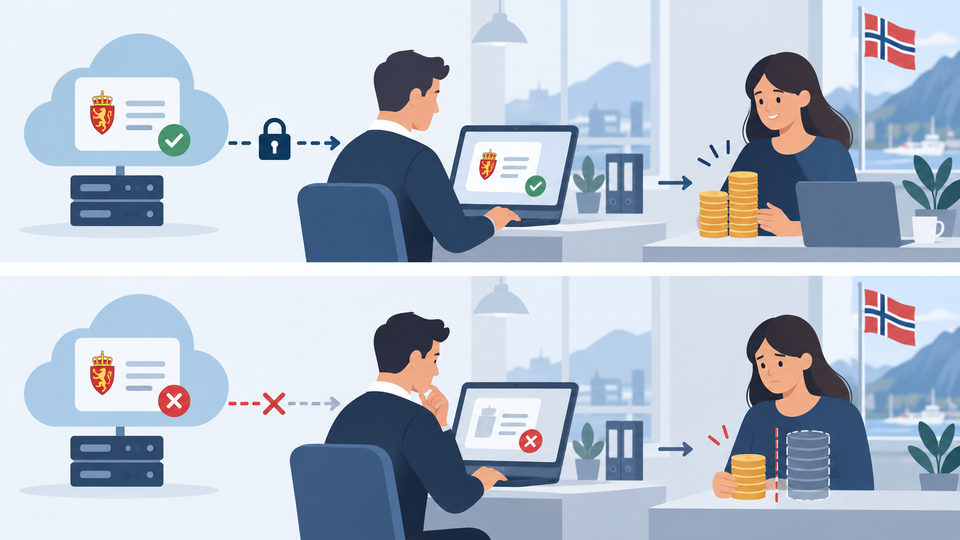
"Transfer 36 000 kroner to this account and the apartment is yours"
You have a contract.
The rent is 12 000 NOK.
The landlord says:
"The deposit is three months. Here is the account number."
36 000 kroner.
If you are new to Norway, it may seem to you that this is how a deposit works.
In Poland the money often goes to the landlord.
Here the system looks different.
And it's good to know it before you click "send transfer".
This money is still yours
The most important thing is to understand one thing.
The deposit is not an extra fee for the landlord.
It is still your money, just set aside as security in case of problems related to the tenancy.
For example:
unpaid rent,
damage to the apartment,
other claims arising from the contract.
Therefore the money should not simply end up in the account of the person renting out the apartment.
Norwegian regulations provide a special solution:
deposit account.
It is a blocked bank account opened in the name of the tenant.
Where should the money go?
To a separate deposit account.
Not to the landlord's ordinary account.
Not in cash.
Not to his company's account "because it will be easier".
Husleietvistutvalget states this very clearly: the security should be kept in a blocked account in the tenant's name. The landlord cannot demand payment in cash or to his own account.
If the landlord has just sent you a private account number, before you pay, read the official explanation:
Husleietvistutvalget — landlord wants the deposit on their own account
It's a few dozen seconds of reading that, for a larger deposit, could be worth tens of thousands of kroner.
How does it work in practice?
Let's assume:
rent: 15 000 NOK
deposit: 45 000 NOK
You sign the contract.
It is agreed that the security equals three months' rent.
Then a special bank account is opened.
The account is:
in your name,
but it is blocked.
You deposit 45 000 NOK into it.
During the tenancy neither you nor the landlord can simply go to the bank and take that money for yourselves.
And that's the point.
The money is not under the control of just one party to the dispute.
Who pays to open the account?
The landlord.
Not the tenant.
The law explicitly states that the cost of opening the deposit account is borne by the landlord.
So if you hear:
"Deposit 30 000 and an extra 700 kroner fee for the account"
stop.
The fee for opening this account should not be passed on to you.
Official explanation from Forbrukerrådet:
Forbrukerrådet — rules regarding the deposit
What is the maximum the landlord can demand?
The law allows the deposit to be set at a maximum equivalent to:
six months' rent.
If the rent is 14 000 NOK, the statutory upper limit is therefore 84 000 NOK.
However, that is the maximum.
That does not mean every landlord demands six months' rent.
In practice you will very often encounter a smaller security deposit.
The most important thing is what you agree in the contract.
Forbrukerrådet also points out that the arrangement concerning the deposit should be made when signing the rental agreement. The landlord should not sign an agreement with you without such security, and later suddenly say:
„I've reconsidered. By tomorrow pay three more months' rent as a deposit.”
What about interest?
The money sits in an account.
The account may generate interest.
As a rule, they belong to the tenant.
There is a special exception for student housing, where different arrangements may apply.
For ordinary apartment rentals, however, the most important rule is simple:
a deposit does not become the landlord's money just because it secures his interest.
„But the landlord says he always does it this way”
Maybe.
He may also say:
„I have five apartments and everyone transfers the deposit directly to me.”
That still does not change the rules.
You do not have to get into a conflict.
You can calmly respond:
„No problem with the deposit. I just want it to be paid into a standard deposit account.”
That's not a strange demand.
That is exactly the standard provided for in the regulations.
And if the landlord says: „I don't have time to open an account”?
That also should not shift the risk onto you.
You send three months' rent.
After a few months the landlord has financial problems.
Or a dispute arises between you.
Or he simply doesn't want to return the money.
If the funds are in his regular account, recovering them becomes your problem.
If they are properly secured in a deposit account, the mechanism is completely different.
That's why this is not a bureaucratic formality.
It's protection for your money.
What if you have already transferred the money to the landlord?
And here is the most important thing:
don't panic.
The fact that the transfer has already been made does not mean you have lost your rights.
If the deposit was paid in cash or directly into the landlord's account, Husleietvistutvalget treats it as an improper deposit.
The tenant can in such a situation demand a refund at any time. As a rule, there may also be a right to late payment interest calculated from the moment the payment was made.
Do you already have such a situation? Start here:
Husleietvistutvalget — what to do with an improper deposit
First ask the landlord to sort out the situation.
Preferably in writing.
Don't start with a fight.
Just write that you want the security deposit to be handled according to the rules.
„I'll give it back when you move out”
That's not the same.
The landlord may be honest.
He may indeed return every krone.
But the whole point of a deposit account is that security does not depend on whether someone later keeps their word.
What happens to the money when you move out?
If everything is in order, the matter is simple.
The tenancy ends.
The apartment is returned.
The rent is paid.
Both parties agree that the money can be released.
The bank releases the security deposit.
The problem arises when the landlord says:
“I disagree. I am keeping the security deposit.”
On a proper account he cannot simply take the money himself.
If after the end of the tenancy you want to recover the funds, you can contact the bank directly. The bank then notifies the landlord. If the landlord wants to keep the money because of a disputed claim, he must take the appropriate steps. In a typical situation he has five weeks from notifying the bank to document the initiation of the case.
Exact step-by-step procedure:
Husleietvistutvalget — landlord does not return the security deposit
This is a very important difference.
You do not have to wait for months for the landlord to “find time”.
You can start the formal procedure through the bank.
There is one important exception: unpaid rent
Here the procedure may look different.
If the landlord claims that you are behind on rent, the rules provide a special possibility to withdraw from the security deposit account, but only after certain conditions are met.
Among other things, the account to which you pay the rent and the security deposit account must be in the same bank, the parties must have the appropriate written agreement, and the landlord must document the claim. The bank is obliged to inform you about such a request.
If you disagree with this, do not ignore the letter from the bank.
In such a situation a deadline runs and you may need to take the matter further to stop the payout.
And what if the landlord claims that you destroyed the apartment?
This is where the photos from the day you moved in come back into play.
The landlord may have a claim for damages.
You may consider it normal wear and tear or that the damage existed earlier.
If you do not agree, money in a proper security deposit account does not automatically become the landlord’s property.
The dispute must be resolved.
That’s why in P0-09 we so strongly urged:
take photos when handing over the apartment.
Not for an album.
For yourself in two years.
What if you don’t have a deposit, but a guarantee?
That also exists.
Instead of depositing your own money, the parties can arrange a guarantee, for example provided by:
an insurance company,
NAV,
or another guarantor.
However, this is not the same as a security deposit account.
With a guarantee, someone else undertakes to secure certain claims of the landlord.
The law provides that the total value of the guarantee and any security deposit may not exceed the equivalent of six months’ rent.
Official explanation of the difference between a security deposit and a guarantee:
Husleietvistutvalget — depositum i gwarancja
If someone offers you a paid guarantee instead of a normal security deposit, read the terms carefully.
With a normal security deposit your money still sits in an account.
The fee for a commercial guarantee may work differently and does not have to be refunded later.
A simple test before sending money
The landlord asks you for 40 000 NOK.
Before you make the transfer, ask yourself four questions:
Is the security deposit recorded in the contract?
Are the funds going to a deposit account?
Is the account in my name?
Does the landlord cover the cost of opening it?
If the four answers are:
yes
then the mechanism looks as it should.
If you hear:
“transfer it to me, we’ll sort it out later”
you don’t have to hurry.
First sort out the account.
Then the money.
You paid the landlord and they won’t give it back?
Don’t stop at messages like:
“please return it”.
Keep:
the rental agreement,
the payment confirmation,
messages regarding the security deposit,
the landlord’s contact details,
all correspondence regarding the refund.
Next you can take the case to Husleietvistutvalget.
HTU states directly that if an incorrectly paid security deposit is not returned, the tenant can file a complaint.
Here you will find official information and the option to proceed:
Husleietvistutvalget — improper security deposit
You don’t need to know everything about housing law.
You need to know at what point to stop acting on someone’s word and start documenting everything.
The simplest rule to remember
If you should remember one sentence from this whole guide, let it be:
The security deposit should not be kept by the landlord. It should be secured in an account in the tenant’s name.
The rest is details.
But this one detail can decide whether, after the tenancy ends, you calmly recover 30–50 thousand kroner, or you will be trying to recover it from another person.