Before you buy a ticket: decide why you are going to Norway
Moving looks different if you already have a signed employment contract, different if you are still looking for work, and different again if you are coming with your family or want to start your own business.
This guide is prepared primarily for citizens of Poland and other EU/EEA countries.
As a citizen of Poland you do not need a work permit to work in Norway. However, if you want to stay here for longer than three months, you must meet the residence law requirements as, for example, a worker, entrepreneur, student or a person with sufficient means. EU/EEA citizens are also subject to the duty to register if staying longer than three months. udi.no
Non-EU/EEA nationals should first check their own residence rules with UDI, because the procedure may require a permit before starting work.
Check the residence rules for EU/EEA citizens at UDI
STEP 1. If you can, find a job before moving
You do not have to have a job to come to Norway as an EU/EEA citizen. A person coming to look for employment may stay in Norway for up to 6 months, but should report to the police no later than three months after arrival. udi.no
Financially, however, it is much safer to arrive with a concrete offer.
Do not base your move solely on the sentence:
„Come, we'll find you something”.
Ask for written confirmation of the terms of employment.
In Norway every employee has the right to a written employment contract, regardless of whether they work permanently, temporarily, full-time or part-time. The contract should specify, among other things, salary, working hours, method of payment, feriepenger and the duration of employment. Arbeidstilsynet
Check employee rights at Arbeidstilsynet
STEP 2. Prepare money for the start
The first paycheck will not arrive on the day you cross the border.
You should expect the following costs:
housing,
deposit,
food,
transport,
phone,
insurance,
and living expenses until the first paycheck.
Therefore arriving without any financial reserve is risky.
Starting with housing can be particularly expensive. The owner may require a deposit, but by law it should be placed in a separate deposit account in a bank in the name of the tenant, and not in the owner’s private account. The deposit cannot exceed six times the monthly rent. Forbrukerrådet
Check the rental and deposit rules at Forbrukerrådet
STEP 3. Take documents you may need
Before you leave, prepare at least:
a valid passport or national identity card,
an employment contract or job offer,
a rental agreement, if you already have one,
children’s birth certificates, if a family is moving,
a marriage certificate, if it may be needed for family matters,
documents regarding professional qualifications,
employment certificates and diplomas.
Not everyone will need all of these, but obtaining documents after moving often unnecessarily prolongs procedures.
STEP 4. After arrival you need skattekort
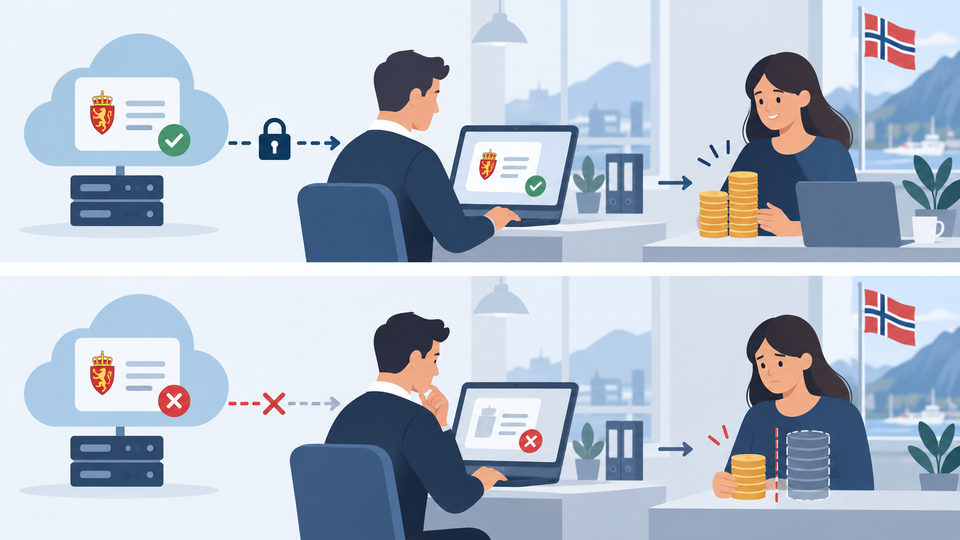
If you start working in Norway, you need a skattekort, that is an electronic tax card.
The employer retrieves it directly from the Skatteetaten system.
If you do not yet have a Norwegian identification number, you may be referred for an identity check when submitting the application. Skatteetaten may then grant you a D-nummer. Skatteetaten
Without skattekort the employer must as a rule withhold 50% of wages for tax until the card is issued. Skatteetaten
Apply for skattekort as a foreign worker
Here we link through an Internal link:
“Kildeskatt/PAYE 25% in Norway: when it’s simpler, and when you may overpay?”
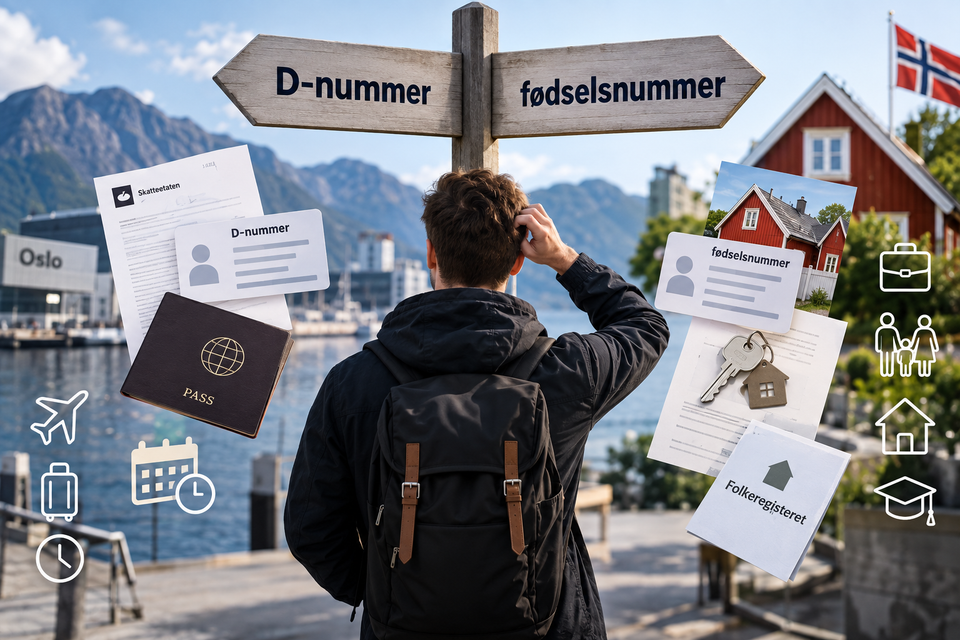
STEP 5. D-nummer or fødselsnummer?
This is not a choice you make.
Norway has two basic identification numbers for people who have a connection to the country.
D-nummer is often assigned to people who do not meet the conditions for receiving a fødselsnummer, e.g. who work in Norway for a shorter period.
Fødselsnummer is assigned to a person who is registered as living in Norway. If you plan to live here for at least 6 consecutive months, you should report your move to Folkeregisteret. After the registration is accepted you receive a fødselsnummer and the status resident. Skatteetaten
Internal link: “D-nummer or fødselsnummer: what is the difference and which number will you get?”
STEP 6. If you stay for at least 6 months, report your move
This is another thing that is often confused with registration at UDI.
Registration of an EU/EEA citizen and reporting a move to Folkeregisteret are not the same.
If you intend to live in Norway for at least six consecutive months, you report your move to Skatteetaten/Folkeregisteret.
A personal identity check and documentation showing that you will actually live in Norway for the required period may be needed. Skatteetaten
Internal link: "Folkeregister: when and how to report a move to Norway?"
STEP 7. Stay longer than 3 months – remember EU/EEA registration
A Polish national working and living in Norway for more than three months should register in accordance with EU/EEA rules.
Registration is free of charge.
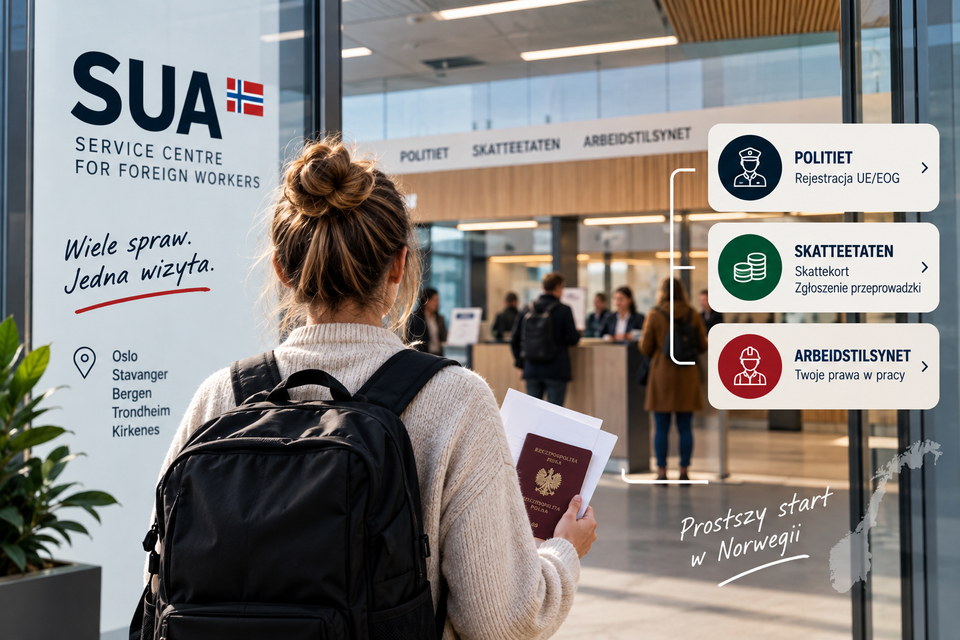
First you enter your details into the UDI system, then you schedule an appointment at the police or the relevant SUA – Service Centre for Foreign Workers and present the required documents. udi.no
After successful registration you receive a registration certificate.
Important: the certificate alone does not create the right of residence. The right arises from the fact that you actually meet the conditions, e.g. you work or run a business. udi.no
Check EU/EEA worker registration at UDI
STEP 8. Bank account and electronic login
A Norwegian identification number is needed for many public and private services, including banking. A D-nummer may suffice for some services, but individual banks set their own requirements for opening accounts and issuing electronic ID. Skatteetaten
Therefore, do not assume:
"I'll arrive in the morning and have BankID by the afternoon."
In the first weeks the process may require some patience.
BankID later makes it much easier to use NAV, Skatteetaten, Helsenorge, banks and other services.
STEP 9. Employment also means entering the Norwegian insurance system
A citizen of an EU/EEA country taking up legal employment in Norway essentially becomes a member of the National Insurance Scheme from the first day of employment.
You do not need to be a citizen of Norway or previously hold resident status in Folkeregisteret. nav.no
However, there are exceptions, e.g. for some posted workers from another EEA country.
This membership later matters for NAV benefits, healthcare and accruing pension rights.
STEP 10. Check your doctor and Helsenorge
After sorting out registration, it is worth logging in to Helsenorge and checking your situation regarding fastlege, i.e. your general practitioner.
The fastlege system is managed by the municipality. In some municipalities there are queues for specific doctors, so you may not always get your chosen doctor immediately. Helsenorge
Check information about fastlege on Helsenorge
If you are coming with children
Do not leave these formalities until the last moment.
After you have determined your place of residence you need to check, among other things:
school or kindergarten,
Folkeregisteret,
fastlege,
child benefit,
and any family rights arising from the EEA rules.
Internal link: “Child benefit in Norway – how much is the child benefit and how to get it”
And if you are still looking for a job?
You do not need to carry out all procedures in the same way as a person who arrives with a signed contract.
An EU/EEA citizen can come to Norway to look for work for up to 6 months. After three months, however, they must register with the police as a job seeker. udi.no
When you obtain employment, you switch to registration as an EU/EEA worker.
First 30 days – in what order?
It is simplest to think about it like this:
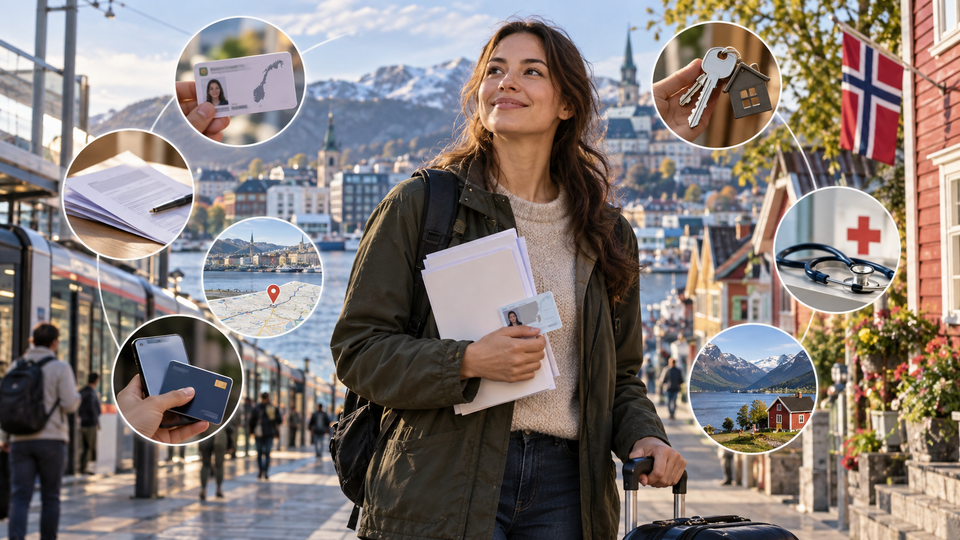
work or a realistic plan to find it → housing → identity document → arrival → skattekort and identification number → EU/EEA registration → Folkeregisteret after a minimum stay of 6 months → bank account → health system → further family and official matters.
Do not try to do everything in one day.
Some processes depend on others.
The most important thing is to establish the correct order.
Here it is worth linking the guide as the main follow-up via the Internal link:
“First 30 days in Norway”
The biggest mistake? Arriving without a plan and assuming “it will somehow work out”
Norway offers many opportunities, but the start costs money and requires formalities.
The safest start is to:
have a job or a realistic plan to find one,
have money for the first weeks,
know where you will live,
have all the documents,
and know which formalities to complete first.
You can learn the rest once you are here.
You do not need to know the entire Norwegian system before crossing the border.
You only need to know what the next step is.
Information verified: 26 September 2026.