The same car, different settlement rules
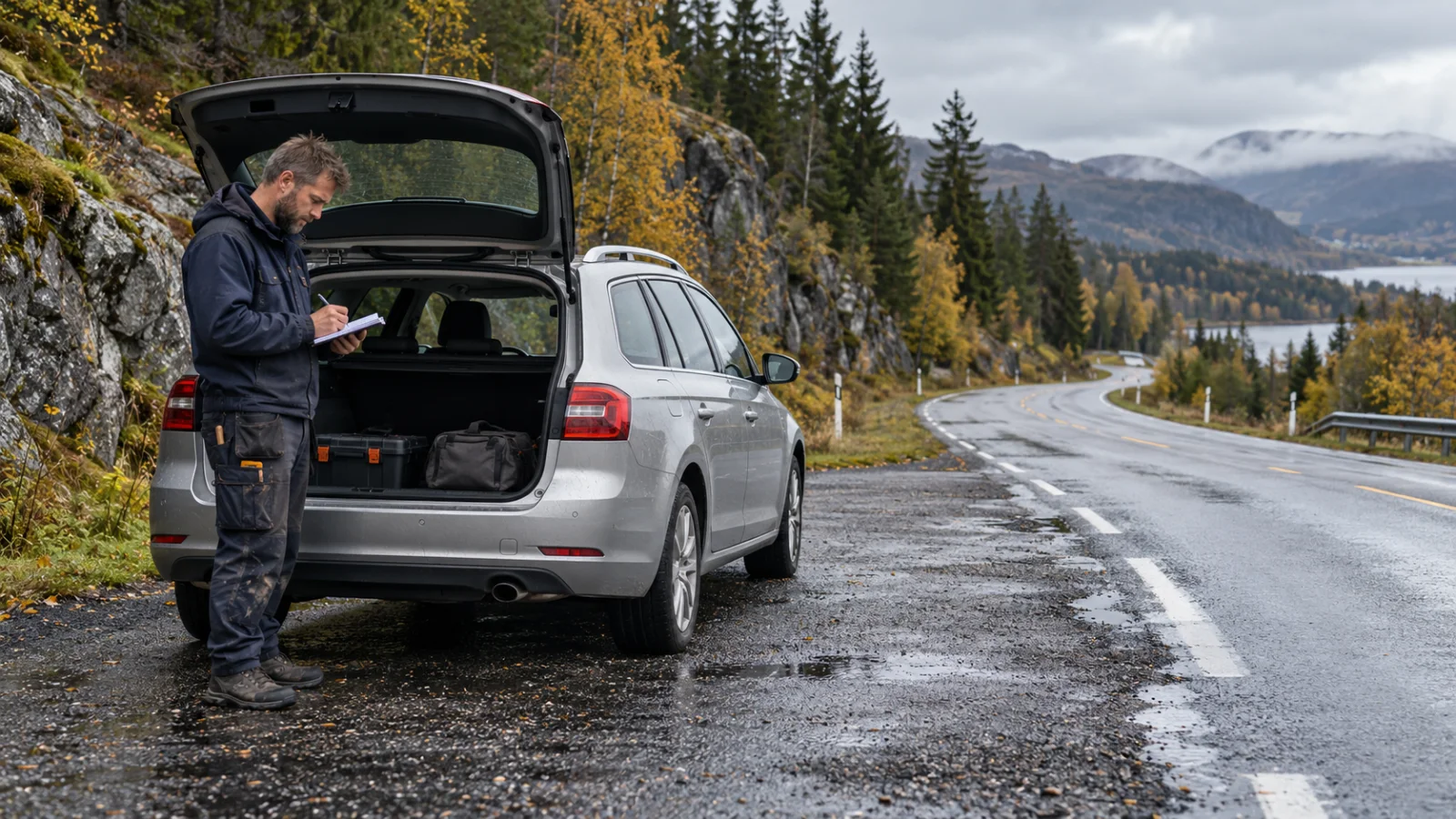
In the morning you drive to a client, later to pick up materials, and in the evening to shop for the family. You do all the trips with the same car, but they do not all have the same tax implications.
In an ENK the method of accounting for the car depends on its actual use, mileage and type of vehicle. You cannot freely choose between the per-kilometre allowance and full cost accounting just because one option looks more favourable. Own car in business (yrkesbil)
Before you record the first expense, determine how you use the car and which trips actually relate to the business.
Step 1. Separate business trips from private ones
In Norwegian regulations it is important to distinguish:
yrkesreise - business trip;
arbeidsreise - commute between home and a permanent workplace;
private trip.
The commute from home to a permanent workplace is, as a rule, treated as private use when accounting for a company car. The mere fact that you are driving “to work” does not make the route a business trip of the enterprise. Skatteetaten
A client’s location can in certain circumstances also become a permanent workplace. The actual conditions and the regularity of performing duties there are significant. The Norwegian Tax Administration
In practice: record the purpose of the trip. “Meeting regarding the assignment…” gives more information than simply “business drive”.
Step 2. Check which model the car falls under
For a car used both privately and professionally, Skatteetaten indicates two basic models:
Usage Principal method of accounting: Below 6 000 km for business per year, without meeting other conditions for a company car — deduction according to the per-kilometre rate. At least 6 000 km for business per year or more than half of total use in the activity — essentially yrkesbil/næringsbil, recorded in the accounts. Exclusively business trips, without private use — Yrkesbil regardless of mileage
The 6 000 km threshold applies to business driving, not to the total odometer reading. A car used exclusively for business cannot at the same time be used for ordinary commutes between home and a permanent workplace. Skatteetaten
In unusual situations, a change in the way the car is used, or a one-off exceedance of mileage, check the detailed rules before changing the accounting method.
Step 3. For a private car, calculate the deduction for trips
If the car qualifies for the private car used in business model, the rate published by Skatteetaten for the deduction is 3,50 NOK per business kilometer. Skatteetaten
Example - we assume the car meets the conditions of this model:
ItemValueDocumented business trips2 000 kmRate3,50 NOK/kmCalculated cost deduction7 000 NOK
This is a cost deduction, not a refund of 7 000 NOK from the tax authority. The effect on tax depends on the overall settlement.
With this model you do not add ordinary car maintenance costs such as fuel, insurance or servicing twice. Do not combine the mileage allowance with a full accounting of the same costs. Own car in business (work vehicle)
Step 4. Keep a driving log
Driving log is a record of trips.
Skatteetaten points out that the documentation of business driving should contain the date, the route from–to, the purpose and the number of kilometers. Skatteetaten
Example of an entry:
DateRoutePurposeKilometers18.10.2026Workshop → client → workshopMeasurement before order fulfillment42
This is only an example of the format. The entry itself does not determine whether a specific route qualifies as business.
It is also worth recording the mileage at the beginning and end of the year and the vehicle identification. This will make it easier to compare business driving with total usage.
Do not reconstruct all routes from memory only when filing your tax return.
Step 5. For a work vehicle, account for costs and private use
If the car is treated as a work vehicle/commercial vehicle, you basically account for the actual costs of its upkeep, including appropriate depreciation.
If you also use it privately, a correction - reversal - related to the value of private use is required. This does not automatically mean a simple division of all expenses according to the percentage of kilometers. Skatteetaten
In practice, prepare:
the purchase or lease document;
vehicle data and classification;
cost documentation;
business and total mileage;
information on private use.
Do not assume that "the car is in the company", so every family trip is automatically without tax significance.
Varebil klasse 2: check separate rules
For varebil klasse 2, when there is a professional need for such a vehicle, special rules for determining private use are available.
One method is based on actual private kilometres and requires an electronic driving logbook. Another uses flat-rate rules. Own car in business (professional vehicle)
Do not automatically apply these rules to an ordinary passenger car. Check the vehicle category in the documents and the conditions of the specific accounting method.
Step 6. Separate income tax from VAT
A car can be used in the company, and yet the VAT deduction may be limited.
As a general rule, deduction of charged VAT is not allowed for the purchase, leasing, maintenance and use of passenger vehicles, which also includes varebil klasse 1. There are special exceptions, among others depending on the type of activity. Skatteetaten
Therefore separate two questions:
Do I, and how do I, account for the car's cost for income tax purposes?
Do I have the right to deduct VAT from this purchase?
An invoice billed to the company does not automatically provide the answer to either.
More: Company expenses in Norway: what can really be deducted?.
ENK and an employee's car are different situations
Do not copy without checking the rules applied by the employer who pays the employee mileage allowance.
In this guide we describe the accounting of the ENK owner. A vehicle made available to an employee, a private car of the employee, and an ENK owner's vehicle may be subject to different rules. Altinn explicitly refers the self-employed to the rules for yrkesbil, distinguishing them from the employee company car. Company car
What to do now?
Collect data about one car:
the vehicle category;
method of acquisition or leasing;
business and total mileage;
types of routes;
private use;
available documents.
On this basis, check the appropriate model. Only then determine the accounting method.
The most important starting point: correct recognition of trips and documentation, not choosing the largest possible deduction.
Information verified: 18.10.2026.