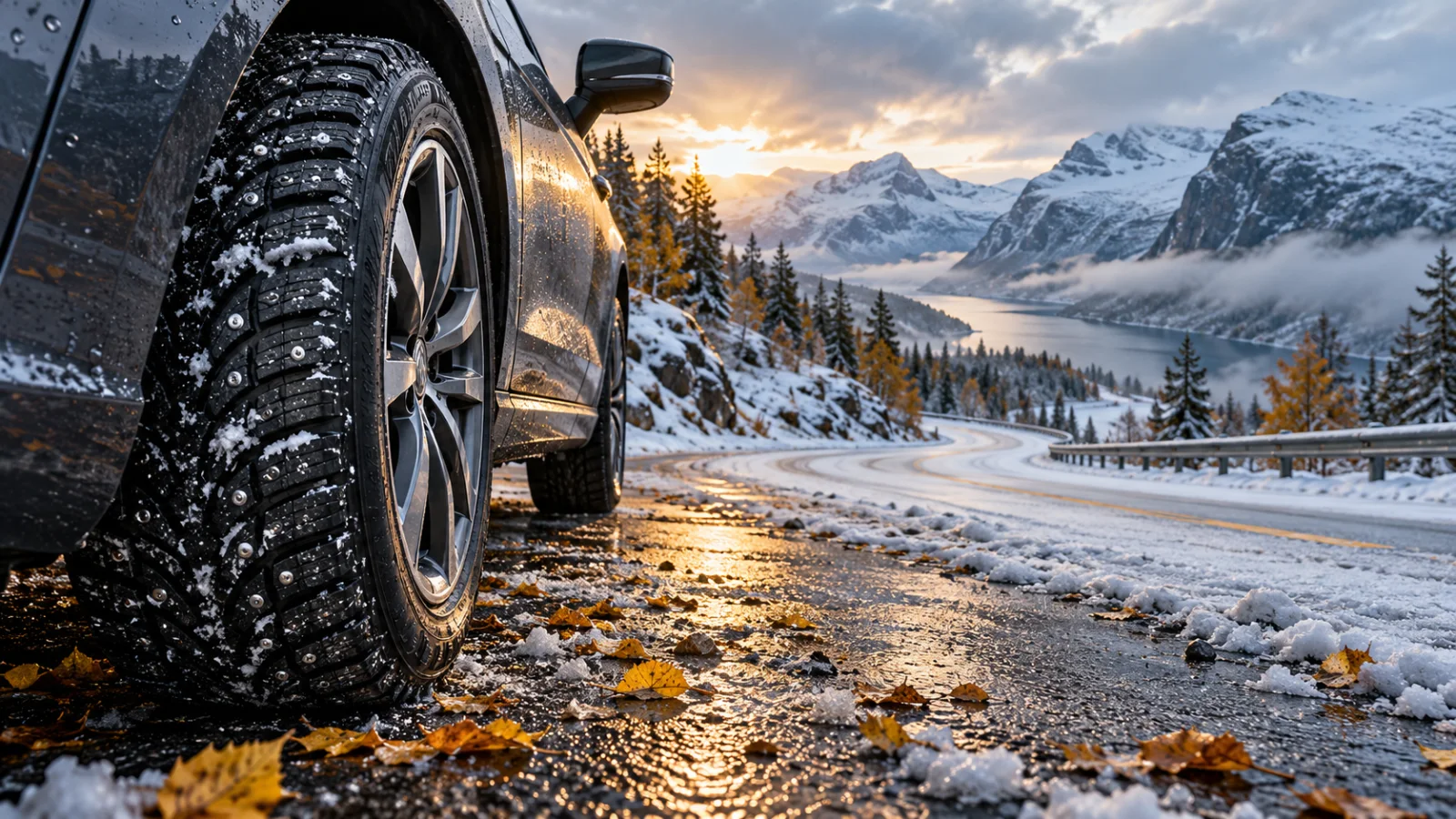
When do you have to change to winter tires in Norway?
Tires must be adapted to the conditions, not solely to the date on the calendar. For passenger cars there is no single date that requires everyone to fit winter tires regardless of the weather. However, the driver must ensure adequate grip throughout the year.
If snow or ice appears on the road, summer tires do not provide proper readiness for driving. You cannot justify driving by saying “it is not November yet.”
The rules are explained by Statens vegvesen — requirements regarding tires. The legal basis is the regulation on the use of vehicles, § 1-4. www.vegvesen.no
Don’t wait for the first snow
Plan the timing of the change based on forecasts and your daily routes. Consider morning frosts, returning at night, uphill drives and passages through higher-altitude areas.
Prepare your wheels earlier. If you only discover a worn tread or tire damage on the day it snows, there will be much less time to find a safe solution.
This guide applies primarily to passenger cars and light vehicles up to 3.5 t permissible total weight.
When can studded tires be used?
Studded tires, that is piggdekk, have a defined basic period of use.
Area: Standard period for using studs. Most of Norway: From 1 November to the first Sunday after Easter Monday, inclusive. Nordland, Troms and Finnmark: From 16 October to 30 April, inclusive
In the 2026/2027 season this means:
most of the country: 1 November 2026 - 4 April 2027;
Nordland, Troms and Finnmark: 16 October 2026 - 30 April 2027.
If conditions require it, studs may also be used outside these dates. The exception serves to ensure grip, not to arbitrarily extend the season.
In a passenger car using studs, all wheels must have them. Studless winter tires are not subject to these date restrictions, but being usable all year does not mean they are a good choice for summer.
Check the official rules for using studs. The 2026/2027 season dates for Oslo are confirmed by the Oslo kommune page. www.vegvesen.no
Tread: the legal minimum is not a safety reserve
During the statutory winter period a minimum of 3 mm tread is required. In the north this period runs from 16 October to 30 April; in the rest of the country from 1 November to the first Sunday after Easter Monday.
NAF recommends at least 4 mm for winter. A tire that is just above the permissible limit does not provide much allowance for wear over the coming months.
Measure the tread on all tires, in several places. Also check:
uneven wear;
cracks and bulges;
sidewall damage;
the condition of studs;
age and condition of the rubber.
A tire can have sufficiently deep grooves and still perform worse on winter surfaces due to rubber aging. Low mileage is not a guarantee of good condition.
Practical tips can be found in the NAF guide on tread, age and choosing tires. www.naf.no
Studded or studless winter tires? Choose for your route
Start with the question: what type of surface will I drive on most often and which will be the most difficult section of my route?
Operating conditions What to particularly compare Icy climbs and frequent driving on ice Braking and handling on ice City and regularly cleared roads Behavior on wet asphalt, snow and ice Mountain roads and changing conditions Performance on the most difficult sections, not just near home Trips abroad Traction and the regulations of each country traveled through
NAF points out the differences between studless winter tires intended for the Nordic climate and those for the Central European climate. The mere label “winter” does not mean identical performance on Norwegian roads.
Before buying, check the the NAF/Motor 2026 winter tire test. Compare braking and handling results on specific surfaces, not just the final ranking. Part of the compilation may require membership.
Pay attention to the size of the tested tire. The result for one variant does not guarantee identical properties for all sizes of that model. www.naf.no
M+S and the mountain with a snowflake symbol - what do they mean?
M+S stands for “Mud and Snow”. The designation alone does not require the certified snow test applicable to 3PMSF.
The 3PMSF symbol depicts a three-peaked mountain with a snowflake. It confirms that the requirements of a specified snow test have been met. However, it is not a guarantee of excellent braking on every type of ice.
The markings are explained by Michelin - how to recognize a winter tire.
When purchasing, also check the approved size, load capacity and other requirements for the specific car. Mere compatibility of the rim diameter is not sufficient. www.michelin.no
Sudden weather changes: check the entire route
Rain, followed by a drop in temperature, freezing rain or fog depositing ice can quickly reduce grip. MET identifies these phenomena as causes of dangerous icing.
Check the weather not only at your departure point. Consider higher-altitude sections, your destination and the time of return. An image from a single traffic camera does not guarantee conditions for the entire journey.
Before you set off:
Check the forecast and MET weather warnings.
Open Vegvesen traffic - messages, cameras and route planning.
Check for closures and the possibility of implementing convoy driving.
Assess whether the car is prepared for the most difficult expected conditions.
Allow extra time and the option to postpone the trip.
More about the hazard is explained by MET - icing warnings. www.met.no
Do you have summer tyres and it has snowed? Leave the car behind
A short distance to work or a garage does not guarantee safety. If the tyres do not provide adequate grip, arrange a replacement on site, transport of the car or alternative transportation.
On slippery roads reduce speed well in advance, increase following distance and drive smoothly. Avoid sudden acceleration and steering. In the worst conditions consider postponing the trip or waiting for snow clearance and gritting.
4×4 drive does not replace proper tyres. Electronic driver-assistance systems also do not remove the limitations caused by lack of grip.
Read NAF recommendations for driving on slippery surfaces. www.naf.no
Fines for tyres: the penalty can apply to each wheel
Some Norwegian sanctions are administrative penalty fees - overtredelsesgebyr, commonly called fines.
Violation Fee Tread below the minimum on a vehicle up to 7500 kg DMC1000 NOK for each non-compliant tyre Unauthorized use of studs or chains1000 NOK per offenceDriving in Oslo without the required stud fee Additional fee 750 NOK
Four tyres with tread below the minimum can therefore mean 4000 NOK.
This is not a single universal rate covering every case of improper tyres. Serious violations may have other consequences. A dangerous vehicle condition may also result in a prohibition on continuing to drive.
The basis for the rates is § 9 of the regulation on fees for violations of traffic regulations. Statens vegvesen provides information about inspections and bans on the use of passenger cars. lovdata.no
Can the insurer reduce the compensation?
Yes. Inappropriate tyres may be relevant when assessing a claim. Gjensidige warns of reduced payouts after collisions on summer tyres in forecasted winter conditions.
This does not mean automatic cancellation of the entire insurance. The assessment depends on the circumstances, the policy terms and the legal basis. However, do not assume that insurance will remove the consequences of knowingly driving an unprepared car. www.mynewsdesk.com
Studded tyre fees in the city
In Oslo the fee also applies when you are just driving through the city. In the season 1 November 2026 - 4 April 2027, for a vehicle up to 3.5 t it is:
35 NOK for 24 hours;
450 NOK for a calendar month;
1400 NOK for the whole season.
You can check purchase, exceptions and the rules for recognizing fees from other cities on the page Oslo municipality - studded tyre fee.
Bergen and Trondheim also have their own systems. Before departure check the municipality's current information. www.oslo.kommune.no
Wheel change: check installation and company qualifications
After the change, check the pressure on cold tyres, in accordance with the car manufacturer's recommendations. Pay attention to the direction of rotation and correct tightening.
Statens vegvesen recommends checking the tightening of the wheel bolts after about 40 km from the seasonal change. The torque appropriate for the vehicle should be used.
Replacing complete wheel assemblies is a different service than mounting a tyre to a rim.
Companies offering wheel changes and storage can be checked in the Arbeidstilsynet register.
Have new tires mounted on rims by a company with the appropriate approval. Use the Statens vegvesen search.
An entry in one register does not replace all other permissions. If you change complete wheels yourself, use the NAF instructions. Never go under a car supported only by a jack. www.vegvesen.no
Trailer, camper and travel through the mountains
Don’t stop your checks at the car. The trailer is also subject to tread requirements.
Vehicles over 3.5 t have separate rules, with exceptions for some campers. Before travelling, check the requirements for heavier vehicles.
For a mountain route, prepare warm clothing, food, a hot drink and an appropriate reserve of fuel or energy. Closures and convoy driving, i.e. travel in an organized column, are possible.
Do not bypass a closed barrier. Conditions higher up can be much worse than at the waiting area.
Preparation is described by Statens vegvesen - mountain crossings. www.vegvesen.no
Your checklist before winter
Remove the wheels from storage before the start of the season.
Measure tread depth and inspect all tires.
Match the tires to your car and the most challenging sections of your routes.
Schedule the change before the weather is forecast to worsen.
Check the pressure, and after about 40 km retighten the wheel nuts.
If you have studs, check city fees.
Before a more difficult trip, check the forecast and Vegvesen traffic.
If the car is not prepared for the conditions, postpone the trip.
An earlier check gives you time to calmly choose and replace tires. On an icy road, that margin no longer exists.