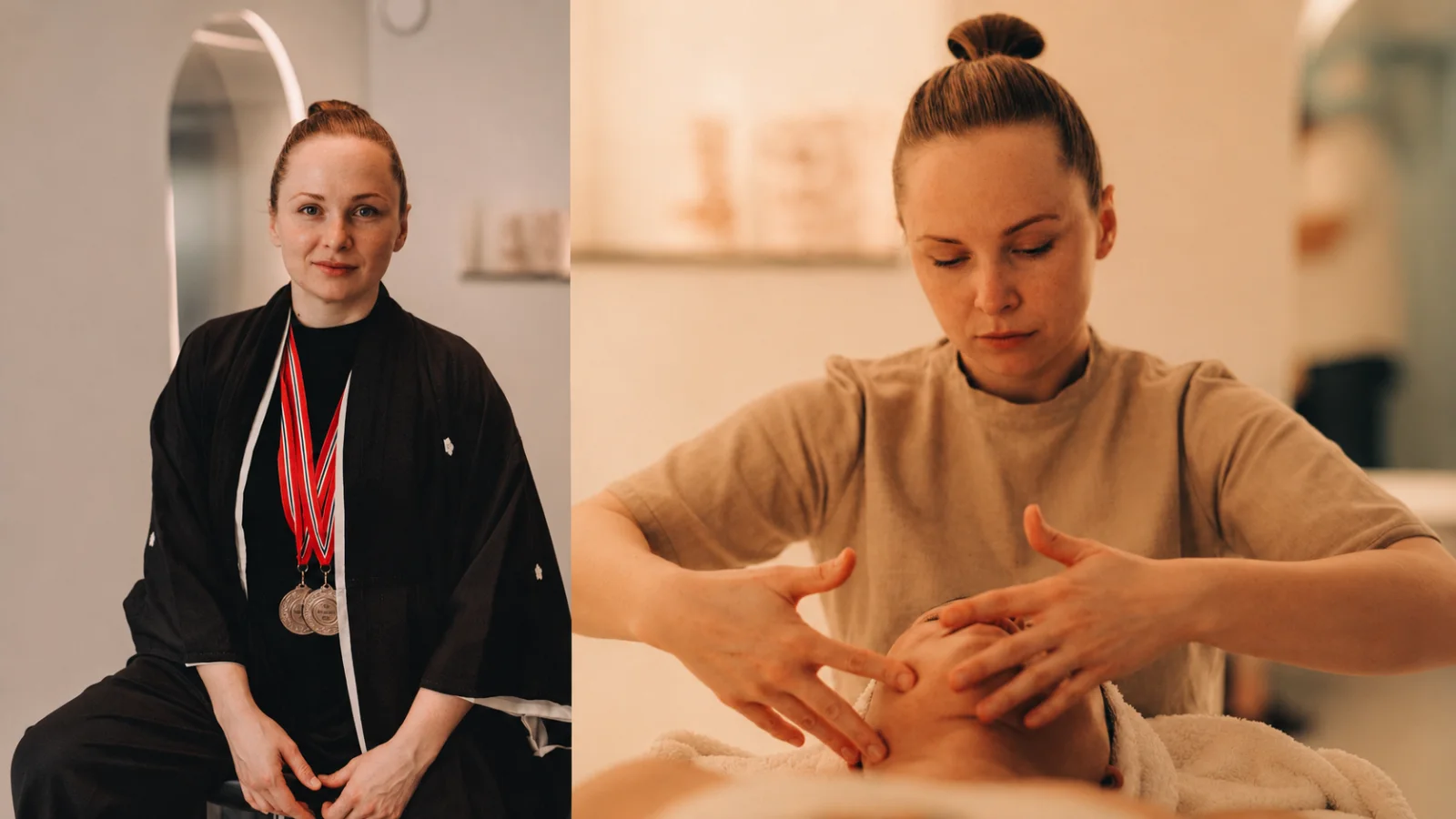
She found her first job in Norway in a kitchen. She was a chef’s assistant, then she was promoted and trained teams when new restaurants opened. Over time she was also sent to help abroad. So in Norway she started with work that was meant to allow her to get a foothold. It quickly turned out that others entrusted her with a task that determined how the new team would cope after the venue opened.
Today Joanna Ewa Młynarczyk runs ASI Pure Spa at Josefines gate 26 in Oslo. In her salon you can book, among other things, a classic massage, deep tissue massage and the Japanese facial massage Kobido. When I ask how many years it took her to develop her own approach to facial massage, Joanna answers with a smile: “It will sound strange if I say that a whole life.” ASI Pure Spa - official salon website
From Zagłębie to Norway
Joanna was born in Sosnowiec and comes from Dąbrowa Górnicza. “A nice mix” — she says when I ask her about her beginnings. In Poland she studied Far Eastern culture and learned Japanese. Later she began teacher training studies, which she interrupted when the decision to move to Norway was made. On the day of our conversation she said that thirteen years had passed since her arrival.
She returned to work in her profession after about a year and a half. Through work contacts she received an invitation to an interview and was employed as a masseuse at The Well. It was there that she learned spa work. She herself expected that as a massage therapist she would end up in a place connected with rehabilitation. Later she got a job in a medical spa in Oslo and was able to see how her profession looks in a different setting.
The Japanese thread, which began back in Poland, returned with Kobido. Joanna writes on her site that her studies of Japanese culture helped her understand this tradition of facial massage. In her official biography she also lists more than 600 hours of specialist courses and training in Poland, India, Italy and Japan. Joanna Ewa Młynarczyk - biography on the ASI Pure Spa website
Her own salon gave her a place to learn
At the time of the interview Joanna estimated that she has been self-employed for about ten years. When we talk about the entrepreneurship of Polish women in Norway, she says that she opened her own salon primarily out of a need for development. She wanted the freedom to learn and to introduce into her work what she learned in trainings.
For nine years, she says, she devoted successive funds to courses. Some classes were aimed at doctors and physiotherapists. Then she wrote to the organizers, was frank about her education and asked if she could participate. Sometimes she was accepted as an auditor, sometimes as a participant. She could observe how specialists from other fields approached the problems that people later also brought to her salon.
When I congratulate her on what she has built, Joanna begins to speak about the women she meets at her place.
“I really sometimes forget about myself, that it really was like that. But I see […] those women who come to me. When they sometimes tell me, it just […] my heart grows.”
In the conversation about Polish community entrepreneurship that moment is the one I remembered best. Joanna easily sees the courage in the women who tell her about their lives. She speaks about her own path with similar ease only when someone starts asking her more questions.
How long does it take to trust something new in Oslo?
Joanna recalls that when she started offering Kobido, it took quite some time to introduce clients to the very idea of facial massage. In the interview she points out two things she notices while working in Norway. People need time to warm up to a new service. Once they trust someone, they can return for years.
The hardest part for her is often getting a straightforward answer from a client about whether something suits them. According to Joanna, some people prefer to stay silent about discomfort rather than say it directly. In the salon such politeness can make conversation difficult. Information about whether the pressure is too strong or whether a position is uncomfortable allows her to adjust her technique during the session.
She herself is direct. At the beginning of the visit she explains what she intends to do and how the session will look. She says that some clients come tense, especially if something has been bothering them for a long time. In her experience the very fact that they know what to expect helps them feel more at ease.
“I explain everything to them, how it will look. And I can already see that because they know […] what we will be doing, they calm down.”
A face that shows life
When I ask Joanna about her original ASI approach, she talks about years of gathering experience and combining manual techniques. In her facial work she also takes into account other areas of the body. On the salon’s website you can see how this translates into the offer. One of the sessions combines back and neck massage with facial massage including elements of Kobido. ASI Pure Spa - facial and body massages
The conversation about aesthetic treatments quickly turns to wrinkles. Joanna speaks about the lines that form when we smile. She likes them. When I ask why forehead smoothing must be pursued at all costs, she answers:
“When there is a smile on the face and that real sparkle in the eye, and a person feels good […], then really no wrinkle will bother them.”
In the salon she works with people who want to take care of the appearance of their face, and with those who book a body massage. She does not give one number of visits for everyone. She talks about what the person comes with, and openly says when it is worth talking to another specialist.
Where the masseuse’s role ends
In the interview I ask Joanna what she would do if I came with shoulder, elbow or back pain. Joanna returns to the question of what is already known about the ailment. She talks about cooperation with physiotherapists who tell her which area they worked on and what can be taken into account during the next massage session. With long-term ailments she sometimes suggests a consultation with a specialist.
As an example she gives a simple thing that can be told to a doctor during a visit – when the pain intensifies and with which movement. It is precisely in such specification that Joanna sees her role. Decisions about diagnostics and treatment she leaves to the specialists the client sees.
She says the same about nutrition. When the subject comes up in conversation, she is ready to address everyday habits. For detailed questions she refers to people who work in dietetics. She explains that people already hear a lot of advice every day. She prefers first to find out what their situation looks like.
Polonia is a woman
I ask Joanna what annoys her in Norway. She answers without hesitation that there are quite a few little things she has to cope with. She immediately adds: “If these were big things, I wouldn’t be here anymore.” In the same part of the conversation she talks about how novelties are slowly taking root and how much she values the loyalty of people who gave her a chance.
After thirteen years in Norway she has a story to tell that began in a restaurant, led through The Well and thanks to years of learning brought her to her own practice. She also has stories of other Polish women to tell. Those she meets every day and whose courage she can appreciate sooner than her own. When I return in thought to our conversation, it is precisely with them that she becomes most animated.
Editorial comment TwojaNorwegia.no
In the series “Polonia in Norway - meet us” we give a voice to people who are making their lives here and building something of their own. In Joanna’s story I was particularly intrigued by the part about writing to course organizers. She told them plainly what her education was, and asked if she could come to learn. Behind those simple emails were years of decisions about what to spend money from her own work on and what else she wanted to learn.
Do you know a Polish woman in Norway whose path should be shown in the next episode? Write to us and tell us what in her story moved you. Radio Wataha · TwojaNorwegia.no
Where to find Joanna and ASI Pure Spa?
The practice is located at Josefines gate 26 in Oslo. The contact number is +47 925 32 820. Check the booking system for current prices and available appointments. ASI Pure Spa website · Instagram @asipurespa · Online booking in Timma