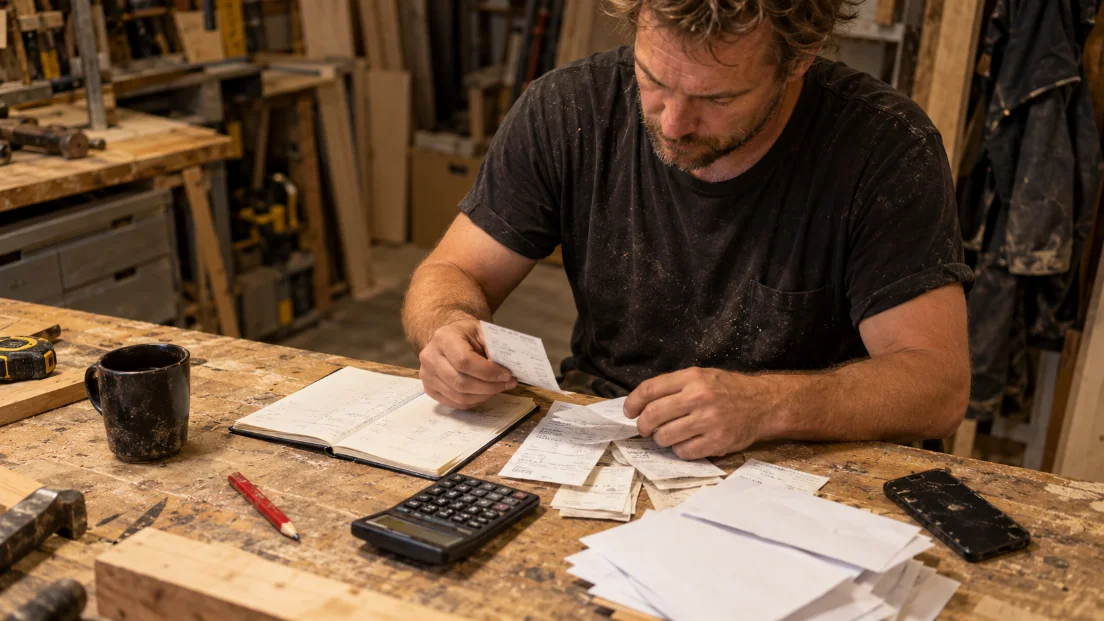
The company is running. Now you need order in your documents
You issued an invoice, bought equipment and received the first payment. Each of these events should have its proper place in the business documentation.
It is not about collecting receipts in a box at the end of the year. You need a method that will allow you to determine: what you sold, what you bought, who paid and which liabilities are still awaiting settlement.
Bokføringsplikt means the obligation to keep records according to accounting rules. It includes documenting and recording transactions that form the basis for settlements with authorities. It is a different concept than regnskapsplikt, which refers to additional obligations concerning the annual financial statement. what you should know before starting up
This guide concerns the organisation of accounting for a small ENK. It does not replace separate rules for specific industries.
Step 1. Determine who handles the accounting
There is no general obligation to hire an external accountant. You can keep the accounts yourself if you have the appropriate knowledge and time. You are still responsible for their accuracy. Do I need an accountant?
Before choosing, ask yourself:
Do I understand how to document sales and purchases?
Can I recognise private transactions?
Do I know when I must settle MVA?
Do I have time to check documents regularly?
You can also establish a division of work: you deliver the documents and describe the transactions yourself, and the office handles their posting and specific settlements.
If you outsource bookkeeping, choose an authorised office. Altinn points out the possibility of checking it in the Finanstilsynet registry. Also determine the scope of services and the method of delivering documents. Do I need an accountant?
Step 2. Choose a system matched to your method of sales
An invoicing program and an accounting program do not always offer the same range of functions.
When choosing, check practically:
Need What to check Invoicing Numbering, corrections, handling EHF if needed Documenting purchases Adding invoices and photos of receipts Payment control Matching documents with transfers VAT reporting Functions corresponding to the business status Cooperation with an accountant Access and division of permissions Changing the program Data export and access to documents
This is a list to help you choose, not a statutory catalogue of functions.
Altinn points out that, if conditions are met, it is permissible to keep records in a spreadsheet, but this requires greater knowledge and is prone to mistakes. Do not assume, therefore, that any table with income and expenses meets accounting requirements. Accounting system
Step 3. Separate company transactions from private ones
Altinn recommends a separate account used for business and a separation of company and private finances. In ENK it can also be helpful to set aside funds separately for tax and MVA. what you should know before starting up
Practically: for each transfer check its nature. Not every incoming payment is a sale and not every expense is a business cost.
For example:
a transfer from a client may settle an issued invoice;
a deposit of personal funds requires a different designation;
a transfer for private living expenses should not automatically be booked as a business purchase.
If you paid with a private card for a purchase related to the business, keep the document and describe the method of payment. This will allow the transaction to be correctly assessed and booked.
Step 4. Collect documents from the start
Set one place for submitting purchase invoices and receipts: a program, a designated e-mail address, or an archive agreed with the accounting office.
The document should allow the transaction and its connection to the business to be identified. A bank transfer confirmation alone does not replace a proper purchase document. info.altinn.no
When receiving a document check:
Is it legible?
Does it concern the correct purchase?
Are the details correct?
Is it clear what the purchase is used for?
Have you already sent the same document?
Instead of putting an unclear receipt aside for later, immediately add a clarification question.
We describe the rules for deductions here: Business expenses in Norway: what can you really deduct?.
Step 5. Match documents with payments
At the end of the month compare bank transactions with the documentation.
For each payment determine whether it corresponds to an invoice, a purchase, a fee, or another properly described transaction. Also check documents that have not yet been paid.
Practical monthly checklist:
Check What you want to determine Sales invoices Which have been sent and which remain unpaid Purchases Do you have all the documents Payments Do they match the corresponding transactions Adjustments Whether a credit note and any new invoice are included Private transactions Whether they have not been confused with sales or expenses Taxes Whether you have funds and know the nearest deadlines
This is the suggested work rhythm. It does not mean that for every company the statutory bookkeeping deadline is monthly.
Step 6. Check your company's actual deadlines
Accounting must be up to date for the purposes of mandatory settlements. If you settle MVA every two months, the records must be prepared for those deadlines.
For companies without an MVA obligation the general rule is to update at least every four months; there are exceptions for businesses with a small number of documents. Do not treat them as a reason to postpone collecting documentation. Bookkeeping obligation
Set aside in your calendar:
deadlines for preparing documents;
deadlines for sending declarations;
deadlines for payment.
Submitting the declaration and making the payment are different actions.
The owner of an ENK files a single tax return covering private matters and the business. The basic deadline is 31 May. The obligation to file also applies if the company had no turnover. Skatteetaten
Customer pays by card or Vipps? Check the sales rules
The word kontantsalg does not mean only banknotes and coins. Sales with immediate payment may also include payment by card or Vipps.
As a rule, such sales require an appropriate cash register system, with the prescribed exceptions. Do not assume that the payment history in the app alone fulfills the documentation obligations. Skatteetaten
Orders and payments made entirely over the internet may be subject to different documentation rules. Therefore determine the method of sale before choosing a tool. Skatteetaten
Step 7. Secure access to the archive
Accounting records are generally kept for five years after the end of the financial year. Different periods apply for some documents and industries. For an electronic archive it is required to secure the documentation, including backups. info.altinn.no
Before changing software or accounting office, check whether you will retain access to:
invoices and credit notes;
purchase documents;
accounting entries and reports;
submitted declarations and confirmations.
Do not assume that after the subscription ends everything will still be available under the same terms.
What to do now?
Choose the last completed month and perform the first check: sales, purchases, payments, missing documents and upcoming settlements.
If you have an accounting office, agree on who performs the individual tasks and by which day you hand over the documents. If you keep records yourself, write down the questions that need to be clarified before sending the declaration.
Properly managed accounting should help you see the business result and obligations before you run out of money to pay them.
Information checked: 18.10.2026.