Three matters, three offices? Not necessarily
Imagine a typical start in Norway.
You already have an employment contract.
You must register as an EU/EEA citizen.
You need a tax card.
You plan to stay longer, so Folkeregisteret is added.
And then you realize that one matter leads to the Police, another to Skatteetaten, and if there's a problem with the employer Arbeidstilsynet also appears.
First instinct?
Book three appointments and start running around the offices.
Before you do that, check SUA.
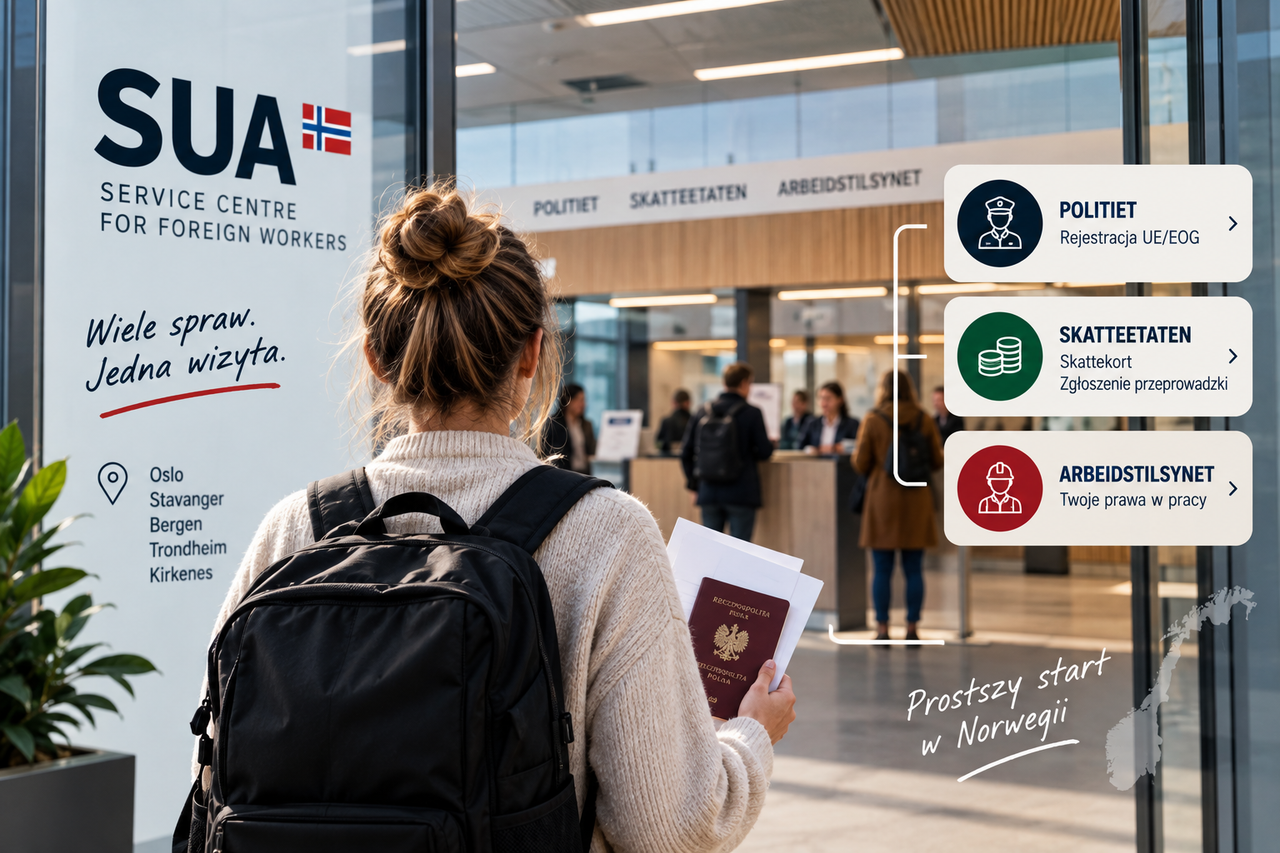
Service Centre for Foreign Workers was created precisely so that a foreign worker does not have to figure out on their own which building and which office they should go to now. SUA combines the services of the Police, Skatteetaten and Arbeidstilsynet, in cooperation with UDI.
Check the official SUA website
First, one important thing: SUA does not handle "everything"
The name can be a bit misleading.
SUA is not one super-office that issues all documents to a foreigner.
Different institutions and different procedures still operate inside.
This is important because:
EU/EEA registration is the responsibility of the Police,
tax cards are the responsibility of Skatteetaten,
Folkeregisteret is administered by Skatteetaten,
employee rights and workplace issues are the responsibility of Arbeidstilsynet,
residence permit matters are handled by the Police and UDI.
The advantage of SUA is that you encounter several of these institutions in a single service system.
And sometimes during a single visit.
Case 1. You arrived from Poland and are starting work
This will be one of the most common situations for a reader of TwojaNorwegia.no.
You have Polish citizenship, that is you are an EU/EEA citizen.
You have a job in Norway.
You will be living here for more than 3 months.
You need EU/EEA registration and to handle tax matters.
In such a situation SUA can be a very good starting point.
First, registration with the Police
If, as an EU/EEA citizen, you will stay in Norway for more than 3 months and are exercising the right of residence, you must complete registration.
The registration itself is carried out by the Police. UDI also states that the registration certificate confirms the registration, but on its own does not create the right of residence.
At SUA you can book the appropriate appointment with the Police.
SUA: registration and visit for an EU/EEA citizen
And here the biggest benefit of SUA begins
Assume that during the same visit you also need:
tax card
or
notification of moving to Norway.
SUA states directly that if an EU/EEA citizen comes for a Police appointment and also has one of these matters, they will be directed to the Skatteetaten desk.
Then you do not need to book a separate appointment with Skatteetaten.
This is exactly an example of a situation where preparing before the visit can save you another appointment.
So do not come to the Police only with documents if you already know that you also need a tax card or want to report your move.
Check the requirements of both procedures right away and prepare a complete set of documents.
What to bring if you need a tax card?
If you are starting work in Norway, most workers need a tax card and a Norwegian identification number.
SUA indicates that an EU/EEA citizen applying for a tax card should prepare, among other things:
passport or national identity card,
employment contract or a written job offer,
the required tax card form, unless the application has already been submitted by your employer.
If you work for a company from the EU/EEA and have been sent to Norway on assignment, documents concerning that assignment may also be required.
Check the current list of documents before your visit to SUA
Do not print a random checklist from a few years ago.
Check it again before your appointment.
What to bring if you also want to report your move?
If you intend to live in Norway for at least 6 months, you may also be required to report your move.
And here we return to the previous guide.
SUA does not change the rules of Folkeregisteret.
It simply provides the possibility to handle part of the procedure in the same place.
So prepare in advance documents confirming:
identity,
the basis for your right of residence,
actual intention to reside in Norway for the required period,
employment or another basis for residence,
your place of residence, if the document is required in your situation.
Don't go with the assumption:
“Since I'm at SUA, they'll find everything themselves”.
The better you prepare your documents, the greater the chance that one visit will really remain just one visit.
SUA: documents for an EU/EEA citizen
Case 2. You only need a tax card
You don't have to force different procedures together.
If your only goal is a tax card, you can schedule the appropriate service with Skatteetaten.
This is important because “a visit to SUA” is not a single universal type of visit.
First you determine your situation.
On the booking page SUA first asks you to choose a group:
citizen of a Nordic country,
EU/EEA citizen,
person from outside the EU/EEA.
Only then does it lead to the proper procedure.
SUA: choose your situation and book the appropriate appointment
This is much safer than booking the first available slot that looks similar to what you need.
Case 3. You have a problem with your employer
And here SUA shows a completely different side.
It's no longer about D-nummer, a tax card, or registration.
It's about your rights at work.
Arbeidstilsynet also operates at SUA.
You can obtain information there, among other things, about:
employment contract,
salary,
overtime,
leave,
occupational health and safety and working conditions,
HMS-kort,
problems at the workplace.
SUA also informs that anonymous information about illegal or dangerous working conditions can be submitted to Arbeidstilsynet.
And what's very practical:
You do not need to book an appointment with Arbeidstilsynet at SUA in advance.
However, this concerns Arbeidstilsynet's service.
It does not mean that you can go to the Police or Skatteetaten without an appointment.
Case 4. You are not an EU/EEA citizen
Here the procedure may look completely different.
A person from outside the EU/EEA may need a residence permit with the right to work.
After it is granted, additional steps related to the Police, the residence card, the identification number and taxes may follow.
SUA has a separate pathway for people from outside the EU/EEA and separate information for family members of EU/EEA citizens.
Therefore do not use a colleague's checklist from Poland if you hold citizenship of a country outside the EU/EEA.
It may be a completely different procedure.
SUA: procedure for people from outside the EU/EEA
Where exactly is SUA?
Currently, SUA centres operate in:
Oslo
Stavanger
Bergen
Trondheim
Kirkenes
The official SUA website confirms these five locations.
Opening hours may change, and individual service desks may operate at different times.
Therefore we do not list them here permanently.
Check them on the day you plan your visit:
SUA: current locations and opening hours
This is particularly important, because the SUA website also publishes temporary closures of specific locations.
And what if you live far from SUA?
The fact that SUA exists does not mean that every foreigner has to travel to one of the five centres.
Some matters can also be handled at local Police or Skatteetaten offices.
For example, Skatteetaten also carries out ID checks at selected offices outside SUA. It currently indicates 42 locations that perform such checks.
Find a Skatteetaten office that performs ID checks
Therefore, if you live several hundred kilometres from the nearest SUA, first check whether you can carry out the specific procedure closer.
Do not drive across half of Norway just because you read the word SUA.
First, determine exactly which service you need.
How to prepare one good visit instead of two bad ones?
Before booking, answer four questions.
1. What is my citizenship?
This determines which procedure you should follow.
2. What exactly do I need to do?
EU/EEA registration?
Tax card?
Notification of move?
A problem with the employer?
3. Can I combine several procedures during one visit?
If, as an EU/EEA citizen, you have an appointment with the Police and at the same time need a tax card or a notification of move, this is exactly where SUA can save you a second appointment.
4. Do I have the documents needed for all these matters?
One location won't help if you arrive without the required contract, identification document, or form.
What not to do?
Don't book an appointment "blindly" without knowing which agency you're dealing with.
Don't assume that because the Police and Skatteetaten are in the same centre, one procedure automatically covers the other.
Don't go to SUA without checking the current required documents.
Don't assume that all counters accept visitors without an appointment.
Don't travel hundreds of kilometres to SUA before checking whether your specific matter can be handled locally.
And above all:
don't collect documents based on a friend's story from five years ago.
Check the procedure that corresponds to your situation now.
One visit may be enough. But it needs to be planned
This is the most important conclusion of this guide.
SUA does not eliminate Norwegian bureaucracy.
However, it can mean that instead of arranging three agencies in the correct order yourself, you can handle some matters in one place.
For a person who has just arrived in Norway, this can mean not only fewer formalities.
It also means less time off work, fewer trips, and fewer deadlines to keep track of.
Therefore, before booking, don't ask:
"Where should I go?"
First ask:
"Exactly what do I need to arrange and which of these matters can I combine?"
Only then choose the appointment.
What next?
You already have in order:
arrival,
EU/EEA status,
D-nummer and fødselsnummer,
Folkeregisteret,
and a place where you can combine some of the initial formalities.
The next step is one of the most important things for a person starting work:
tax card.
In the next guide we will show not only how to obtain it, but also what really happens to your pay if you start working without a valid tax card and how to check whether your employer is withholding the correct tax.
OFFICIAL SOURCES
SUA: what is Service Centre for Foreign Workers
The scope of SUA's activities, institutions present in the centre, available services and current locations.
SUA: booking for an EU/EEA citizen
Registration with the Police, tax card, notification of move and documents needed during the visit.
SUA: people from outside the EU/EEA
Procedures regarding residence permits, the Police, residence cards, taxes and family members.
SUA: visits and locations
Current opening hours and information about the handling of Arbeidstilsynet.
Skatteetaten: SUA
Official information about service centres for foreign workers.
UDI: registration of EU/EEA citizens
Rules for registration with the Police and the meaning of the registration certificate.
Information verified: 22.09.2026